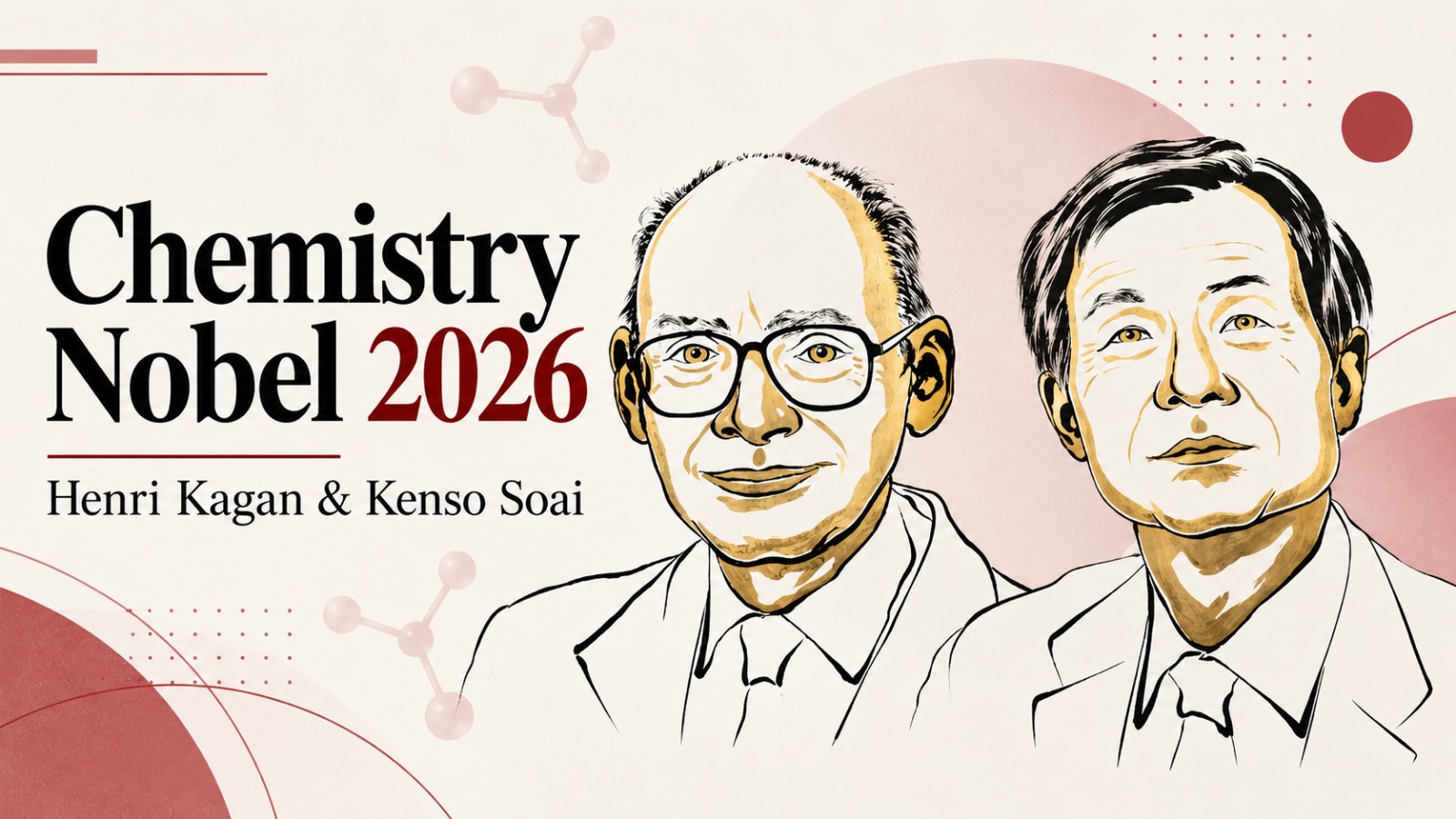
Henri Kagan of Université Paris-Sud and Kenso Soai of Tokyo University of Science have been awarded the 2026 Nobel Prize in Chemistry for discoveries that helped explain how chemistry can favour one molecular form over its mirror image.
Henri Kagan and Kenso Soai have won the 2026 Nobel Prize in Chemistry for work at the heart of one of organic chemistry’s most fundamental questions: why molecules that appear almost identical can behave differently depending on their three-dimensional arrangement.
The Royal Swedish Academy of Sciences announced the award in Stockholm on Wednesday, October 7, recognising the scientists “for the discovery of non-linear effects and autocatalysis in asymmetric organic synthesis.”
The announcement brings together two researchers from different generations. The Nobel presentation identifies Kagan, born in France in 1930, with Université Paris-Sud in France, while Soai, born in Japan in 1950, is affiliated with Tokyo University of Science. Their portraits and institutional affiliations were displayed side by side during the prize announcement in Stockholm.
Why Kagan and Soai’s Nobel-winning work matters
At the centre of the 2026 chemistry prize is chirality, a property that can make chemistry look deceptively simple from the outside.
Some molecules can exist in two forms that are mirror images of each other. They may contain the same basic components and look remarkably similar, but the two versions cannot be perfectly placed on top of one another.
Heiner Linke, Chair of the Nobel Committee for Chemistry, used an everyday comparison to explain the idea.
Like a person’s left and right hands, the two forms resemble each other but are not identical. The word chiral itself comes from the Greek word for hand, Linke explained during the announcement.
That simple comparison points to the deeper chemistry recognised by this year’s Nobel Prize.
Kagan and Soai were honoured for discoveries involving non-linear effects and autocatalysis in asymmetric organic synthesis, fields concerned with how chemical reactions can produce one mirror-image molecular form preferentially over another.
The Nobel Committee described the award as one rooted in foundational chemistry, placing the emphasis on the principles behind the behaviour of these molecules rather than on a single end product.
Two chemists, one fundamental problem
The 20-year age difference between the two laureates gives this year’s award an unusual generational dimension.
Kagan, born in 1930, is associated with Université Paris-Sud in France. Soai, born in 1950, is affiliated with Tokyo University of Science in Japan. Despite coming from different academic settings and generations, their names now share the Nobel citation for advances in asymmetric organic synthesis.
Rather than rewarding a newly announced invention, the prize recognises work that strengthened scientists’ understanding of how molecular asymmetry can emerge and develop during chemical reactions.
It is a distinction that also explains the Nobel Committee’s description of the research as foundational. The work concerns a basic feature of molecular chemistry: two molecules can be mirror images and still represent genuinely different chemical forms.
Chemistry becomes the third Nobel announcement of the week
The chemistry prize was the third Nobel announced during the 2026 Nobel week, following the prizes for medicine on Monday and physics on Tuesday.
The Nobel Prizes have been awarded since 1901 under the will of Swedish inventor and businessman Alfred Nobel, with interruptions largely associated with the world wars. Nobel himself was a chemist and built much of his fortune from inventions, most famously dynamite.
Chemistry prizes over the decades have recognised discoveries ranging from nuclear fission to techniques connected with genetic sequencing. In 2025, the chemistry Nobel went to Susumu Kitagawa, Richard Robson and Omar Yaghi for developing metal-organic frameworks, molecular structures with potential applications in areas including climate-related challenges and freshwater availability.
Kagan and Soai to share 12 million Swedish crowns
Kagan and Soai will share the Nobel Prize money of 12 million Swedish crowns, approximately $1.2 million at the exchange rate cited at the time of the announcement.
The laureates are due to receive their medals from Sweden’s King Carl XVI Gustaf at the Nobel ceremony in Stockholm on December 10, the anniversary of Alfred Nobel’s death. The ceremony is followed by the traditional banquet at Stockholm City Hall. Kagan and Soai win 2026 Nobel c…
For Kagan and Soai, however, the significance of the award reaches beyond the ceremony and prize money. Their Nobel citation puts a spotlight on a branch of chemistry concerned with something both visually intuitive and scientifically profound: molecules that can resemble one another like two hands, yet remain fundamentally different.
Also Read: Is QNet a Scam? Arrests, Bans and Warnings Explained