The IPL may be passing through a more complex commercial phase, but one thing is becoming harder to ignore: the franchises themselves are only getting more valuable.
Two recent transactions have brought that reality into sharp focus. Rajasthan Royals were pegged at around ₹16,000 crore after a US-based consortium led by tech entrepreneur and existing minority investor Kal Somani acquired full ownership.
Royal Challengers Bengaluru went a step further, touching roughly ₹16,660 crore in a deal involving a consortium led by Aditya Birla Group, Times of India Group, Bolt Ventures and Blackstone. Before that, Gujarat Titans had also commanded a valuation of about ₹7,500 crore when Torrent Group acquired a 67% stake from CVC Capital.
These are not just large numbers. They are clear market signals.
For years, IPL franchise values were spoken about in broad terms, often shaped by brand recall, trophy cabinets, fan loyalty and celebrity pull. But with actual transactions remaining rare, there was little by way of hard market discovery. That is beginning to change. These deals offer some of the clearest evidence yet of how seriously investors now view IPL teams as long-term assets.
What makes this shift even more striking is the backdrop against which it is happening.
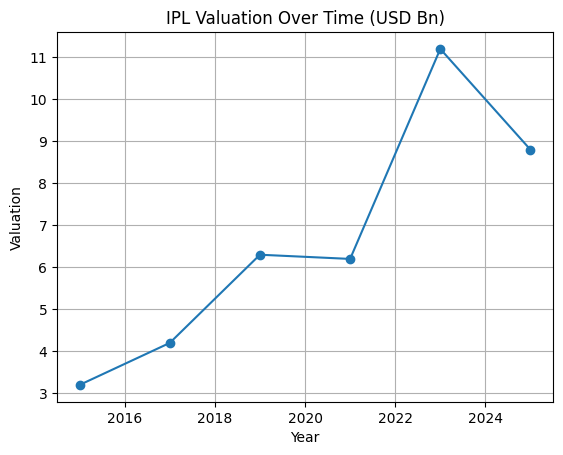
The IPL ecosystem was valued at $8.8 billion, or about ₹76,100 crore, in 2025, down from its 2023 peak of $11.2 billion, or ₹92,500 crore. The decline was the second in a row. One major reason was the Disney Star-Viacom merger that created JioStar, bringing television and digital rights under one umbrella and ending the intense bidder competition that had previously helped drive media values higher.
Another drag came from the exit of real-money gaming companies, once among the league’s most aggressive advertisers. Their contribution across league, franchise and broadcaster deals had been estimated at ₹1,500 crore to ₹2,000 crore annually before that revenue stream disappeared.
And yet, franchise valuations are moving in the opposite direction.
That contrast reveals something important about how investors now see the league. They are no longer valuing teams only through the lens of current-cycle media rights or short-term sponsorship trends. They are valuing scarcity, entry barriers and the strategic power of owning one of only ten IPL franchises.
In a market where supply is tightly capped, every sale becomes consequential. There are no frequent opportunities to buy into the IPL. That scarcity intensifies competition whenever a team or a meaningful stake becomes available. It also means that valuations are increasingly being driven by the premium attached to access itself.
The Gujarat Titans example captures this shift well. It is not among the oldest franchises and does not enjoy the historical advantage of teams that have spent more than a decade building identity and fan culture. Yet it still drew a valuation of around ₹7,500 crore.
That suggests investors are pricing more than legacy. They are pricing the league’s larger business architecture and its staying power as a sports-entertainment property. Just as important is the fact that the IPL franchise model has changed dramatically from its early years.
When the league launched in 2007, doubts over its economics were common. The season was short, the revenue model looked narrow, and the idea of running a cricket team as a sustainable business was still untested. Broadcast revenue sharing, sponsorships and merchandise were seen as useful, but perhaps not enough to justify very large long-term valuations.
That equation no longer holds.
Many franchise owners today are no longer tied to a single tournament window. Several have expanded across other T20 leagues in England, South Africa and the United States, turning team ownership into a year-round sports business instead of a seasonal one.
The launch of the Women’s Premier League in 2023 has added another layer to that expansion, with several IPL owners also holding stakes there. The result is a broader, more diversified business model, one that gives investors more reasons to think beyond the two-month IPL calendar.
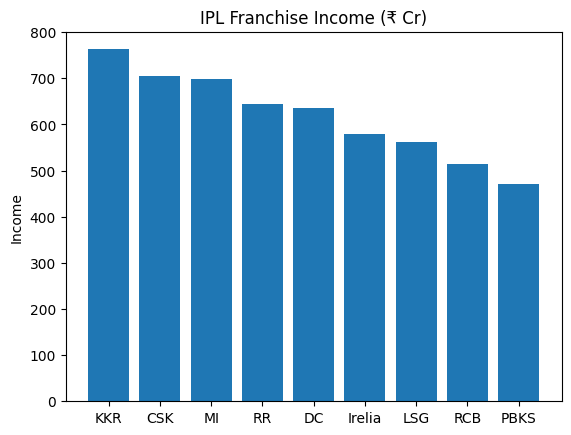
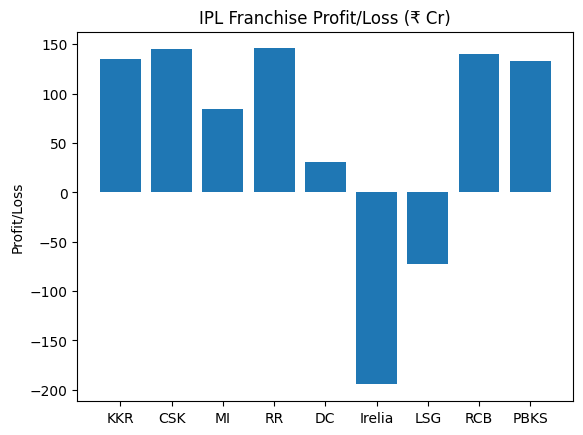
The financial picture reinforces that shift. The D&P report shows Knight Riders Sports with total income of ₹762.7 crore and net profit of ₹134.8 crore, Chennai Super Kings Cricket with ₹704.3 crore in income and ₹145.2 crore in profit, Royal Multisport Rajasthan Royals with ₹644.3 crore in income and ₹145.8 crore in profit, and Royal Challengers Sports with ₹514.9 crore in income and ₹140 crore in profit.
Not every team is shown to be equally profitable, and some have posted losses, but the broad message is unmistakable: these are no longer businesses that can be dismissed as glamour-heavy sporting experiments.
What the RCB and Rajasthan Royals deals ultimately do is bring clarity to a market that long relied on estimation and instinct. They suggest that even when the broader IPL ecosystem faces pressure, the franchises themselves can continue to command a premium. Investors appear to be betting that the league’s fundamentalsm audience scale, cultural relevance, commercial reach and scarcity value remain intact.
That is why these deals matter beyond the headlines. They are not just sales. They are valuation markers for the future of sports ownership in India.
If the broader ecosystem is entering a phase of recalibration, the franchises at its core seem to be entering one of consolidation and strength.
Also Read: Vaibhav Suryavanshi’s Rise Is Bigger Than a Net-Worth Number