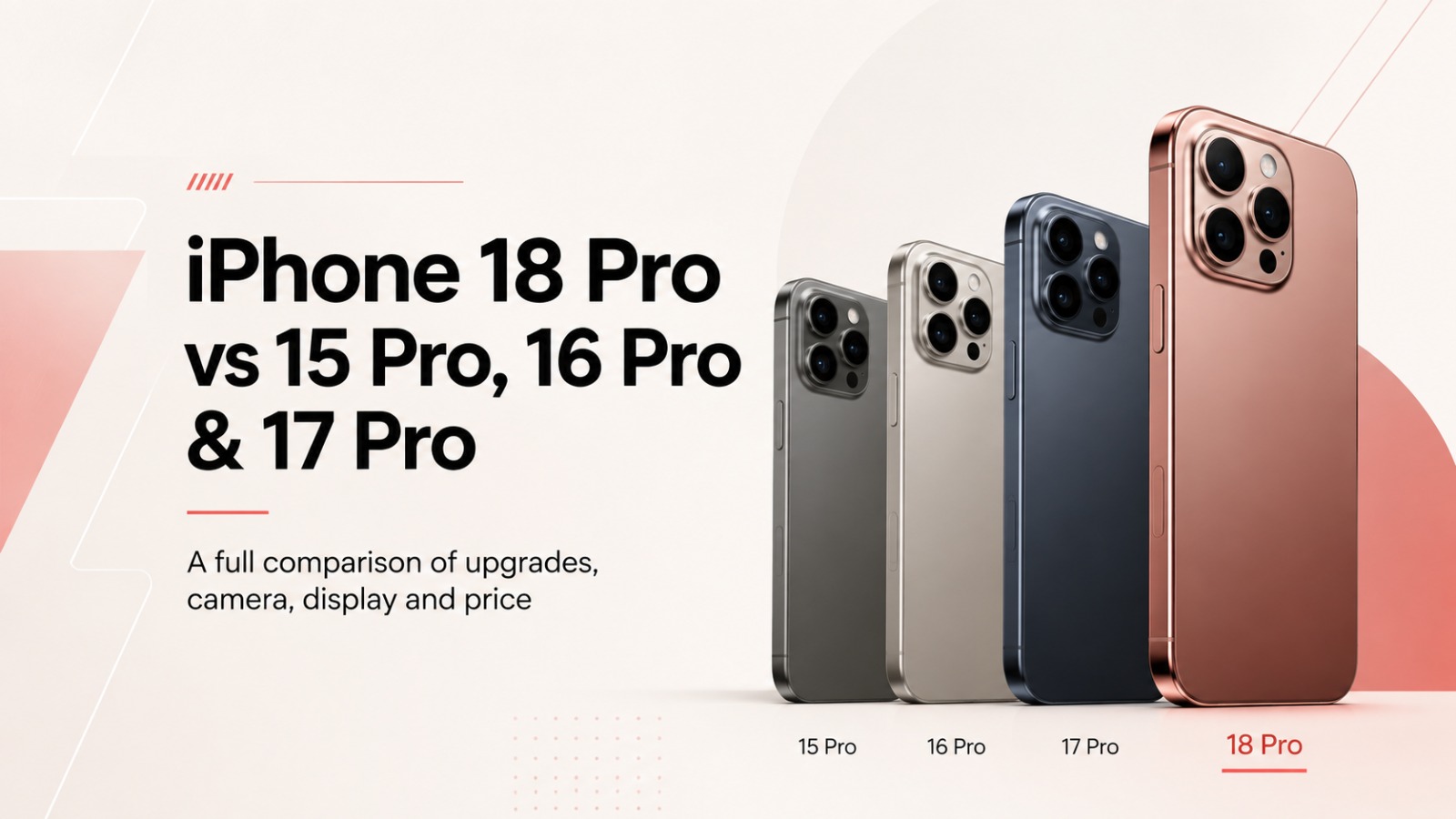
Apple’s next Pro iPhone is shaping up to be less about one headline-grabbing redesign and more about a series of hardware changes that become increasingly meaningful the further back you go in the upgrade cycle.
For someone using an iPhone 15 Pro, the expected iPhone 18 Pro represents a three-generation jump involving a larger display, a different frame material, a new chip architecture and substantial camera changes. For iPhone 16 Pro owners, the gap is narrower. And for those already on the iPhone 17 Pro generation, much of the story appears to be refinement rather than replacement.
The biggest uncertainty is price. One recent comparison puts the expected iPhone 18 Pro starting price at about $1,300, while earlier reporting around the iPhone 18 Pro Max suggested Apple could avoid a major price increase. That difference is a reminder that pricing remains firmly in leak territory ahead of launch.
Here is how the iPhone 18 Pro generation currently compares with the iPhone 15 Pro, iPhone 16 Pro and iPhone 17 Pro generation, using only the details supported by the available information.
iPhone 18 Pro vs iPhone 15 Pro: This is where the upgrade gap looks widest
The physical change becomes obvious before getting into processors or cameras.
The iPhone 15 Pro uses a 6.1-inch display and weighs 187 grams with a titanium frame. The expected iPhone 18 Pro moves to a 6.3-inch display and is described in one comparison as using an aluminium body weighing 206 grams. Thinner bezels are expected to keep the increase in screen size from translating into a dramatically larger-feeling handset.
That makes the iPhone 15 Pro the only phone among these older generations where moving to the iPhone 18 Pro also means stepping up from Apple’s earlier 6.1-inch Pro format. The iPhone 16 Pro had already moved to 6.3 inches.
Display brightness is another expected change. The iPhone 18 Pro has been linked with an LTPO+ OLED panel and around 3,000 nits of outdoor brightness. The supplied comparison places the iPhone 15 Pro at 2,000 nits.
There is also the interface hardware. The expected iPhone 18 Pro gets a smaller Dynamic Island and Camera Control, a feature absent from the iPhone 15 Pro generation in the supplied comparison.
For iPhone 15 Pro users, this therefore looks less like a single-feature upgrade and more like several generations of design, display and camera development arriving together.
iPhone 18 Pro vs iPhone 16 Pro: Same screen size, very different internals
The comparison becomes more interesting with the iPhone 16 Pro because both phones use a 6.3-inch display.
The expected iPhone 18 Pro is tipped to retain the same basic screen size while moving to more efficient LTPO+ technology, an anti-reflective treatment and roughly 3,000-nit outdoor brightness. The iPhone 16 Pro is listed at 2,000 nits. The newer model is also rumoured to make the Dynamic Island or Face ID area nearly 35% narrower.
That 35% figure may end up being one of the most immediately visible changes between the two phones because the overall display dimensions themselves are not changing.
The frame story reverses what some buyers may expect from a newer Pro model. The iPhone 16 Pro uses titanium, while the expected iPhone 18 Pro is described as carrying forward an aluminium design. The reason suggested for that choice is thermal performance, helped further by vapor-chamber cooling.
Camera Control is expected to remain, but potentially in a simplified form. Reports cited in the comparison say the iPhone 18 Pro version may drop gesture support, meaning swiping on the control to adjust zoom or other camera functions could disappear.
A20 Pro and 12GB RAM create the clearest performance divide
Under the hood, the expected iPhone 18 Pro is linked with Apple’s A20 Pro processor, described as the company’s first iPhone chip built on TSMC’s 2nm process.
The iPhone 16 Pro uses the 3nm A18 Pro.
Memory is expected to rise from 8GB on the iPhone 16 Pro to 12GB on the iPhone 18 Pro. The newer phone is also listed with 256GB, 512GB and 1TB configurations in the comparison, while the iPhone 16 Pro listing begins at 128GB.
The source cites TSMC estimates suggesting the newer manufacturing technology could deliver up to 30% better power efficiency at the same level of performance. That figure should not be read as a promise of 30% faster everyday performance. It relates specifically to potential efficiency from the process technology.
The camera may be the real reason to move from an iPhone 16 Pro
The expected camera system shows a much clearer generational difference.
Both the iPhone 18 Pro and iPhone 16 Pro are listed with 48MP main and ultra-wide cameras, but the expected iPhone 18 Pro introduces a variable-aperture main camera. Rumours put that aperture roughly between f/1.6 and f/4, while the comparison table lists an expected f/1.4 to f/4 configuration. Previous iPhones use fixed apertures.
The telephoto system changes more dramatically on paper.
The expected iPhone 18 Pro is listed with a 48MP 4x telephoto camera at a 100mm equivalent focal length. The iPhone 16 Pro comparison lists a 12MP 5x telephoto at 120mm. So the newer model gives up some optical reach in the quoted specifications, but moves to a much higher-resolution telephoto sensor.
The front camera also rises from the iPhone 16 Pro’s listed 12MP unit to an expected 18MP sensor. The newer square sensor is linked with easier switching between portrait and landscape framing and support for simultaneous front-and-rear video recording through Dual Capture.
Battery could become a bigger upgrade than the dimensions suggest
Battery information is particularly interesting because the expected iPhone 18 Pro may differ by region.
The comparison says a Chinese 3C listing points to a 4,056mAh battery for a global version with a physical SIM tray and 4,288mAh for a US eSIM version. The iPhone 16 Pro is listed at 3,582mAh.
The expected iPhone 18 Pro is also listed at 40W wired charging and 25W wireless charging. More importantly for the generational story, the report says the 40W wired charging capability is carried over from the iPhone 17 Pro generation.
iPhone 18 Pro vs iPhone 17 Pro: More evolution than reinvention
The iPhone 17 Pro appears to sit much closer to the expected iPhone 18 Pro than either the 15 Pro or 16 Pro.
Several features expected on the iPhone 18 Pro are described as being inherited directly from the iPhone 17 Pro. These include 12GB of RAM, the 4x telephoto camera, the improved square-sensor selfie camera, aluminium construction with vapor-chamber cooling, around 3,000-nit display brightness and faster 40W wired charging.
That leaves the expected A20 Pro chip, smaller Face ID or Dynamic Island area and variable-aperture main camera as some of the more meaningful differentiators.
The camera aperture is particularly notable. The iPhone 17 Pro is specifically described as using a fixed f/1.78 main-camera aperture, while the iPhone 18 Pro is expected to introduce Apple’s first variable-aperture system.
For the Pro Max line, the direction is similar. Reporting on the iPhone 18 Pro Max points to a smaller Dynamic Island, a larger battery, upgraded cameras and the 2nm A20 Pro chip, while describing Apple’s emphasis as performance and efficiency rather than a dramatic redesign.
iPhone 15 Pro vs 16 Pro vs 17 Pro vs expected iPhone 18 Pro
| Area | iPhone 15 Pro | iPhone 16 Pro | iPhone 17 Pro generation | Expected iPhone 18 Pro |
|---|---|---|---|---|
| Display size | 6.1-inch | 6.3-inch | 18 Pro inherits 3,000-nit display features from 17 Pro | 6.3-inch |
| Peak/outdoor brightness | 2,000 nits in supplied comparison | 2,000 nits | Around 3,000 nits referenced | Around 3,000 nits |
| Frame | Titanium | Titanium | Aluminium referenced | Aluminium expected |
| RAM | Not specified in supplied material | 8GB | 12GB referenced | 12GB expected |
| Chip | Not detailed in supplied material | A18 Pro, 3nm | Not detailed in supplied material | A20 Pro, 2nm expected |
| Main camera aperture | Not detailed | Fixed aperture | Fixed f/1.78 | Variable aperture expected |
| Telephoto | Not detailed | 12MP, 5x in comparison | 4x system referenced | 48MP, 4x expected |
| Front camera | Not detailed | 12MP | Improved square sensor | 18MP square sensor expected |
| Dynamic Island | Larger than expected 18 Pro | Standard current form | Smaller change expected on 18 generation | Around 35% narrower, according to one report |
| Cooling | Not detailed | No vapor chamber in comparison | Vapor chamber referenced | Vapor chamber expected |
| Wired charging | Not detailed | Lower than expected 18 Pro | 40W referenced | 40W expected |
| Price position | Not compared directly | $1,000 starting price cited | Exact starting price not directly stated | About $1,300 expected in one report |
Which generation has the strongest case for upgrading?
For an iPhone 15 Pro owner, the case is the easiest to see. The screen grows from 6.1 to 6.3 inches, the display is expected to become brighter, Camera Control enters the picture, and three generations of camera and processor development separate the two devices.
For iPhone 16 Pro users, the argument becomes more specific. The screen size is unchanged, so the value rests more heavily on the A20 Pro, 12GB of RAM, battery improvements, variable-aperture photography, the higher-resolution telephoto camera and the smaller Dynamic Island. The supplied comparison itself concludes that everyday use and casual photography may still feel broadly similar on the 16 Pro, despite the newer model’s improvements.
For iPhone 17 Pro users, the expected upgrade is the narrowest. The 18 Pro appears to carry forward several of the 17 Pro’s biggest changes. Unless the variable-aperture camera, smaller Face ID area or 2nm A20 Pro proves transformative in real-world use, the difference may be more evolutionary than dramatic.
That is also why price could decide the story. A $1,300 starting point would make the iPhone 18 Pro a very different proposition from an incremental annual upgrade. If final pricing lands closer to the previous generation, the camera, battery and efficiency improvements become easier to justify.
Until Apple confirms the hardware and pricing, however, the iPhone 18 Pro remains a comparison built around leaks, reported specifications and certification information rather than a finished retail product.
Also Read: Apple iPhone 18 Pro Release Date: When Is the New Model Expected to Launch?