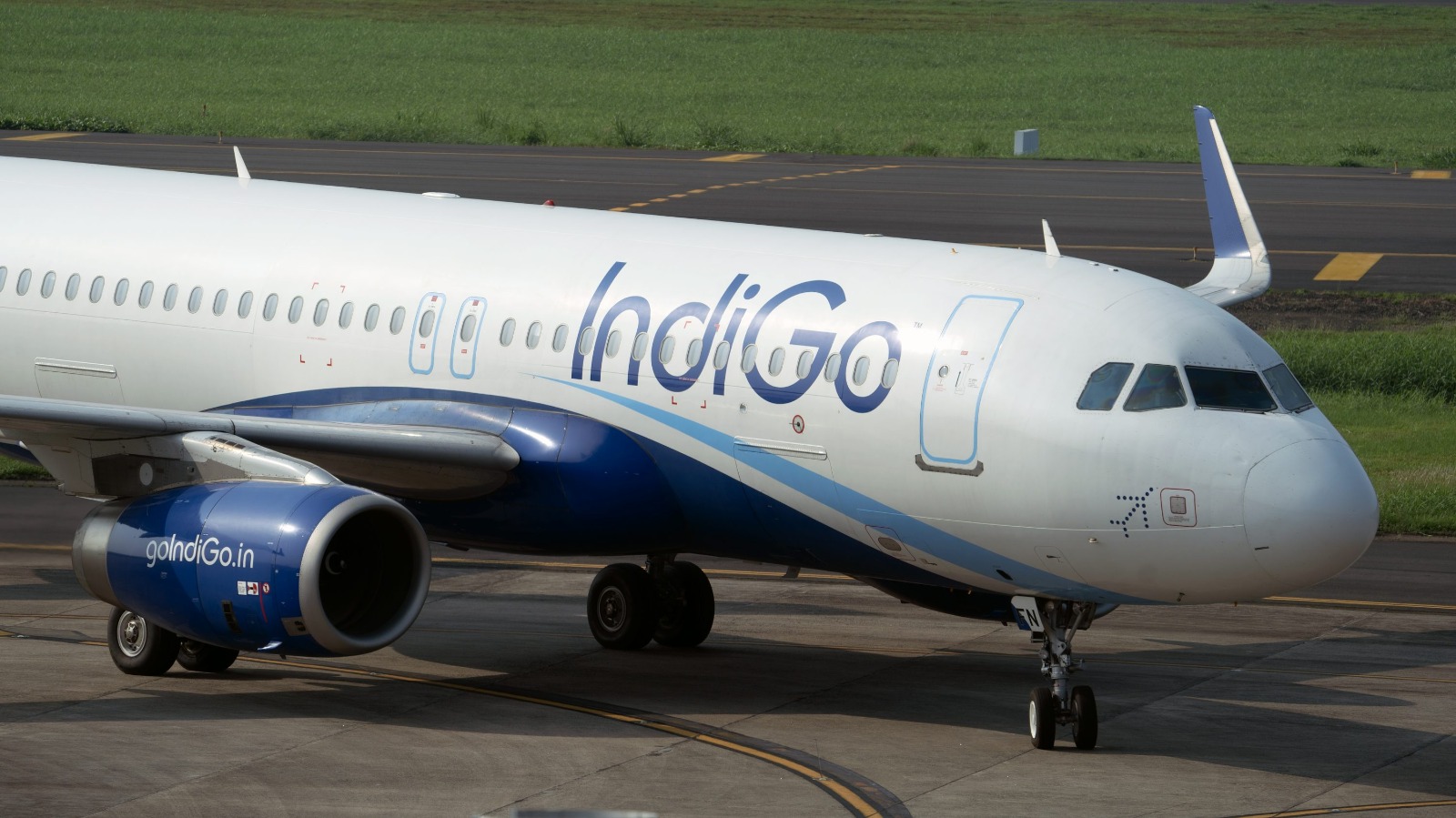
India’s largest airline by market share is in the middle of one of its worst operational crises, with IndiGo’s flight disruptions stretching into a sixth straight day and throwing travel plans into disarray across the country. The carrier has told passengers it expects to bring its network back to some degree of stability by December 10, even as thousands remain stranded or delayed at key airports.
Indigo Crisis: Six days of cancellations and a patchy schedule
On Sunday, IndiGo scrapped around 650 flights and said it would operate about 1,650 of its roughly 2,300 daily services, a trimmed schedule that underlines the continuing stress on its operations.
Data compiled from major hubs shows the scale of the disruption. At least 112 flights were cancelled at Mumbai airport and 109 at Delhi on Sunday alone, according to figures shared with news agency PTI.
The weekend numbers come on the back of even sharper cuts: IndiGo had cancelled around 1,600 of its 2,300 daily flights on Friday, before the situation eased marginally on Saturday with cancellations dropping to roughly 800.
The turbulence has not been confined to the metros. At Tripura’s MBB airport, an official confirmed that nine IndiGo flights, both arrivals and departures, were called off on Sunday, with only two services operating as per schedule.
Passengers stranded, tempers fray at airports
The rolling cancellations and extensive delays have left passengers stuck at airports for hours, in some cases over multiple days. Flyers at Delhi, Mumbai, Patna and other cities have reported missed connections, disrupted work schedules and ruined family plans as they try to rebook on a shrinking pool of available seats.
Videos from terminals, widely shared on social media, show angry exchanges between frustrated passengers and ground staff. Some travellers can be seen raising their voices over lack of timely information and the uncertainty around rebookings and refunds. At the same time, there have been lighter moments: in at least one clip from a crowded waiting area, stranded passengers are seen breaking into song and dance in an attempt to lift spirits while they wait.
IndiGo’s explanation: more flights, partial network restored
In a public statement, IndiGo said it is “on its way” to operating more than 1,500 flights by the end of Sunday and claimed that over 95% of its network connectivity has been restored. According to the airline, it is now flying to 135 out of its 138 destinations, though with a reduced number of services on several routes.
The carrier has also said that full refunds are being processed for cancelled flights and that rebooking support is being offered to impacted passengers.
IndiGo said its Board of Directors met on the very first day cancellations and severe delays began, receiving a detailed briefing from the management on the “nature and extent of the crisis”.
Following that review, the airline set up a Crisis Management Group, comprising the chairman, board members and chief executive officer Pieter Elbers. The group has been holding regular meetings and telephonic consultations to track the impact of corrective measures and the pace at which normal operations can be restored.
Government steps in: scrutiny on duty-time norms
The Centre has signalled that it is treating the disruption as a serious lapse in airline management. Minister of state for civil aviation and cooperation Murlidhar Mohol said on Sunday that the government is closely monitoring the situation and will initiate action against IndiGo once an internal investigation committee submits its report.
Mohol’s comments also drew attention to concerns that the airline may not have complied with Flight Duty Time Limitations (FDTL), the rules that govern how long pilots and cabin crew can be on duty. He underlined the psychological toll on passengers, saying travellers had suffered “mental distress” and “mental harassment” because of the cascading delays and cancellations.
DGCA issues show-cause notice to IndiGo CEO
Regulatory pressure has intensified as well. The Directorate General of Civil Aviation (DGCA) has served a show-cause notice on CEO Pieter Elbers, holding IndiGo responsible for the “large-scale operational disruptions” seen in recent days.
The watchdog has flagged what it describes as “significant lapses in planning, oversight and resource management” and has asked Elbers to explain within 24 hours why enforcement action should not be taken under relevant provisions of the Aircraft Rules and Civil Aviation Requirements.
The notice comes after a week in which thousands of passengers across the country have been left stranded, in some cases without clear timelines for alternate arrangements.
Railways deploys 89 special trains as pressure valve
As aviation capacity shrinks, the Railways has moved to provide an emergency safety valve for travellers. Railway officials said 89 special trains are being run across all zones over three days, starting Saturday, specifically to help passengers affected by IndiGo’s large-scale cancellations.
The additional services, planned after a review of traffic patterns in major centres such as New Delhi, Mumbai, Chennai, Bengaluru, Patna and Howrah, will together make more than 100 trips. Railway divisions have been asked to publicise these trains widely, with some units coordinating with nearby airports so that stranded flyers can be guided towards available rail options. The South Eastern Railway has requested airport authorities to display information about the new special trains within terminal premises.
Current Situation
For now, IndiGo is operating a significantly reduced schedule and is attempting to gradually ramp back to its normal roster. The airline’s own target of stabilising operations by December 10 suggests that passengers may continue to face cancellations, truncated routes and last-minute changes in the days ahead, even if the intensity of the disruption eases.
Regulators and the civil aviation ministry are focusing on two tracks: immediate relief and long-term accountability.
The special trains, airport-level coordination and refund processing are aimed at clearing the current backlog of stranded passengers. The DGCA probe and the government’s scrutiny of FDTL compliance, meanwhile, are expected to determine whether IndiGo faces penalties or additional operational conditions once the crisis is brought under control.
For India’s aviation ecosystem, the episode is a reminder of how quickly a disruption at a single dominant carrier can spill over into a nationwide travel emergency. How IndiGo manages the next few days and how regulators respond, will shape not just its immediate reputation with passengers, but also the broader debate on airline preparedness, staffing and duty-time planning in one of the world’s fastest-growing aviation markets.
Also Read: IndiGo Flight Disruptions: Chaos Eases, But Ripples Still Felt Across Key Routes