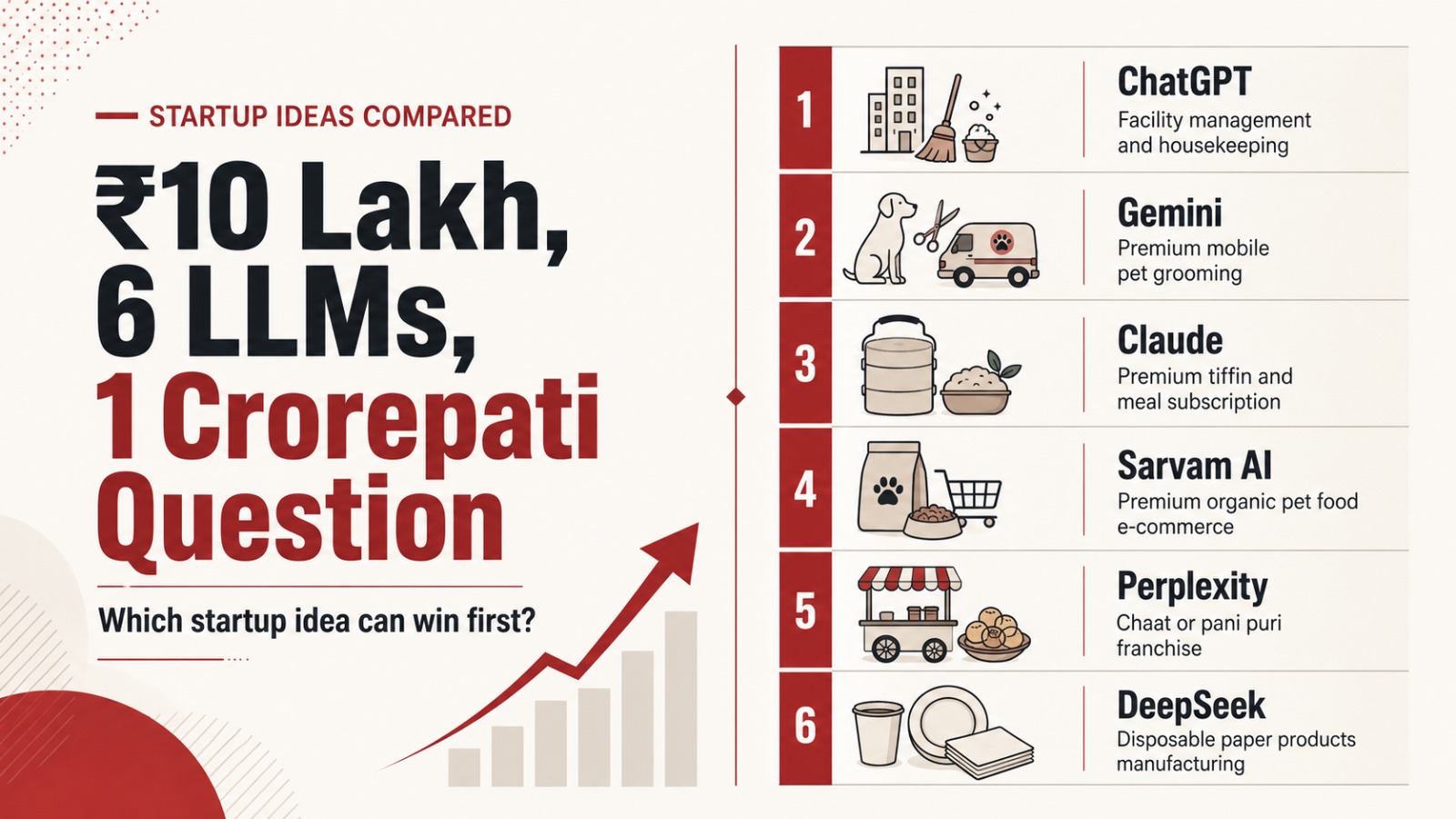
ChatGPT, Gemini, Claude, Sarvam AI, Perplexity and DeepSeek were asked the same question on startup ideas: what can a non-IT graduate start with ₹10 lakh to reach ₹1 crore in three years? Their answers reveal something bigger than business ideas. They show the difference between revenue, profit, valuation and real wealth.
A person with ₹10 lakh in hand and no IT background asks a simple but sharp question: which startup can turn this money into ₹1 crore in three years?
Six AI models answered the question. Each came back with a different business. ChatGPT picked facility management. Gemini went for mobile pet grooming. Claude chose a premium tiffin and meal subscription service. Sarvam AI suggested premium organic pet food e-commerce. Perplexity backed a chaat and pani puri franchise. DeepSeek recommended disposable paper products manufacturing.
At first glance, all six sound convincing. But the real story begins when we ask a tougher question: who is actually talking about becoming a crorepati, and who is only talking about crore-level sales?
The First Problem: ₹1 Crore Means Different Things To Different Models
This is where the comparison becomes interesting.
ChatGPT was the most cautious. It clearly said the target should be ₹1 crore in annual turnover, not ₹1 crore profit. Its facility management idea reaches ₹1.08 crore annual revenue if the business gets 12 clients paying ₹75,000 per month. But the model also admits that net profit may only be ₹10 lakh to ₹18 lakh a year.
Gemini was far more aggressive. It projected that a mobile pet grooming van could grow into a fleet of 5 to 6 vans and cross ₹1.5 crore annual revenue by Year 3, with annual net profit exceeding ₹80 lakh. That is the boldest wealth creation claim among all answers.
Claude gave the most direct crorepati promise. Its tiffin business model claims that by Year 3, the business could reach ₹12 lakh to ₹15 lakh monthly net profit and ₹1.4 crore to ₹1.8 crore in cumulative profit over three years.
Sarvam AI focused on revenue growth through premium organic pet food and accessories. It projected ₹1 crore plus revenue by Year 3 through subscriptions, private label products, veterinary partnerships and even international shipping. But it did not prove how much of that revenue would remain as actual profit.
Perplexity’s pani puri and chaat franchise answer mixed revenue, profit and reinvested capital. It projected ₹1.2 crore revenue in Year 3, ₹24 lakh profit and ₹76 lakh reinvested capital, calling that a path to ₹1 crore total capital.
DeepSeek’s disposable paper products idea claimed that ₹10 lakh can help build a setup capable of ₹1 crore annual sales and about ₹24 lakh net profit per year. It is practical in tone, but its jump from machine purchase to crore-level sales depends heavily on distribution, repeat buyers and capacity utilization.

So the first verdict is clear: not all crore claims are equal.
The Most Practical Pick: Facility Management
ChatGPT’s facility management answer may not sound exciting, but it is grounded. Offices, clinics, schools, warehouses and housing societies need housekeeping, maintenance and manpower services. A non-IT founder can understand this business without needing coding skills or a heavy digital setup.
The strength of this model is recurring revenue. Once a client signs a monthly contract, cash flow becomes predictable. The numbers are also easy to understand. Twelve contracts of ₹75,000 per month can create around ₹9 lakh monthly revenue.
But this is not a quick crorepati route. It is a steady business route. The founder still has to handle staff reliability, client complaints, salary cycles, attendance issues, transport and working capital pressure. It can build a respectable business, but it is unlikely to make the founder personally rich in three years unless contracts scale much faster than projected.
Best for: Someone who can manage people, sell locally and handle operations daily.
Weakness: Profit is modest compared with revenue.
Crorepati chance: Strong for turnover, moderate for personal wealth.
The Most Glamorous Bet: Mobile Pet Grooming
Gemini’s premium mobile pet grooming idea is the most stylish of the six. A grooming van that visits affluent neighbourhoods has a clear convenience angle. It also avoids the rent burden of a fixed salon.
The model’s numbers are attractive. One van doing four grooming sessions a day at ₹2,500 each can generate ₹2.5 lakh monthly revenue. Gemini then assumes monthly net profit of ₹1.6 lakh and uses reinvestment to scale to 5 or 6 vans by Year 3.
But this answer depends on a premium customer base, trained groomers, trust, scheduling discipline and repeat bookings. Pet grooming is not just a van business. It is a service quality business. If the groomer is late, careless or inconsistent, the brand suffers immediately.
The idea can work well in affluent city pockets, but it may not be equally strong across all markets.
Best for: Someone in a metro or wealthy urban cluster with access to premium pet owners.
Weakness: Scaling depends on trained staff and consistent service quality.
Crorepati chance: High if execution is excellent, risky if demand is overestimated.
The Strongest Cash Flow Story: Premium Tiffin And Meal Subscription
Claude’s tiffin and meal subscription idea is the most aggressive on profit. It starts with 50 subscribers at ₹3,500 per month, then scales to 300 subscribers by Month 12, and 600 to 700 subscribers plus corporate clients by Year 3.
This is the only answer that directly claims cumulative profit of more than ₹1 crore in three years.
The business is also understandable for a non-IT graduate. Food quality, hygiene, delivery and local marketing matter more than technology. A basic WhatsApp ordering system is enough in the beginning.
But the risks are real. Food businesses look simple from outside and become brutal in daily operations. Taste has to be consistent. Delivery cannot fail. Hygiene must be non-negotiable. Customer churn can be high if meals become repetitive. Scaling from 50 to 700 subscribers is not just a marketing challenge, it is a kitchen management challenge.
Still, among all six answers, Claude’s model has one clear advantage: it can generate daily demand and monthly cash flow without waiting for large clients or big purchase orders.
Best for: Someone who can control food quality, delivery and local relationships.
Weakness: Operational stress, hygiene risk and customer retention.
Crorepati chance: Highest on paper for cumulative profit, but only with disciplined execution.
The Most Brandable Idea: Premium Organic Pet Food E-Commerce
Sarvam AI’s pet food and accessories e-commerce idea has a modern startup feel. Subscription pet food, premium accessories, influencer marketing and private labels all sound scalable.
But this answer is also the most dependent on marketing efficiency. With ₹10 lakh, spending ₹3 lakh on digital marketing and ₹4 lakh on inventory can become risky if customer acquisition is expensive or inventory does not move quickly.
The model projects ₹35 lakh to ₹40 lakh revenue in Year 1, ₹70 lakh to ₹80 lakh in Year 2 and ₹1 crore plus in Year 3. But revenue alone does not answer the crorepati question. E-commerce can burn cash through ads, discounts, returns, logistics and dead stock.
Private label can improve margins later, but building trust in pet food is not easy. Pet owners may experiment with accessories, but food requires confidence, quality and repeat satisfaction.
Best for: Someone strong in branding, online selling and supplier management.
Weakness: Ad cost, inventory risk and unclear profit.
Crorepati chance: Good for revenue, uncertain for profit.
The Most Local And Low-Tech Idea: Chaat And Pani Puri Franchise
Perplexity’s chaat and pani puri franchise is the most grounded in Indian street consumption. The entry cost is low, the product is familiar and a non-IT founder can run it without complex systems.
The model projects ₹1 lakh monthly sales from one cart, then expansion to multiple kiosks and shops. By Year 3, it imagines 5 plus outlets generating ₹10 lakh per month and ₹1.2 crore annual revenue.
The strength is simplicity. The weakness is the same simplicity. Food carts can be copied easily. Location matters enormously. Hygiene, taste, staff honesty, municipal permissions and daily supervision decide survival. Also, a ₹1 crore capital claim built from profit plus reinvested capital is not the same as ₹1 crore in cash or net profit.
Best for: Someone who can operate locally, supervise outlets and maintain taste.
Weakness: Low differentiation and daily operational leakage.
Crorepati chance: Possible through outlet expansion, but not automatic.
The Most Industrial Pick: Disposable Paper Products Manufacturing
DeepSeek’s disposable paper products manufacturing idea is practical and less glamorous. Napkins, cups and plates are everyday products. The business depends on machines, raw material, production, local distribution and repeat B2B buyers.
The model claims that a ₹5 lakh to ₹7 lakh machine setup can support ₹1 crore annual sales and ₹24 lakh net profit per year. That makes it attractive on paper.
But manufacturing has a different kind of difficulty. Machines must run efficiently. Raw material rates can affect margins. Buyers may demand credit. Local hotels, caterers and offices may negotiate hard. A founder may produce goods but struggle to sell them at the required volume.
This is not a digital business. It is a sales and distribution business disguised as manufacturing.
Best for: Someone comfortable with machines, vendors and B2B sales.
Weakness: Distribution pressure, credit cycle and competition.
Crorepati chance: Strong if sales channels are secured early.
Final Ranking: Who Can Make Crorepati First?
1. Premium Tiffin And Meal Subscription
Best shot at real profit if hygiene, taste and delivery are tightly controlled. It has the clearest path to cash flow and repeat customers.
2. Mobile Pet Grooming
Potentially high-margin and brandable, but demand must be strong enough to support multiple vans.
3. Facility Management
The most realistic and stable revenue model, but it may not create ₹1 crore personal wealth quickly.
4. Disposable Paper Products Manufacturing
Good industrial opportunity, but sales and distribution will decide everything.
5. Chaat And Pani Puri Franchise
Simple, local and expandable, but the model needs constant supervision and differentiation.
6. Premium Organic Pet Food E-Commerce
Attractive on paper, but the most exposed to marketing cost, inventory risk and unclear profitability.
The Verdict
If the question is which business can reach ₹1 crore annual turnover first, facility management, paper products and food outlets all have a reasonable path.
If the question is which business can make the founder a crorepati in actual profit, Claude’s premium tiffin and meal subscription model makes the boldest claim, but it also demands relentless daily discipline.
If the question is which idea balances realism, cash flow and non-IT suitability, the winner is the premium tiffin and meal subscription business, followed closely by facility management.
The real lesson is simple: ₹1 crore revenue can make a business look big, but ₹1 crore profit makes the founder rich. Any model that does not clearly separate the two is selling excitement, not clarity.