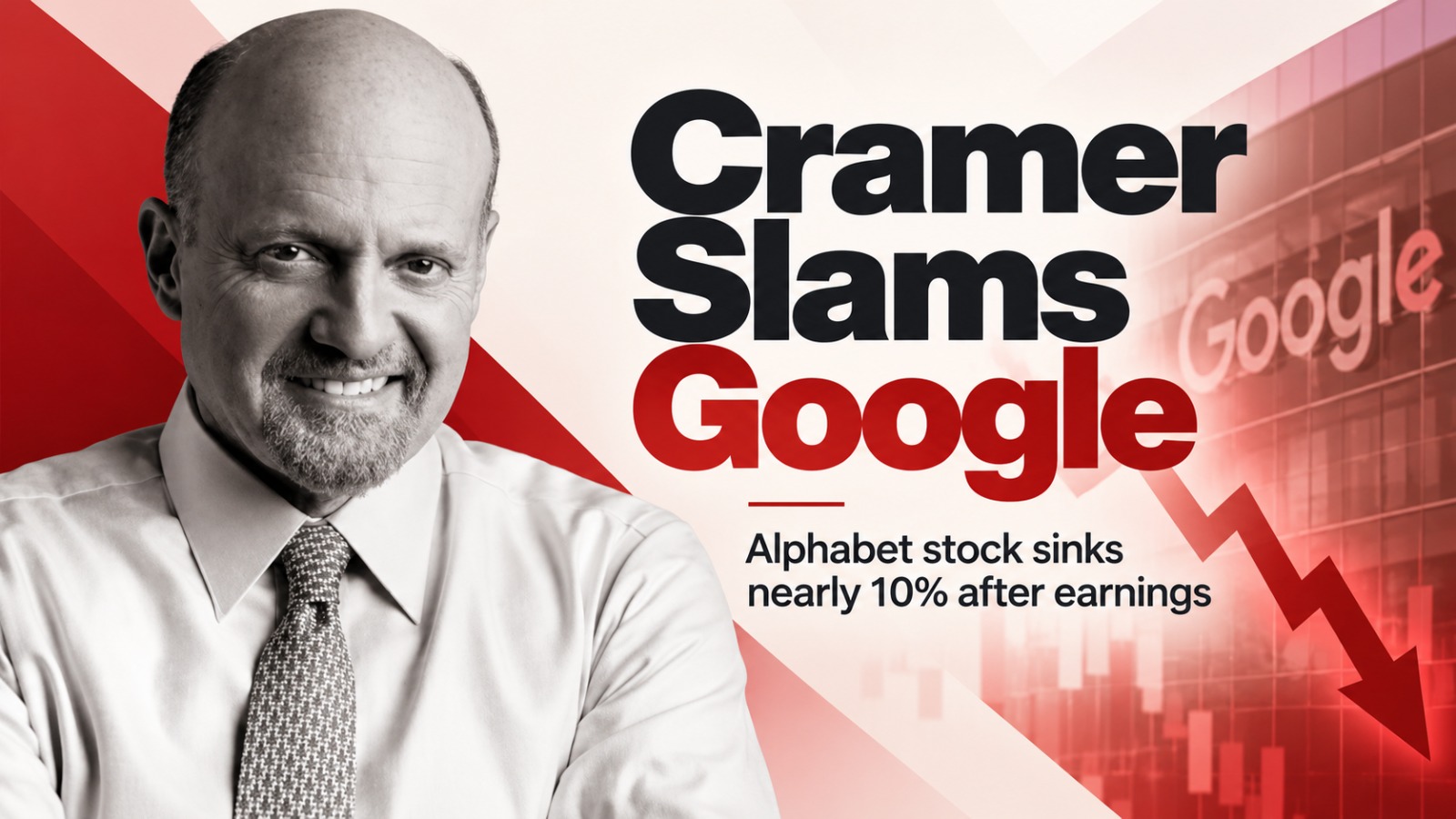
CNBC commentator Jim Cramer has criticized Google’s strategy and execution, pointing to a lack of discipline and unclear differentiation between Gemini and traditional Google services as Alphabet shares plunged nearly 10% in after-hours trading following the company’s third-quarter 2026 earnings report.
In a post on X, Cramer wrote: “I know it is difficult to isolate, but Google’s problems have a lot to do with a lack of discipline and a lack of differentiation between Gemini and Google classic.”
His remarks put the spotlight on a central challenge facing Google’s parent company: turning rapid artificial intelligence adoption into sustainable revenue while protecting the profitability of its established Search business.
Alphabet’s Class A shares (GOOGL) fell 9.97% to $292.50 in after-hours trading on October 28, down from their regular-session closing price of $324.89. Class C shares (GOOG) dropped 9.75% to $290.50.
The selloff came despite Alphabet reporting quarterly revenue of $127.58 billion, an increase of nearly 25% from a year earlier. Revenue nevertheless fell short of Wall Street’s approximately $128.2 billion consensus estimate.
The bigger concern was Google’s advertising business, where growth has struggled to keep pace with the company’s expanding AI ambitions.
Google Search and other revenue rose 12% to $63.35 billion, slowing from 17% growth in the previous quarter. Total advertising revenue reached $82.01 billion, about $1.41 billion below expectations.
Google executives acknowledged that increased AI-powered search activity has not yet translated into comparable advertising revenue.
During the earnings call, Google’s chief business officer, Philipp Schindler, identified “lower monetization we were seeing in AI Mode” as one factor affecting performance.
The disclosure adds financial context to Cramer’s criticism about the distinction between Gemini and what he called “Google classic.”
Google is expanding AI experiences across its products, but the company faces the difficult task of generating revenue from those services without weakening the economics of traditional search advertising.
The challenge is particularly important because Google Services, which includes Search, YouTube, subscriptions and devices, remains Alphabet’s primary source of operating profit.
Meanwhile, Google’s cloud business delivered exceptional growth.
Google Cloud revenue surged approximately 103% to $30.71 billion in the quarter, while operating profit reached $11.12 billion. The segment’s operating margin improved to 36.2%.
However, the cloud division’s strong performance did not produce a corresponding increase in Alphabet’s overall quarterly operating profit.
Alphabet reported operating profit of $40.58 billion, slightly below the previous quarter’s $40.77 billion, as higher company-wide spending, including shared AI research and development, absorbed much of the cloud division’s improvement.
The company’s bottom line also faced pressure.
Net income available to common shareholders declined 25.2% to $26.17 billion, while diluted earnings per share fell to $2.12 from $2.87 a year earlier.
A significant portion of the earnings weakness came from an $8.66 billion net loss on equity securities. Chief Financial Officer Anat Ashkenazi attributed the weakness in other income primarily to an unrealized loss related to Alphabet’s SpaceX investment.
Cash generation presented another challenge.
Alphabet reported negative free cash flow of approximately $9.07 billion after spending $51.36 billion on property and equipment during the quarter.
The company maintained its full-year 2026 capital expenditure forecast of $195 billion to $205 billion, highlighting the scale of its ongoing investments in AI infrastructure.
Despite all these factors, CEO Sundar Pichai was confident about Alphabet’s expansion based on its $500 billion revenue run rate annually and Gemini app user base of one billion people.
Google is also working to improve advertising monetization within AI-powered search, including expanding AI Mode advertising into international markets and introducing ads across multi-turn conversations in the United States.
For investors, however, the central question remains whether those initiatives can generate enough additional revenue and profit to justify the company’s expanding infrastructure costs.
Cramer’s comments draw attention to a strategic concern that extends beyond a single disappointing earnings report. Google is achieving substantial growth in AI and cloud computing, but it still needs to demonstrate how its newer AI experiences can coexist profitably with the search business that has long powered its financial success.
Also Read: Viridian Ingni Propulsion Raises Rs 1.47 Crore to Begin Pilot Production of Electric Motors