If you have been following the Indian startup ecosystem for the last couple of years, the biggest change is probably not what you would expect. It is not the technology. The tech was always going to get better. The realisation – slow, then sudden, is that building a good product is only half the battle. The other half is getting noticed. And in 2026, the startups winning that half look very different from the ones winning it five years ago.
Think about it. India has lakhs of DPIIT-recognised startups today, and a good few thousand of them are building genuinely solid products. But attend any pitch event in Bengaluru or Gurugram and you will hear investors asking something that hardly came up back in 2021: how is anyone supposed to find out you exist? Distribution – which, when you strip it down, is just the unglamorous work of putting your story in front of the right people – has quietly turned into the moat everyone is digging.
How the funding landscape rewired everyone’s priorities
The boom years around 2021 taught a particular lesson. The correction that followed taught a very different one. There was a period, not that long ago, when capital was cheap enough that a startup could more or less buy attention. Just throw money at ads, sign the big sponsorship deals, blitzscale your way into being relevant – that was the playbook. Then the tap tightened, and the startups that made it through were mostly the ones that had built an audience of their own rather than renting one.
This shift is now showing up in funding conversations. Investors still care about unit economics and burn – that never went away. But alongside the spreadsheets, there is a new line of questioning: show me your content engine. They want to see the founder’s following, and the newsletter’s open rates, and the videos that people are actually sharing. A startup walking into a fundraise with ten thousand genuinely engaged followers is carrying an asset that will never appear on its balance sheet – but it absolutely shows up in the valuation conversation.
AI has quietly entered the growth stack.
The more interesting development is this. AI started in startups as a product story – every pitch deck suddenly had “AI-powered” on slide two. Then it became an operations story: support tickets answered by bots, sales outreach drafted by models, code reviewed by assistants. Now it is becoming a distribution story, and honestly, that might be the biggest shift of the three.
The logic is hard to argue with. Content is how startups get discovered, and content has always been expensive to produce well. AI has started collapsing that cost across formats – research summaries, social posts, email sequences, and increasingly video. A founder who could never afford a content team can now run a respectable publishing operation with two people and the right tools.
Early-stage teams are already doing remarkable things with this. A fintech founder in Mumbai publishes a weekly market explainer that gets picked up by business newsletters. A D2C brand in Jaipur turned its founder’s product notes into a video series that outperforms its paid ads. None of these teams hired a media department. They just figured out that in a noisy market, the best storyteller wins – and that AI had lowered the cost of telling it well.
Video is where the attention went.
If content is the moat, video is the deepest part of it. Anyone who has opened Instagram or LinkedIn in the last two years knows where the attention lives. What is less appreciated is how completely video has taken over B2B discovery too. An investor will often watch a founder’s video before ever opening the deck. Enterprise buyers tend to watch a product walkthrough before they book a demo. Job candidates watch “day in the life” clips before applying.
For Indian startups specifically, this whole shift has been turbocharged by cheap mobile data and audiences that live on their phones. People in this country watch more online video than almost anywhere else on earth, and business audiences are no exception to that. A SaaS founder who gets on camera and explains her roadmap will reach people that a blog post would simply never reach.
The bottleneck, as it so often is, comes down to production. Good video is expensive. You need crews, editors, agencies. Early-stage teams rarely have that kind of cash. So founders have been getting creative. Written scripts get turned directly into finished videos, with tools like a text to video AI generator from Dreamina by CapCut, for instance and published as investor updates and product explainers, all without hiring a videographer. It is a small hack, but it captures the larger shift, distribution getting cheaper while attention gets more expensive.
What investors are actually rewarding now
Put the pieces together, and a pattern emerges in what gets funded. It is no longer just product-market fit; it is product-market fit plus distribution-market fit. Can you actually build it – and then, can you make people care that you built it?
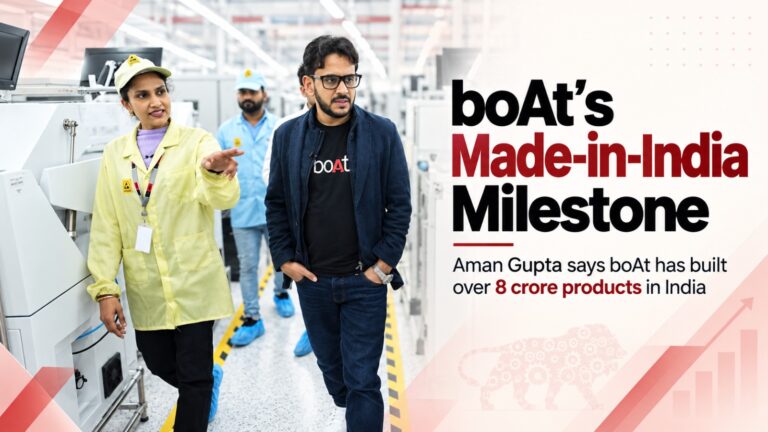
Look at the startups raising the strongest rounds right now, and one pattern keeps showing up: visible founders. CRED’s Kunal Shah spent years building a public audience through his commentary before the company’s later funding rounds. boAt’s Aman Gupta became a household name on television while the company kept scaling.
Mamaearth’s Varun Alagh documented the brand’s journey in public all the way to its IPO. They write, they post, they show up on camera. Not in a performative way – the market punishes that quickly – but steadily, and with something useful to say. They teach things, share their numbers, explain the thinking behind their decisions. Give it time, and that turns into trust, and trust is what brings in the customers, the talent, and the term sheets.
In my view, this is the most underrated shift the ecosystem has seen in a long time. We spent a decade celebrating builders. We are now learning to celebrate builders who can also broadcast.
The moat is attention, and it compounds.
The takeaway: distribution used to be something startups bought after product-market fit. Now it is something they build alongside it, from day one. Teams that start publishing early, sharing what they learn, explaining their industry, showing their work as they go, slowly accumulate an audience asset that no competitor can copy overnight.
To be clear, AI did not create this dynamic – but it has accelerated it brutally. Once producing content gets ten times cheaper, the advantage stops belonging to whoever can afford to publish and starts belonging to whoever actually has something worth saying. Which is good news for sharp founders who have something real to share – and bad news for everyone who has been hiding behind a big marketing budget.
Conclusion
The Indian startup story in 2026 goes beyond funding rounds and unicorn counts. Underneath all of that, there is a quieter rewiring going on, attention turning into the scarcest resource around, distribution turning into the real moat, and AI collapsing what it costs to earn both.
The founders who understand this are not waiting for permission. They are publishing, posting, and putting themselves on camera, building the audience before they need it. In a market with lakhs of startups shouting at once, the ones who get heard will be the ones who learned to tell their story best.
The tools just made that affordable for everyone. The rest, as always, is execution.
Also Read: India Startup Funding Crosses $1 Billion In A Week, Powered By CRED’s $900 Million Round