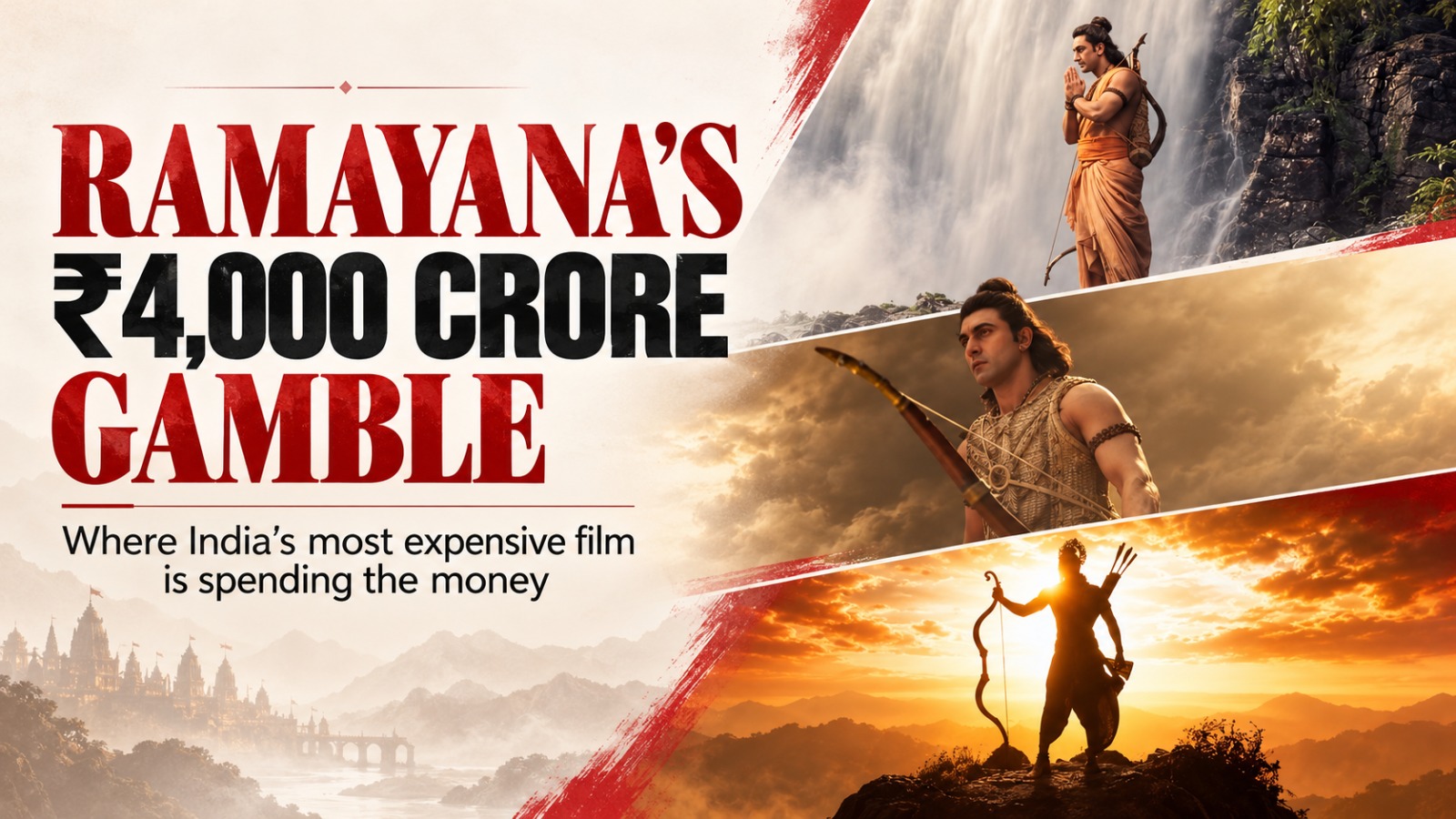
A reported ₹325 crore in pre-release rights deals would be a major achievement for most Indian films. For Ramayana, it represents just over 8% of its staggering ₹4,000 crore budget.
That comparison offers a glimpse into the scale of the project, which is being positioned as India’s most expensive film production. The budget has attracted so much attention that the film’s producer has spoken about being called a “lunatic” for taking on something this ambitious.
But where is the money going?
Firstly, ₹4,000 crore is not the budget of a single film. The amount covers both instalments of Ramayana, including marketing expenses. It is a combined investment in a two-part cinematic project, rather than a production cost attached to Part One alone.
Visual Effects of Ramayana Are a Major Part of the Ambition
One of the project’s most significant commitments is its visual effects work.
DNEG, the visual effects company associated with eight Academy Award wins, is involved not merely as a technical partner but also as a co-producer. More than 200 artists are reportedly working on the project, with post-production said to involve approximately 600 days of work.
Such an extensive schedule points to the importance of visual storytelling in bringing the mythological epic to the screen. However, no itemised breakdown establishes exactly how much of the ₹4,000 crore has been allocated to visual effects.
The production has also brought in international expertise for its action sequences. Terry Notary, known for his work on the Planet of the Apes franchise, is associated with the film’s action direction, while Guy Norris, whose credits include Mad Max: Furiosa, is handling stunt work.
Music is another major attraction. Oscar-winning composers Hans Zimmer and A.R. Rahman have been brought together for the project. Between them, the two have won four Academy Awards.
The cast is equally prominent, with Ranbir Kapoor playing Lord Ram, Sai Pallavi portraying Sita, Yash taking on the role of Ravan and Sunny Deol appearing as Hanuman.
The ₹325 Crore Head Start and the Bigger Financial Question
While the film’s expenditure has dominated discussion, reports of early rights deals have begun drawing attention to its revenue potential.
Hindi distribution rights have reportedly been sold for approximately ₹250 crore, while music rights are said to have fetched another ₹75 crore.
Together, these reported agreements amount to ₹325 crore, equivalent to roughly 8.1% of the film’s stated ₹4,000 crore budget.
That percentage is worth examining, although the reported deal values should not be mistaken for confirmed profit or a complete picture of the producer’s recoveries.
The larger commercial test will come with the theatrical release of both instalments and the performance of the film’s other rights. Premium exhibition formats such as IMAX and ScreenX also form part of the planned release strategy.
Part One is slated for November 5, placing the focus on whether the film’s considerable creative and financial investment can translate into theatrical success.
For now, the ₹4,000 crore figure reveals the ambition more clearly than the actual distribution of expenditure. Visual effects, action, music, casting, marketing and a two-film production are all part of the equation, but their individual costs have not been publicly established here.
Ramayana is not simply betting on a massive opening weekend. It is betting that an Indian mythological story, produced on an unprecedented scale, can justify one of the industry’s boldest investments.
The reported pre-release deals may be an encouraging start. Whether the complete financial gamble pays off remains an open question.
Also Read: Jio Platforms Share Price Surges 21% on Debut After Record IPO