When a young professional quit his ₹18-lakh corporate job to freelance, his family panicked. “Talk some sense into him,” his uncle urged. But the data told a different story. In just three months of freelancing, the cousin had earned ₹16.2 lakh, more than his annual take-home from the “stable” job he had left behind.
His new routine was built on eight clients instead of one employer. His annualised earnings now crossed ₹45 lakh, a 3.6-times jump over his previous salary. When asked about job security, his reply cut through decades of inherited anxiety: “I have eight clients. If I lose one, I still have seven. My corporate friends? One layoff from zero.”
The Numbers That Explain the Shift
This story, shared recently by entrepreneur Ritesh Malik, captures a deeper change reshaping India’s white-collar economy. India currently has an estimated 7.7 million gig workers, a figure projected to reach 23.5 million by 2030.
Major companies across sectors have quietly embraced flexible, project-based models, nearly 55 percent of Indian firms now hire gig or freelance talent for specific roles. Globally, even tech giants mirror this trend; reports note that Google engages more contractors (around 120,000) than full-time employees (roughly 102,000).
The cousin’s choice, therefore, isn’t reckless, it’s rational. In a world where 20 to 30 percent of “permanent” employees can be laid off during economic downturns, spreading one’s income across multiple clients is a hedge against volatility.
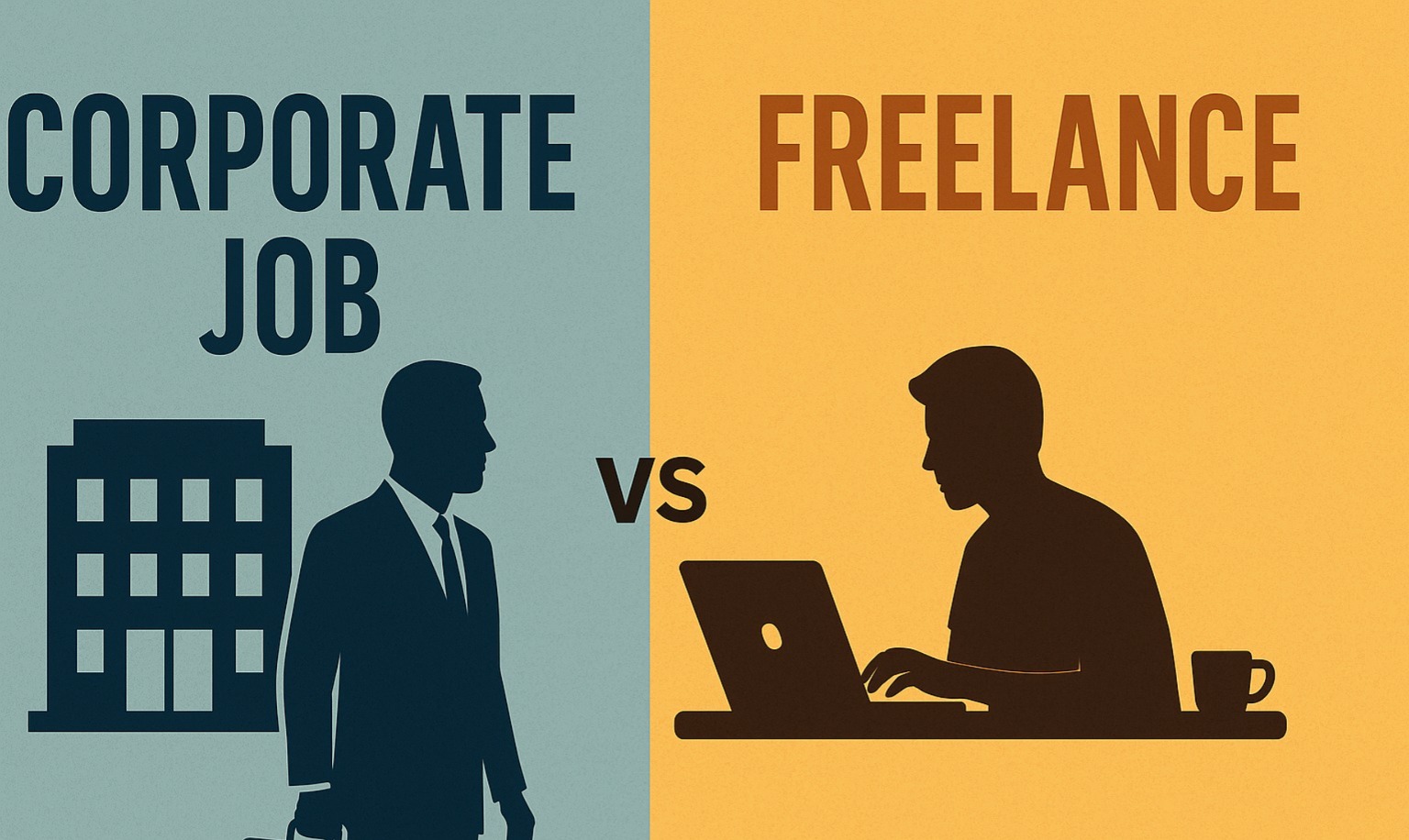
Corporate Job vs Freelance: The Mindset Lag
India’s cultural idea of success still revolves around brand-name employment. We celebrate ₹50-lakh offers from global corporations but question the freelancer earning ₹80 lakh in a year. The unease comes from an older social script built in the 1980s, when long careers in one company defined stability. That worldview made sense in an era of lifetime pensions and slow-moving industries. But in today’s project-driven digital economy, security no longer comes from tenure—it comes from adaptability.
Freelancers, in effect, diversify their income like investors diversify a portfolio. Losing one client hurts but rarely destroys them. Employees with a single employer, by contrast, face total exposure when the company restructures or automates roles. What we label as “risky” work is often, in reality, distributed risk.
Three months into freelancing, the cousin signed a six-month contract worth ₹18 lakh. Had he stayed at his job, he would have earned about ₹9 lakh over that period. The difference is not luck, it reflects how the open market prices outcomes rather than attendance. Skilled professionals who deliver measurable value can charge far more directly than traditional salary structures allow.
The New Definition of Stability
Security today lies less in permanence and more in optionality, the ability to move, re-skill, and remain relevant across projects and clients. The cousin’s story illustrates a broader transition from employment as identity to work as a marketplace of outcomes. Stability is no longer about a single payroll; it is about professional credibility and the freedom to choose who to work with next.
Policymakers have taken note. Government think tanks and labour economists project gig work as a critical driver of India’s non-farm employment by the end of the decade. Formal frameworks for social security, insurance, and benefits for platform workers are already under discussion. Meanwhile, companies themselves are rewriting workforce models to balance full-time teams with agile, contract-based specialists.
Freelancing comes with its own challenges, irregular cash flow, self-managed taxes, and lack of built-in health or retirement benefits. Yet those risks are measurable and manageable. With clear contracts, emergency savings, and skill investment, freelancers build their own safety nets. By contrast, job-holders often outsource that vigilance to employers, only to discover its fragility during downturns.
The real cognitive dissonance lies in what society still defines as “safe.” A generation ago, one employer for life symbolised reliability. Today, the same structure can represent vulnerability. Diversification, once a principle of investing, is fast becoming a principle of working.
When asked again whether he regretted quitting, the cousin pointed to his invoices: eight clients, ₹16.2 lakh earned in three months, and a fresh ₹18-lakh contract underway. His old job would have paid half of that in the same period. The contrast is not just financial, it’s philosophical.
As Ritesh Malik observed, by 2030 one in seven non-farm workers in India will be part of the gig economy. The government is preparing, companies are adapting, and a new generation is already living the change. The only part still catching up is our collective idea of “security.”
Because in the modern economy, having eight income streams is no longer risky. Depending on one employer is.
Also Read: BharatAgri switches off: funding winter claims another agritech hopeful