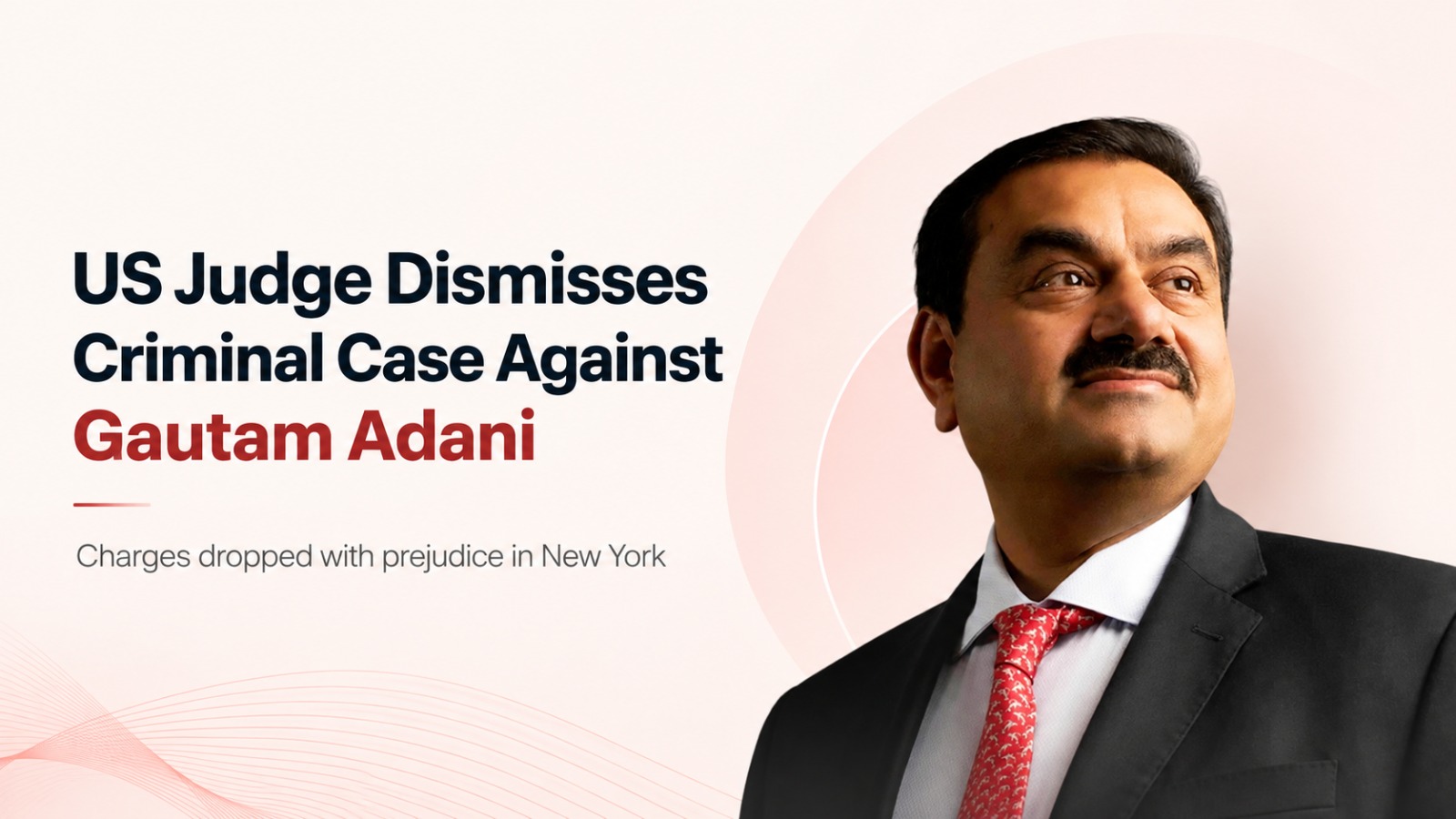
New York/New Delhi, August 11: A US federal judge has permanently dismissed the criminal case against Adani Group chairman Gautam Adani, his nephew Sagar Adani and former Adani Green Energy CEO Vneet Jaain, ending proceedings that had remained unresolved since charges were announced in November 2024.
The US District Court for the Eastern District of New York granted the Justice Department’s request under Rule 48(a) to dismiss the indictment with prejudice. The decision means the three criminal charges cannot be refiled.
The case ended before reaching trial. No witnesses were examined, no evidence was tested before a court, and the judge made no finding on the truth or falsity of the underlying criminal allegations.
Judge Nicholas Garaufis approved the dismissal after requiring federal prosecutors to provide further explanation for abandoning the prosecution and asking the defendants to submit sworn declarations stating that no promise, offer, quid pro quo or undisclosed arrangement was connected to the government’s decision.
Gautam Adani, in his declaration, denied that any such agreement existed.
The dismissed counts involved allegations of securities-fraud conspiracy, wire fraud conspiracy and securities fraud.
Case traced back to November 2024 indictment
US prosecutors had alleged that Gautam Adani, Sagar Adani, Vneet Jaain and others participated in a scheme involving approximately USD 250 million in bribes to Indian government officials in connection with solar power contracts.
According to the prosecution’s original allegations, the contracts were expected to generate more than USD 2 billion in after-tax profits over roughly two decades.
Prosecutors had also accused the defendants of misleading investors while more than USD 3 billion was raised through loans and bond offerings in US markets.
The Adani Group repeatedly rejected the allegations, calling them baseless and maintaining that it had complied with applicable laws and regulatory requirements.
Judge accepts legal risk over alleged compliance statements
In considering the Justice Department’s request to withdraw the case, the court found sufficient legal grounds for dismissal based on one of the government’s arguments.
The issue concerned statements about Adani Green’s anti-bribery policies and corporate compliance. The government argued that such statements could be regarded as “inactionable puffery”, meaning broad corporate claims on which investors could not reasonably be expected to rely.
The court concluded that this created sufficient legal risk for the prosecution to support dismissal of the three counts.
However, the judge did not accept all of the government’s reasoning.
The Justice Department had argued, among other things, that the alleged conduct was overwhelmingly centred in India and presented substantial jurisdictional difficulties under US securities law. The court found that argument insufficient, pointing to allegations in the indictment that investors committed funds in the United States and that the transactions involved the US financial system.
The court also found the government’s argument concerning the absence of deception of sophisticated investors insufficient on its own.
Because the legal risk surrounding the alleged compliance statements was enough to support dismissal, the judge said it was unnecessary to decide that issue further.
Justice Department said prosecution no longer served interests of justice
In its submissions, the Trump administration told the court that continuing the case no longer served the interests of justice.
The Justice Department cited jurisdictional and evidentiary difficulties, the largely Indian character of the alleged conduct, examination of the matter by Indian authorities, the absence of identified investor losses and broader public-interest considerations.
It also argued that the indictment had little realistic prospect of reaching trial.
The department went further in its filing, describing the prosecution, which was unveiled in November 2024 during the closing weeks of the previous Biden administration, as a politically motivated “name and shame” exercise.
That characterization was the Justice Department’s position before the court, rather than a finding made by the judge.
Court examined whether Adani’s US investment pledge played a role
Before granting the government’s request, Judge Garaufis also considered whether Gautam Adani’s November 2024 announcement of a proposed USD 10 billion investment in the United States had influenced the decision to abandon the prosecution.
The judge said he was satisfied that the investment pledge had not factored into the Justice Department’s decision.
The defendants’ sworn declarations were part of that review, with the court requiring confirmation that there had been no hidden agreement or exchange connected to the dismissal.
After reviewing those declarations and the government’s explanations, the court granted the motion and dismissed the case with prejudice.
The judge also noted the limited role courts have when reviewing a federal prosecutor’s decision to withdraw criminal charges.
Because the government itself requested a dismissal with prejudice and the defendants appearing before the court agreed to it, the court found no concern that the prosecution could be repeatedly revived to harass the defendants.
SEC civil case ends separately with USD 6 million penalty
The conclusion of the criminal case is separate from the US Securities and Exchange Commission’s civil proceedings involving Gautam Adani.
That action has also been resolved through a final judgment under which Adani consented to the order without admitting the allegations.
The judgment requires him to pay a USD 6 million civil penalty to the SEC within 30 days.
The criminal dismissal therefore does not erase the separate civil resolution, just as the dismissal itself does not represent a judicial determination on the criminal allegations.
Gautam Adani welcomes court decision
Following the dismissal, Gautam Adani said he accepted the outcome “with humility and deep respect for the judicial process.”
“Throughout this challenging period, our faith in truth, fairness and the rule of law remained unwavering. My deepest gratitude to those who never lost faith in us, in the system and in India’s capacity for justice,” he said in a post on X.
“We will continue doing what matters: building for our nation, creating value that outlasts us and serving a purpose larger than ourselves. That is our commitment,” he added.
Proceedings followed years of international scrutiny
The US proceedings came during a period of intense international scrutiny of the Adani Group following allegations published in January 2023 by short seller Hindenburg Research, which has since shut down.
The report led to a steep decline in the market value of Adani Group companies, with losses at one stage exceeding USD 150 billion.
The group consistently denied those allegations as well and maintained that its companies complied with relevant laws and disclosure requirements.
With the Eastern District of New York’s dismissal now made with prejudice, the criminal prosecution of Gautam Adani, Sagar Adani and Vneet Jaain on the three counts has formally ended without a trial or judicial determination of the allegations themselves.
Also Read: iPhone 18 Pro Max Launching Next Month With 10 Major New Features