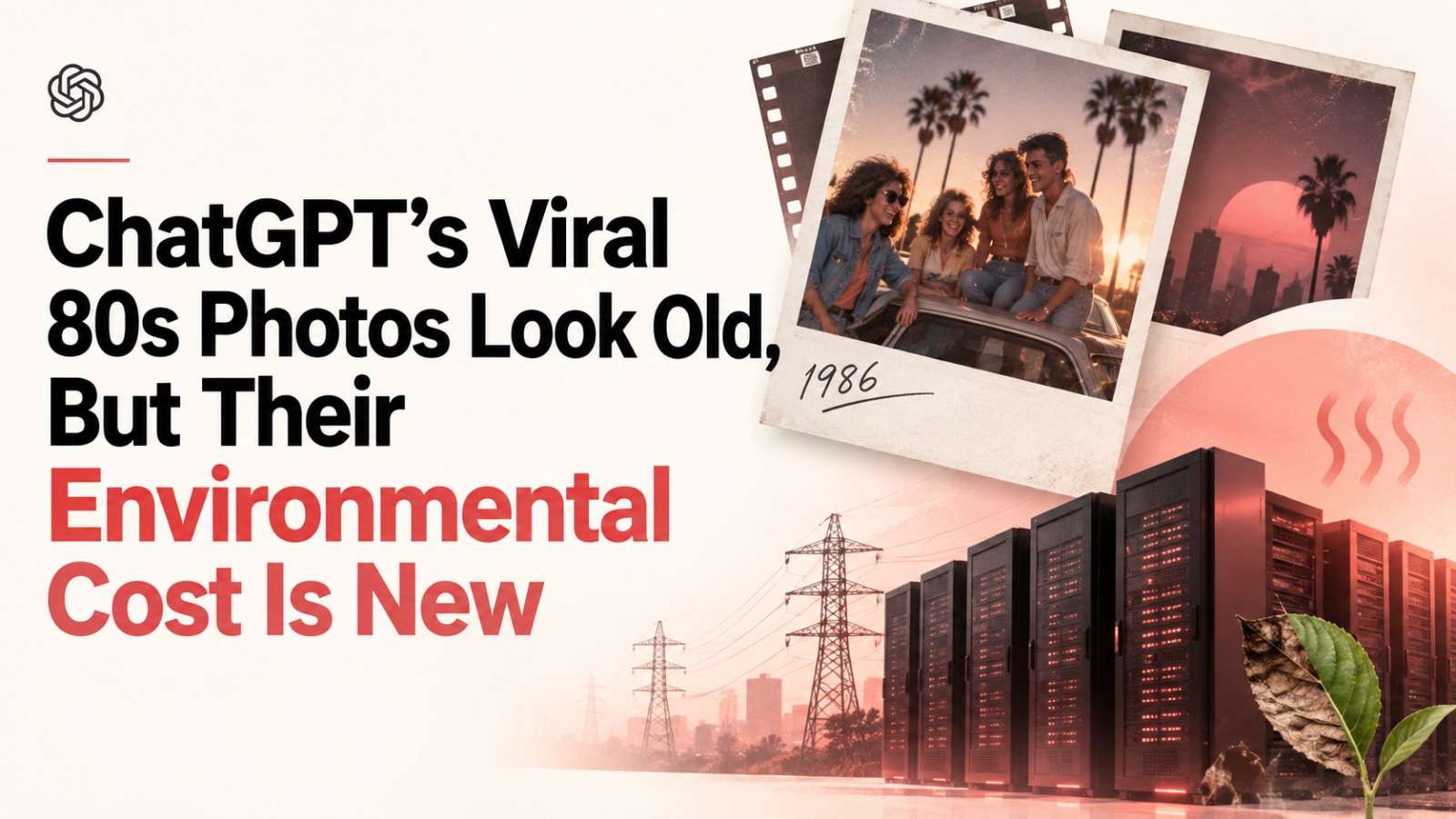
The latest ChatGPT trend is taking social media users back to the 1980s, but the nostalgia comes with a less visible side effect. Across Instagram, X and Facebook, people are using AI image generation to turn modern selfies into retro studio portraits featuring big hair, vintage clothing, film grain and even glowing date stamps designed to make the images look decades old.
The trend is easy to participate in. A user uploads a clear photograph, adds a detailed prompt and asks the AI to recreate their appearance in an unmistakably 1980s setting. The finished image can then be shared across social media, often becoming part of the wider viral cycle.
But behind each generated image is a layer of computing infrastructure that users do not see. As millions of people participate in similar AI trends, the environmental impact of generating, storing and distributing those images becomes a larger question.
What is the ChatGPT 80s photo trend?
The trend goes beyond putting a retro filter over an existing photograph. Users provide ChatGPT with a photograph and ask the AI to preserve their recognizable facial features while changing almost everything around them.
The resulting images commonly feature high-volume hairstyles such as bouffants, mullets and tight curls. Denim jackets, padded shoulders, bright neon windbreakers and aviator sunglasses are also part of the look.
The photography itself is designed to resemble an older studio photograph. Prompts often ask for soft lighting, warm or sepia tones, faded blue backgrounds and visible film grain.
One particularly recognizable detail is the artificial date stamp. Some prompts instruct the AI to place a red-orange date such as 1985 or 1986 in the corner, giving the picture the appearance of an old family photograph.
The trend has also developed local variations, including Bollywood-inspired interpretations and retro looks influenced by regional Kerala and Malayali culture. Public figures and politicians have also joined the trend, adding further visibility to the format.
It starts with one selfie, but rarely ends with one image
Creating a single AI image may appear like a small digital action. The bigger environmental question emerges when the same process is repeated at scale.
Users often generate several versions before deciding which image to post. A first result may not have the right hairstyle, clothing, facial appearance or background, prompting another attempt.
That means the computing work involved in a viral AI trend is not limited to the final picture that eventually appears on Instagram or X. Multiple generations, revised prompts and additional uploaded photographs can all add to the amount of computing required.
The difference is difficult to see from the user’s side. A social media post may contain one finished image, while several earlier attempts may have already been generated and discarded.
Where the environmental cost comes from
AI-generated images require computing resources at data centres. Those facilities need electricity to run the hardware used to process requests, while additional infrastructure is required to keep the equipment operating.
When a trend spreads widely, the same process is repeated by large numbers of people. A small amount of computing associated with an individual request can therefore become a much larger demand when multiplied across a huge number of generations.
The environmental footprint also extends beyond the moment when an image appears on a user’s screen.
Storage keeps the digital trail alive
Generated images may be saved to cloud infrastructure, creating another layer of ongoing data storage.
A viral trend can result in large numbers of high-resolution images being created and retained. Each image may appear insignificant on its own, but the cumulative requirement for storing large volumes of digital content adds to the infrastructure supporting online services.
Sharing adds another layer
The AI generation itself is only one part of the digital journey.
Once users begin sharing their images, the files have to move through online networks. Every view, like or comment contributes to the continued circulation of that content across social platforms and their underlying infrastructure.
This means the environmental footprint of a viral image trend is not confined to the instant the AI produces the picture. Its continued distribution creates additional digital activity.
Data centres also need cooling
Computing hardware generates heat while operating. Data centres therefore require cooling systems to keep equipment running safely.
As computing activity increases, the infrastructure supporting those systems also has to work harder. Cooling equipment, including fans and water-based systems, forms part of the physical infrastructure behind what otherwise feels like an entirely digital experience.
Why viral AI trends make the question bigger
The interesting part of the 80s photo craze is not necessarily one individual image. It is the scale created when millions of people perform similar actions around the same time.
Social media trends are built around repetition. One person generates an image, another tries the same prompt, and others modify it to create their own version. The cycle can encourage users to keep experimenting until they get an image they want to share.
That makes the environmental discussion less about whether one AI-generated photograph is significant on its own and more about what happens when image generation becomes a mass social activity.
The 80s trend may eventually fade and be replaced by another visual format. But the underlying pattern remains the same: a seemingly simple social media challenge can trigger a much larger chain of computing, storage, transmission and cooling activity behind the scenes.
For users, the final product is simply a nostalgic-looking photograph with a retro hairstyle and an artificial 1985 date stamp. Behind that image, however, sits an infrastructure-heavy process that becomes harder to ignore when millions of people decide to recreate the same piece of nostalgia.
Also Read: GTA 6 Will Not Launch on Xbox Game Pass, While GTA 5’s Last Game Pass Run Ended on April 15, 2026