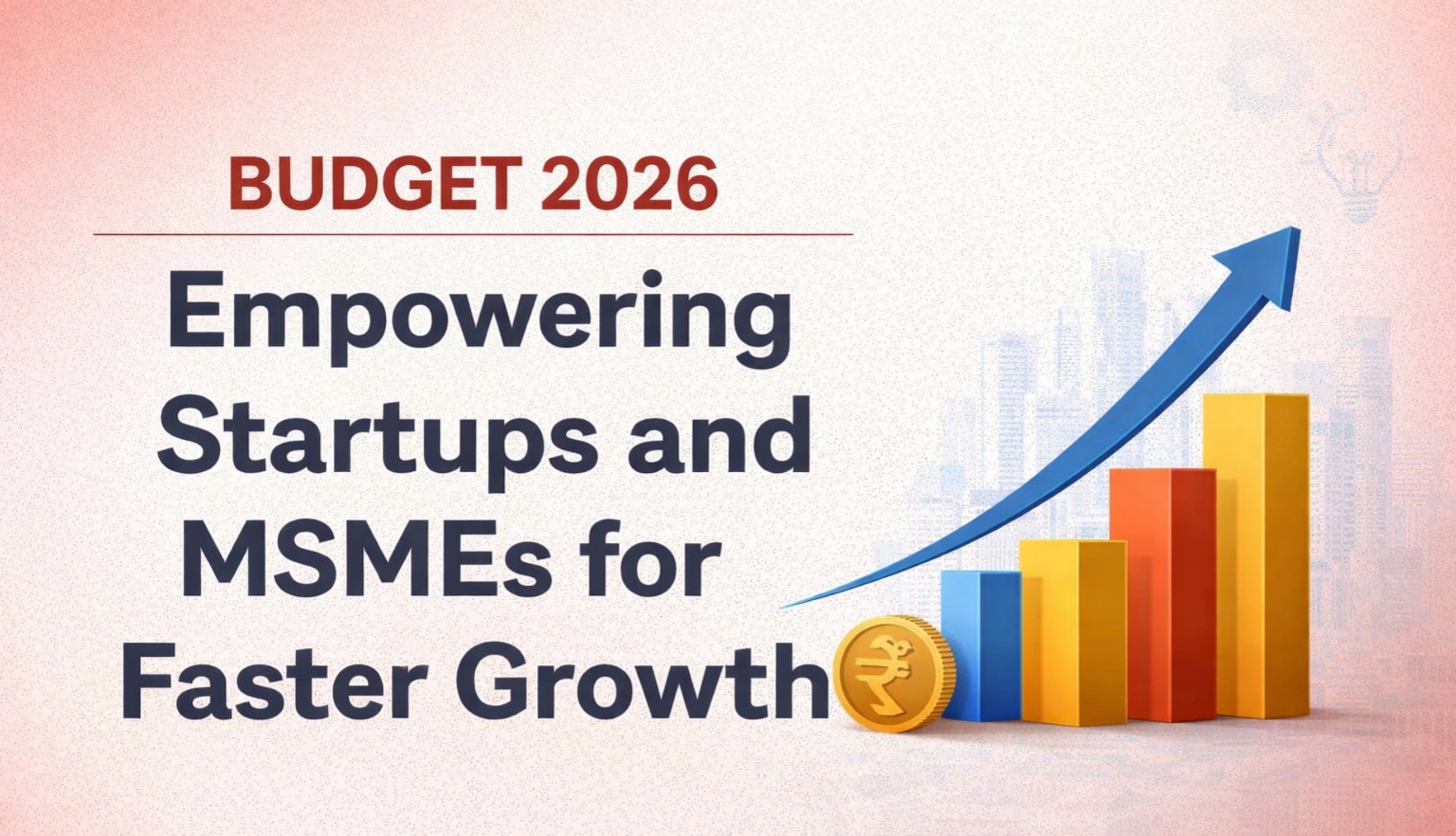
Budget 2026: India’s startup and MSME ecosystem rarely changes course because of one Budget announcement. But Budget 2026-27 signals something more structural: a shift from short-term relief to long-term scale.
Rather than viewing startups and small businesses as beneficiaries of schemes, the Budget treats them as engines of India’s next chapter of growth, employment, and exports. Public investment is seen as a catalyst, and the hard work has to be done by the private sector.
For many founders, the disconnect between headline economic growth and ground reality has been stark, funding has tightened, growth-stage capital has been uneven, and delayed payments continue to choke MSME operations. Budget 2026 acknowledges these structural constraints and tries to address the fundamentals: access to growth capital, faster cash-flow cycles, and clearer pathways to scale beyond survival.
Budget 2026: Capital for Growth, Not Just Survival
One of the central pillars of the Budget is the push to improve long-term capital availability. A ₹10,000 crore SME Growth Fund is proposed to support “future-ready” MSMEs with equity-style backing tied to performance and expansion, complemented by a top-up to the Self-Reliant India Fund so micro enterprises are not forced to rely purely on debt. The objective is to plug the long-missing growth capital gap between early traction and institutional funding.
Concurrently, the government has also announced the creation of a Fund of Funds worth ₹10,000 crore to support the growth of startups by providing funding through registered venture funds, thus ensuring that the government is not directly involved in the funding process. This is particularly important at a time when risk capital is being quite conservative, especially with regard to startups.
Together, these measures indicate a dual strategy: help MSMEs grow through structured equity support while ensuring startups continue to have financing pipelines through the venture ecosystem.
Fixing the Real MSME Problem: Delayed Payments
Ask any small business owner, and the biggest operational stress often isn’t taxation or compliance, it’s unpaid invoices. Budget 2026 attempts to address this by putting the Trade Receivables Discounting System (TReDS) at the centre of MSME payments.
Under the plan, payments from Central Public Sector Enterprises to MSMEs will be mandatorily routed through TReDS, invoice discounting will receive guarantee backing, GeM procurement will be linked to financiers, and receivables will be securitised to create liquidity in secondary markets.
The intended outcome is simple: MSMEs shouldn’t have to wait endlessly to get paid in order to keep operating. For founders, this means working capital may increasingly depend on structured systems rather than personal negotiations.
Inclusion as an Economic Strategy
Another notable feature of the Budget is its attempt to widen participation in entrepreneurship. The government has announced a targeted credit scheme for 5 lakh first-time entrepreneurs, including women as well as Scheduled Caste and Scheduled Tribe founders.
Under this initiative, the term loans of up to ₹2 crore with a five-year tenure are available for eligible entrepreneurs, which will help lower the barriers to entry that first-generation founders face when trying to access the formal credit markets. This is a sign that the focus is shifting to inclusive entrepreneurship as a tool for economic growth and not just a social cause.
Manufacturing and Deep-Tech Open New Doors
The Budget also positions manufacturing and deep-tech sectors as fertile ground for startups. Through programmes and incentives spanning semiconductor initiatives, component manufacturing, container production, and rare earth corridors, the government is trying to create demand ecosystems that startups can plug into as suppliers and innovators.
This marks a policy shift where startups are not seen only as app-based or service-led ventures, but also as participants in industrial and hardware innovation aligned with global supply chains.
From Startup India to Scale-Up India
The underlying message of Budget 2026 is subtle but clear: entrepreneurship in India is moving from survival to scale. The focus is now on longer capital runways, faster liquidity cycles, and institutional support mechanisms that allow businesses to compete globally rather than merely exist domestically.
The Budget also pushes entrepreneurship beyond metro hubs, promoting development across Tier-II and Tier-III regions and industrial clusters, decentralising where the next breakout company might emerge from.
Budget 2026 is not a startup giveaway. It is more of a scale blueprint. Rather than providing incentives that make headlines, it tries to engineer a situation where private enterprise can scale in a predictable manner.
For founders and MSMEs, the signal is unmistakable: the state is shifting from protector to enabler, trying to make growth systemic rather than accidental. Whether these measures translate into easier scaling will depend on execution, but the direction is now clearly toward building enterprises that can compete, export, and employ at scale.
Also Read: Union Budget 2026 LIVE: Nirmala Sitharaman presents Budget 2026-27