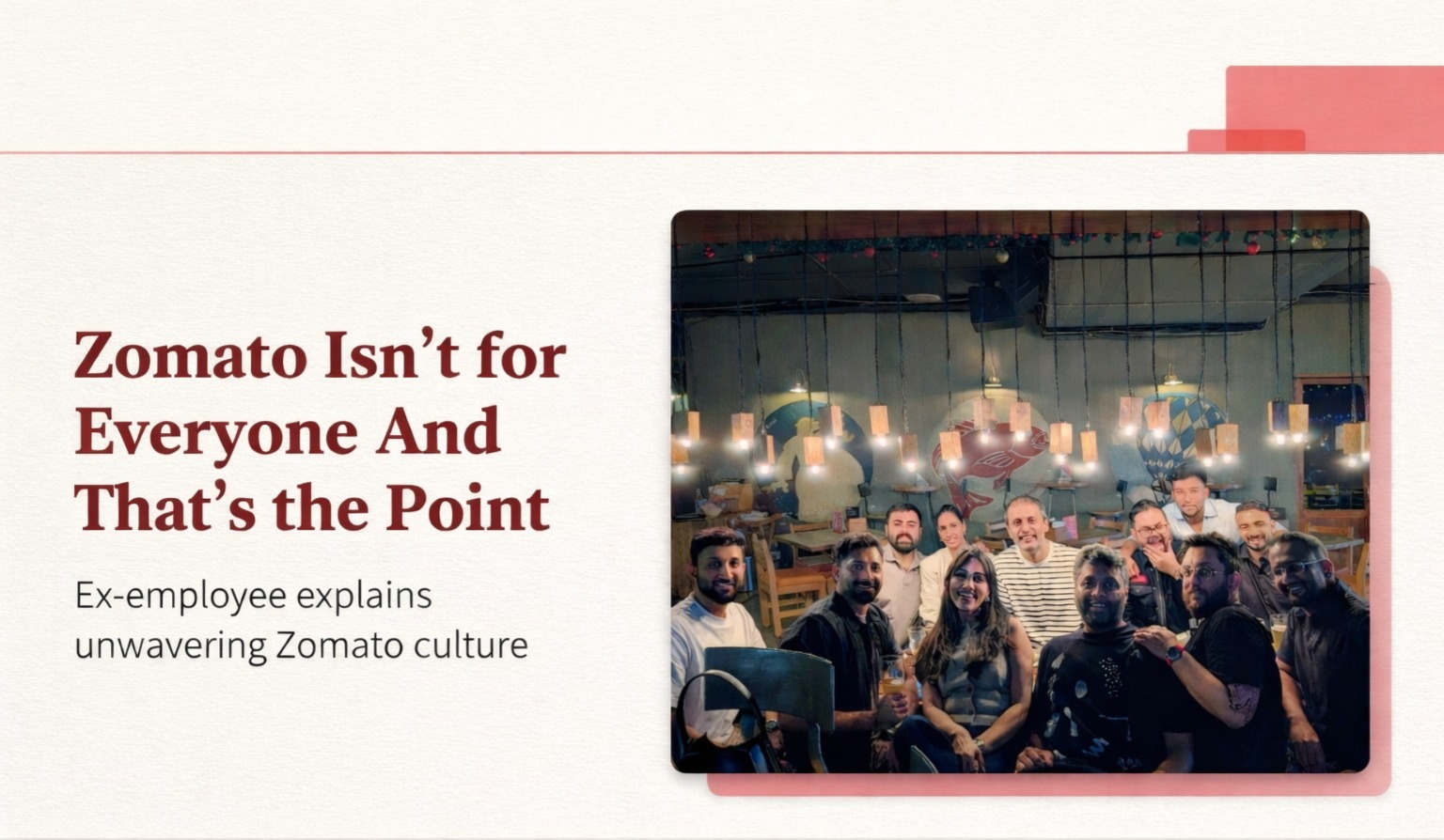
A candid LinkedIn post by Ragini Das, Head of Google for Startups, India, is sparking fresh conversation around Zomato’s work culture, its pace, expectations, and the kind of people who thrive in high-intensity environments.
In her post, Das describes herself as a “proud ex-Zoman” (Zomato’s colloquial term for employees) and ties her reflection to the chatter around Deepinder Goyal’s recent note about calling ex-Zomans back, which she says has flooded her feed and inbox.
She also links to a piece she wrote in 2019 about what Zomato meant to her “from the inside.”
But this time, Das writes from a different vantage point: as someone who moved on from Zomato and went on to build her “life’s work” at leap.club and who still credits Zomato with shaping her approach to execution, resilience, and long-term thinking.
“It’s not ‘just a job’”
The core of Das’s message is simple: Zomato is not designed to be universally comfortable and that’s intentional.
“If you want to clock in and clock out, you won’t survive Zomato. It is intense. It’s fast. It’s demanding.”
She frames the intensity not as a warning sign but as a filter, one that tests commitment and, in her telling, rewards it with trust and responsibility.
“The people who grew there gave it their all. In return? The company gave it right back, in trust, responsibility, and irrational belief in your potential.”
Growth, according to Ragini Das, happens “between the numbers”
One of the most specific parts of Das’s post is her personal example of growth over time, less as a headline achievement and more as a slow build.
She recalls being 22, driving around Hyderabad and Bangalore to sell a banner ad for ₹3,000. By the time she left sales, she says, the cheques she was picking up were for ₹60 lakh.
“Between those two numbers is where the grit was built.”
“They trust you before you are ready”
Another theme in the post is early responsibility. Das writes that at 26, despite never having worked in an international market before, she was trusted with a million-dollar budget to launch a new product.
Her point isn’t that it was comfortable, her point is that it forced competence.
“They trusted you before you were ready. And because they trusted you, you always figured it out.”
Monday blues were rare
Das also pushes back on the idea that high-intensity workplaces are automatically unhappy workplaces. She says that during her six years at Zomato, she had “Monday blues” only a handful of times, crediting the energy of the people around her.
She lists what the environment taught her: overcommunication, resilience, and what she calls the meaning of a “dream team.” She also notes that some professional relationships turned into lifelong ones, mentioning bosses who became mentors, and “one who became my co-founder.”
The “ex-Zomato network” effect
In a line that will feel familiar to anyone who has worked at a fast-scaling company, Das describes how alumni networks form when people “grow up together” inside intense workplaces.
“70% of my closest circle today are ex-Zomato.”
She references a group photo from December ’25 featuring some of the “Zomato Bangalore Class of 2014-2016,” adding that life paths diverged, founders, parents, marriages, moves across countries, but the bond stayed. “Everything has changed, and yet, nothing has changed.”
Also Read: Silver’s Big Fall Shocks Markets, Even Long-Time Critics See a Short Bounce
Das’s post isn’t a corporate announcement or a hiring pitch. It reads like an insider’s reality-check, both a tribute and a boundary-setting statement.
At a moment when work culture debates often swing between glamorizing hustle and rejecting it outright, her framing offers a third idea: some companies are intentionally not built for balance-first expectations and for the people who choose that trade-off, the experience can be formative.
Or, as she puts it: Zomato isn’t for everyone. And that is the point.
Also Read: India Ends China’s Long Reign as the World’s Largest Rice Producer