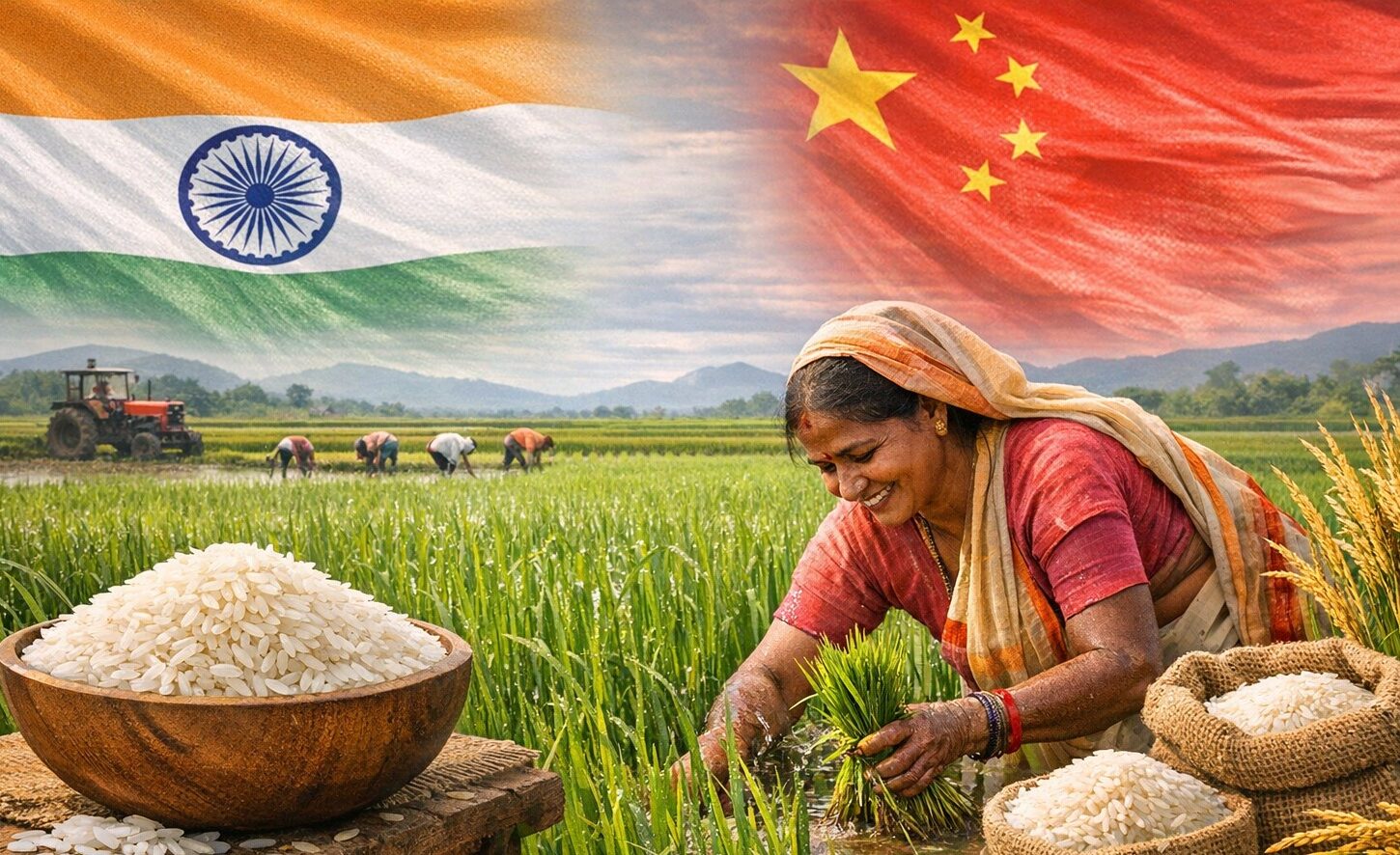
India has surpassed China to become the world’s top rice-producing nation, ending a dominance China had held for decades. This milestone marks a significant shift in global agriculture and underscores India’s growing role in ensuring food security worldwide.
According to the United States Department of Agriculture, India’s share of global rice production has crossed 28 percent. In its December 2025 report, the USDA estimated India’s rice output at 152 million metric tonnes, ahead of China’s 146 million metric tonnes. With this, India has officially emerged as the world’s largest rice producer, reshaping long-held perceptions about global rice leadership.
A Historic Crop with Deep Indian Roots
Rice has been cultivated and consumed in India since ancient times. Discussions about the origin of rice often place India among the earliest regions where the crop was grown. Of the nearly 123,000 rice varieties found worldwide, about 60,000 are present in India, reflecting the country’s extraordinary genetic diversity in rice.
Despite this rich heritage, India remained behind China in total production for many years. The current achievement is therefore historic, as it marks the first time India has overtaken China in overall rice output.
Dr Sudhanshu Singh, Director of the South Asia Regional Centre at the International Rice Research Institute, has described India’s rise as a major achievement. Indian rice is now exported to 172 countries, and rice has also become an important component of India’s foreign policy engagement with food-importing nations.
Also Read: Truva Secures $6.3 Million in Series A Funding at Over $30 Million Valuation
Rice Exports Strengthen the Economy
Rice plays a crucial role in India’s agricultural economy and export earnings. In 2024-25, India exported agricultural products worth a record Rs 450,840 crore. Rice accounted for the largest share of these exports, contributing about 24 percent of the total value.
Through exports of basmati and non-basmati rice, India earned foreign exchange worth Rs 105,720 crore in a single year. These figures highlight rice as not only a staple food crop but also a major source of income for farmers and a key contributor to national export revenues.
From Scarcity to Surplus
At the time of Independence, India produced only 20.58 million metric tonnes of rice annually. By 2025, production had risen more than sevenfold to 152 million metric tonnes. This transformation reflects decades of sustained efforts by farmers, agricultural scientists, and policymakers.
In the 1960s, India faced acute food grain shortages. Rice cultivation relied largely on traditional long-stem varieties that yielded only about 800 kilograms per hectare. Although chemical fertilisers such as urea had been introduced, these traditional varieties tended to lodge when additional water and fertiliser were applied, limiting productivity.
Taiwan’s Role in the Green Revolution
A crucial turning point came with the introduction of dwarf rice varieties. Taiwan played a significant role by providing its semi-dwarf rice variety, Taichung Native-1, also known as TN1. This variety had strong stems and responded well to fertilisers, making higher yields possible.
Taichung Native-1 became a cornerstone of the Green Revolution in India and is regarded as the world’s first semi-dwarf rice variety. Its adoption helped India move away from chronic shortages toward self-sufficiency in food grains.
Miracle Varieties and Domestic Innovation
Another breakthrough came in 1968 with the introduction of IR-8 by the International Rice Research Institute. Known as “Miracle Rice” for its exceptional productivity, IR-8 further accelerated the rise in output.
Indian scientists soon began cross-breeding these varieties. In Odisha, a local variety called T-141 was cross-bred with Taichung Native-1 to develop ‘Jaya’, India’s first domestically developed dwarf rice variety. By reducing stem length from about 150 centimetres to 90 centimetres, Jaya significantly increased yields and marked a new phase in Indian rice cultivation.
Basmati and Global Recognition
India is also the world’s largest producer of basmati rice. Exports of basmati alone have crossed Rs 50,000 crore, creating a distinct global market for Indian varieties. India also holds the record for producing the world’s longest rice grain.
This distinction belongs to Pusa Basmati-1121, whose uncooked grain measures about 9 millimetres and elongates to between 15 and 22 millimetres after cooking. Beyond basmati, at least 15 other Indian rice varieties have received the Geographical Indication tag, reflecting their unique regional identities.
The Yield Challenge Ahead
Despite leading the world in total production and exports, India still faces challenges in productivity. While the area under rice cultivation is larger than China’s, India’s per-hectare yields remain lower.
Official data show that yields rose from 668 kilograms per hectare in 1950-51 to 1,235 kilograms in 1975-76. They increased further to 1,901 kilograms in 2000-01 and reached 2,809 kilograms per hectare in 2021-22. The USDA estimates that average yields could reach 4,390 kilograms per hectare in 2025-26.
Even so, this remains below the global average. Bridging the gap with China’s yield of about 7,100 kilograms per hectare remains a key challenge, especially given the high water requirements of rice cultivation.
Also Read: Shankh Airlines Sets January Launch With Focus on Affordable Connectivity