India may be approaching an important strategic crossroads in the future of navigation technology, if the latest industry commentary is any indication.
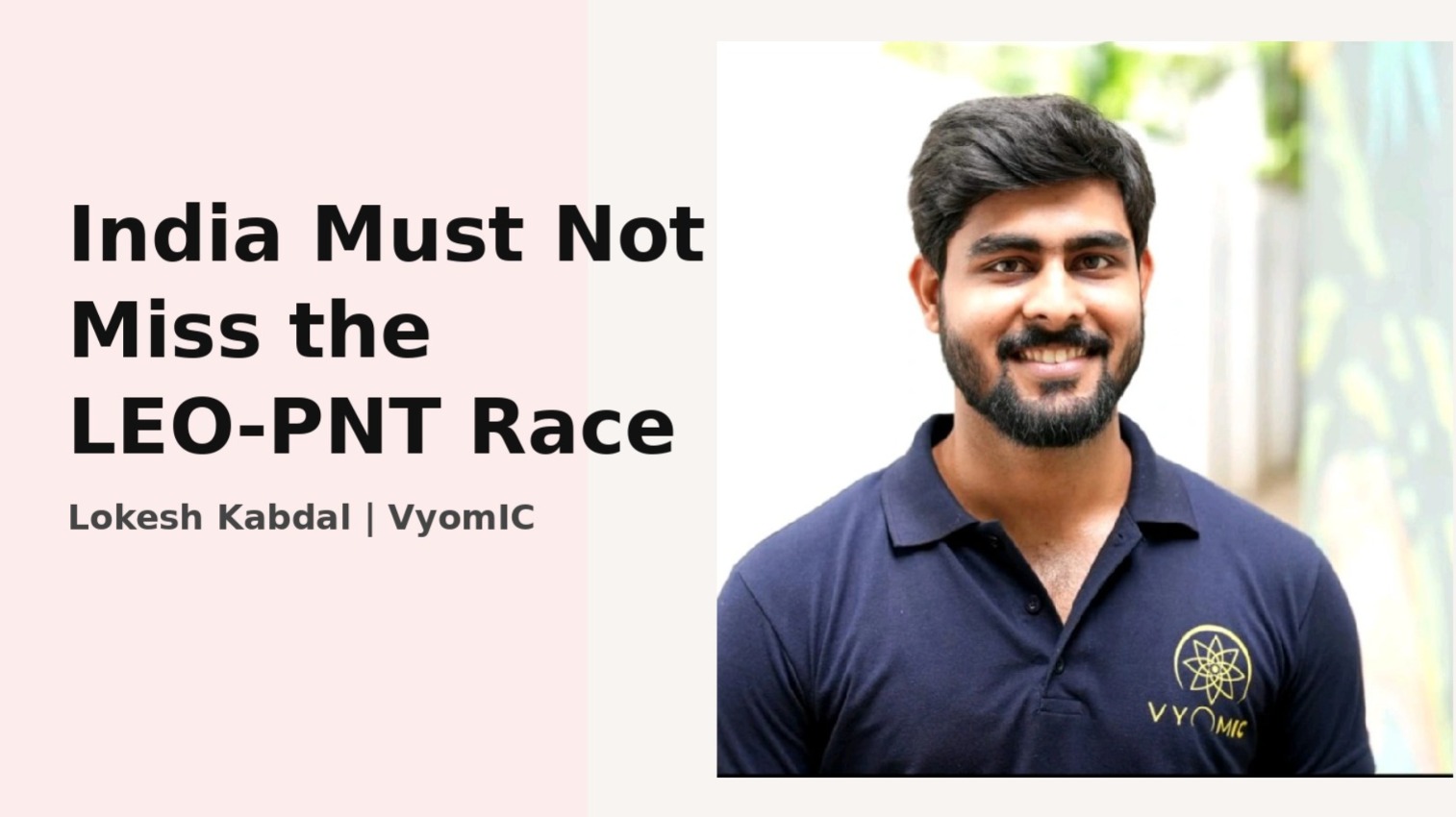
In a LinkedIn post published ahead of the launch of the LEO-PNT demonstrator Celeste, Lokesh Kabdal, Co-founder and CEO of VyomIC, argued that India cannot afford to remain a passive observer while other major powers move aggressively to build next-generation positioning, navigation and timing infrastructure.
His message was not framed as a routine comment on a launch. It was a broader warning about technological dependence, strategic timing, and the cost of arriving late in deep-tech sectors that are beginning to define future infrastructure.
According to Kabdal, Europe’s move signals a serious push toward next-generation PNT capabilities. What, in his view, makes the development notable is not only the technology itself, but the way Europe is approaching it: through close collaboration between government and private industry, with a clear focus on sovereign capability and early investment in infrastructure that could become foundational in the years ahead.
That observation sits at the heart of his argument. Nations that begin building early, he suggests, do more than participate in a new market. They help shape its standards, direction and strategic balance. Nations that wait often end up adapting to systems designed elsewhere.
A warning by Lokesh Kabdal against delayed entry
Kabdal’s post places Europe’s move in a wider global context. He notes that the United States, China and Europe are all moving quickly, with private-led deployments playing an important role in the LEO-PNT space. For India, he describes this as a “moment of clarity”.
The core choice, as he presents it, is stark: either India adopts systems built by others at a later stage, or it chooses to build, define and lead.
That line of thinking reflects a concern increasingly visible across strategic technology conversations in India. In sectors tied to infrastructure, security, autonomy and long-term industrial capacity, late entry is rarely neutral. It can create structural dependence that is difficult to reverse. Kabdal captures that in one of the sharpest lines from his post: in deep-tech domains such as this, “late adoption = long term dependence”.
The phrasing is direct, but the underlying concern is larger than one company or one launch cycle. It speaks to a recurring question in India’s innovation ecosystem: when a critical technology stack is emerging globally, should the country participate only as a user, or also as an originator?
More than a reaction to Europe
What gives the post weight is that it does not stop at describing Europe’s intent. It uses that moment to make a case for India’s own strategic urgency.
Kabdal says VyomIC sees this as a “generational opportunity” to contribute toward building a homegrown, resilient navigation layer from India, for the world. That language is important. It frames the opportunity not narrowly as a domestic substitute, but as a capability with international relevance.
The emphasis on resilience and homegrown development also suggests a larger aspiration: that future navigation systems should not be viewed only through the lens of technological novelty, but also through national capability, industrial depth and strategic independence.
His closing message is unmistakably political in tone, though rooted in industrial ambition: enough of dependence and late adoption; it is time to lead.
Even without stretching beyond the information in the post, the intervention stands out for its timing and clarity. Rather than celebrating a foreign milestone from a distance, Kabdal uses it to underline what is at stake for India.
His remarks reflect an increasingly visible confidence among Indian space and deep-tech founders, many of whom are no longer content with the country being seen only as a cost-efficient engineering base or a downstream adopter of global systems. The ambition, at least in this telling, is bigger: to participate in building original layers of critical infrastructure.
That is what makes the post feel less like a reaction and more like a positioning statement. It is not simply saying Europe is moving. It is saying India must decide how it wants to appear in the next chapter of technological competition: as a customer, a partner, or a leader.
For now, Kabdal’s post does not claim that India has already made that choice. But it does make one thing clear: for at least some voices in the country’s space-tech ecosystem, the window to decide is open now, not later.
Also Read: LetzRyd Secures $4 Million Series A Led by JIF Capital