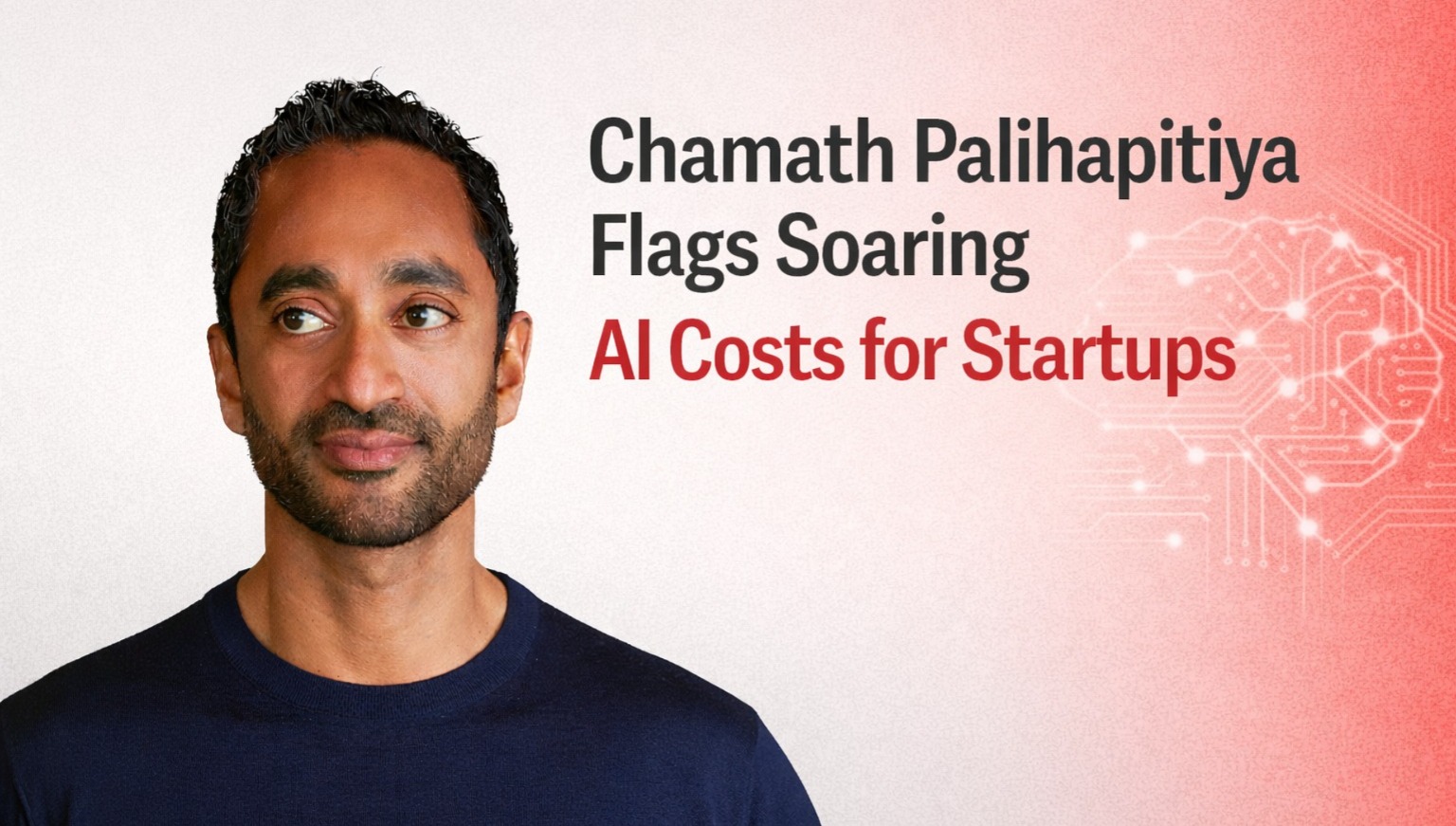
The AI industry’s revenue surge is now colliding with a harder question inside startups: who is actually capturing the value? In a post responding to Broadlume CEO Todd Saunders, Chamath Palihapitiya, CEO at Social Capital offered a blunt view from the buyer side of the market, saying his company’s AI spending has more than tripled since November 2025 and is now running into “many millions per year,” with a trajectory of more than $10 million annually.
That escalation, he said, feels “very scary” for a small startup.
Chamath Palihapitiya Questions AI ROI
The reason is not simply the size of the bill. It is the mismatch between cost and outcome. While leading AI companies may be seeing revenues “doubling and tripling every month,” Palihapitiya wrote that his own business is not seeing a comparable jump in productivity or revenue. The result, in his telling, is straightforward: AI spending is no longer an experimental line item. It is starting to pressure margins.
That comment lands at a moment when AI optimism is still being driven by dramatic success stories. Saunders had highlighted a built-in Claude Code command, /cost-estimate, which he said scans a codebase, cross-references market rates, and estimates what a project would have cost a traditional team to build. In his example, the math was startling: without AI, roughly 2.8 years and about $650,000; with AI, 30 hours.
It is exactly the kind of claim that has powered the market narrative around generative AI tools for developers. But Palihapitiya’s response introduced an uncomfortable counterpoint: even when the tooling looks miraculous in isolated examples, the economics at company scale can feel much less magical.
His concern appears to be twofold.
First, he suggested that some of the swelling cost may be driven by inefficient usage patterns rather than disciplined engineering. He said he is beginning to wonder how much of the spend is being consumed by models “running in Ralph loops on behalf of an engineer ambivalent to how much it costs,” adding that his suspicion is “a lot.”
That is an important shift in the conversation. For much of the last year, the public debate around AI coding assistants has focused on capability: how much faster engineers can ship, how much boilerplate can be automated, how quickly new features can be prototyped.
Palihapitiya’s comments pull attention toward utilization behavior. If developers are free to run expensive model loops without close cost accountability, the promised productivity gains can become harder to measure against ballooning infrastructure and tooling bills.
Second, he signaled that vendor choice is no longer just a product decision. It is becoming a financial and strategic one.
Among the decisions he said his company is now making, the clearest was a planned move away from Cursor. In his words, it is “just too expensive vs Claude Code.” He argued that Claude Code is effectively equivalent and that using its Pro plan can remove the kind of large token-consumption bills that build up in Cursor.
There was also a sharper subtext in that remark. Palihapitiya sarcastically thanked venture capital investors for funding “all you can eat token consumption through their huge investments,” a line that reads as both industry commentary and a warning. Subsidized usage can accelerate adoption and headline revenue, but it can also distort the true cost structure customers eventually have to absorb.
His second major takeaway was about architecture. He said his company needs greater flexibility to swap between models “without everything breaking,” framing that as both a cost-control requirement and a strategic hedge after “the events between Anthropic and DoW.”
The message that can be gleaned from this, even without further explanation, is that startups do not want to be pigeonholed as a model provider or a workflow. If the price model changes, the product model changes, or the vendor model becomes less secure, the dependency can easily translate to a potential point of failure. What was a convenience layer now becomes a potential point of failure.
A slide shared alongside the discussion reinforced the financial tone. Titled “Select OpEx Items,” it showed separate charts for “Inference” and “Coding Tools,” with visible ramps in spending over time. Even at a glance, the presentation underscored the same idea Palihapitiya was making in words: AI costs are no longer theoretical. They are showing up clearly inside operating expenses.
That is what makes this exchange more than a passing social-media complaint. It captures a widening split in the AI economy.
On one side are the vendors and platforms, posting fast growth and selling a vision of massive productivity compression. On the other are customers who are still trying to work out whether the invoices are translating into durable business value. The tension is not about whether AI can do useful work. It plainly can.
The tension is about whether the current cost curve is rational for smaller companies that do not have hyperscaler economics or venture-scale room for experimentation.
Palihapitiya’s comments also hint at what the next phase of AI adoption may look like. The first phase was enthusiasm: try the tools, scale usage, push teams to experiment. The next phase may be procurement discipline: measure ROI, cut redundant spend, choose cheaper equivalents, and build systems that can switch providers with minimal disruption.
That would be a notable shift for the developer tools market. If customers become more price-sensitive and less loyal to individual model ecosystems, companies selling AI coding and inference products may find that raw usage growth is not enough. They will have to prove that spend leads to measurable output, not just impressive demos or anecdotal time savings.
For now, the most striking thing about Palihapitiya’s post is not that AI works. It is that even believers are starting to ask whether they are overpaying for it.
That question may matter more than any revenue ramp.
Also Read: Sundar Pichai Could Earn Up to $692 Million Under Alphabet’s New Pay Plan