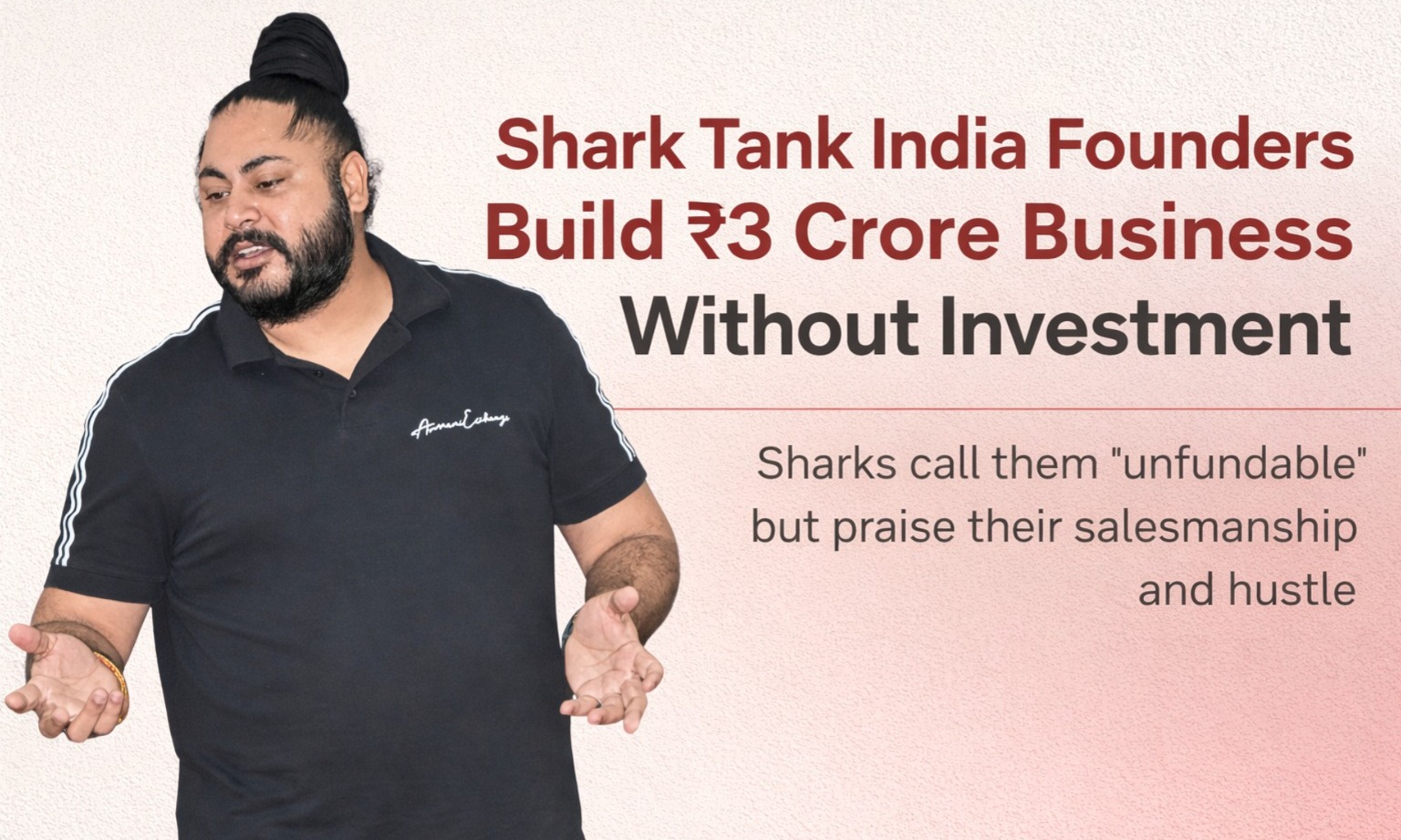
A pitch can win the room and still lose the investment. That is what played out on the latest episode of Shark Tank India 5, where Bareilly-based founders Harpreet Singh and Abhinav Awal brought F2 Fintech to the panel with a confident ask: Rs 1 crore for 3 percent equity, valuing the company at Rs 33.33 crore.
The founders presented F2 Fintech as an AI-powered digital lending aggregator designed to help users compare loan options. Their pitch positioned the business as a technology-led play in a fast-growing fintech space, with an AI bot meant to guide customers toward the most suitable lending option. But while the idea drew attention and the founders’ sales ability earned repeated praise, the business itself did not convince the sharks.
That contrast became the defining theme of the episode.
Shark Tank India: Founders Win Praise, But Face Hard Questions
From the outset, the founders were able to hold the panel’s attention. Their communication skills, confidence and salesmanship stood out, and several sharks acknowledged that. Viraj Bahl praised Harpreet’s selling ability, while Namita Thapar called him a “fabulous salesman” after he cleverly personalized parts of the interaction and made her “feel very special.”
But the real scrutiny began once the conversation shifted from pitch energy to business fundamentals.
Kunal Bahl raised the first sharp question: if this was, at its core, a commission-led business, what truly differentiated it from others already operating in the space? That concern soon opened up a broader discussion around whether F2 Fintech was really a tech platform with scalable advantages, or a business still heavily dependent on offline telecalling.
The founders said they planned to reduce that dependence by replacing telecalling efforts with AI. That, however, did not settle the panel’s doubts. Varun Dua responded with a larger concern about the implications of such automation, saying that if this model were adopted at scale, it could affect jobs in voice-based work. The remark added another layer to the debate: not just whether the model could grow, but what kind of business it actually was.
The numbers shared by the founders gave the sharks more to think about, but not enough to invest. The company said it had done Rs 20 lakh in business in FY22. In 2023-24, it reported revenue of Rs 3.5 crore with EBITDA of Rs 21 lakh. In 2024-25, it posted sales of Rs 3.73 crore with EBITDA of Rs 28 lakh. The founders also said year-to-date revenue stood at Rs 3.5 crore, with projected EBITDA of Rs 45 lakh by year-end.
Those figures suggested traction. They also suggested that the founders knew how to build and sell. Still, the sharks were not persuaded that the business had the kind of scalability, margins or clarity required for venture-style investing.
Kunal Bahl was direct. He said he liked the founders’ sales energy and the fact that they had identified a segment, but added that he did not see the business as venture fundable. His central point was blunt: many businesses are trying to integrate AI, but F2 Fintech still appeared to rely heavily on offline telecalling.
Varun Dua echoed that view. He said the founders were clearly strong salespeople and solid business drivers, but he did not see the company as an investible venture in its current form. He suggested the business could still be profitable for the founders themselves, even if it was unlikely to attract future rounds of outside investment.
Viraj Bahl took a similar line, saying the business could flourish but did not look like the kind of company built for a fundable exit.
Namita Thapar, despite appreciating the pitch and the founders’ ability to connect, also stepped away. Her feedback cut to the heart of the panel’s hesitation: fintech may be one of India’s biggest stories, but a commission-driven model with questions around scale is a harder bet. In her view, talent alone was not enough to bridge that gap.
Vineeta Singh’s concern was slightly different, but pointed in the same direction. She said the pitch initially created the impression of a digital, comparison-led tech platform. As the discussion progressed, however, she came away seeing it as a calling-based business rather than a truly digital one. She also said she was not comfortable with the numbers and did not feel she had enough trust and transparency to proceed.
In the end, all the sharks opted out.
That outcome may sound harsh, but the episode offered a more interesting lesson than a simple rejection story. F2 Fintech was not dismissed because the founders lacked drive. Quite the opposite. The panel repeatedly acknowledged their hustle, persuasion and raw selling strength. What held them back was the gap between a compelling pitch and a business model that investors could see scaling cleanly.
That is often where startup storytelling meets startup reality.
The founders walked in as strong operators with evident market energy. They walked out without a cheque, but not without validation. The sharks did not question their ability to sell. They questioned whether the business, as currently built, could become a venture-backed winner.
And that may be the sharpest takeaway from the episode: in startup investing, charisma can open the door, numbers can keep the conversation alive, but scalability is what decides who gets funded.
Also Read: Edorica Luxury Skincare: India’s Rising Clean Beauty Brand