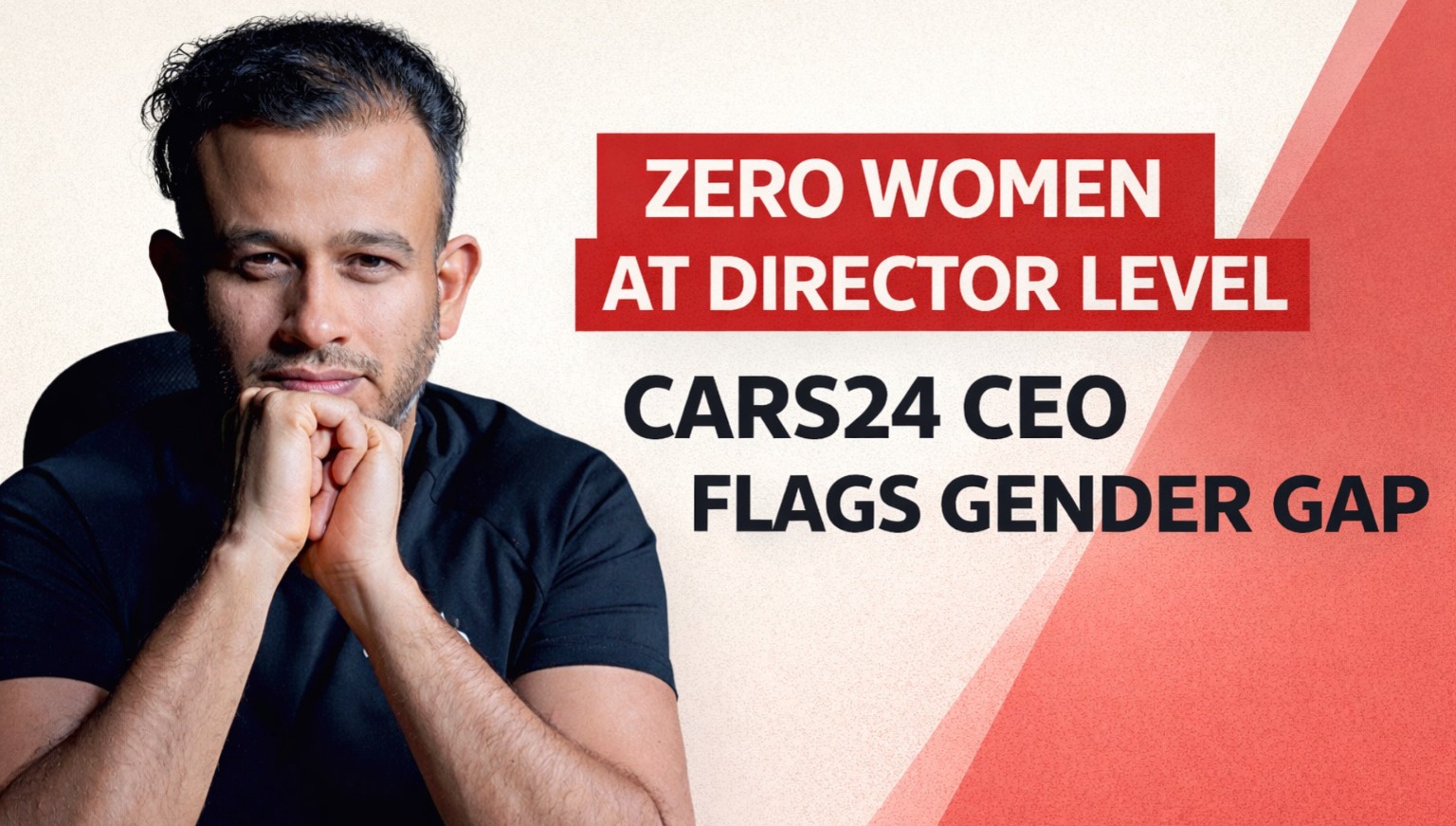
In a candid public reflection on gender representation at Cars24, founder and CEO Vikram Chopra has acknowledged a stark leadership gap within the company’s India workforce, saying the absence of women at the Director level points to a deeper structural issue rather than a simple hiring challenge.
Chopra revealed that Cars24 has 6,803 employees in India, of whom 951 are women, translating to roughly 14% female representation. More strikingly, he said that at the Director level (B6), there are zero women.
The admission came not as a polished diversity statement, but as a moment of visible discomfort and introspection. Chopra said he had been “sitting with this number for a few days,” and made it clear that the issue cannot be explained away as a weak hiring pipeline alone.
“We Lose Them Midway”: Vikram Chopra, Cars24 CEO
“We do hire women. Entry-level representation is meaningfully better. But somewhere between mid-management and senior leadership, we lose them,” he said, framing the gap as a systems problem rather than a recruitment problem.
That distinction matters. In many companies, diversity conversations tend to focus on hiring numbers at the entry level. Chopra’s post shifts attention to a harder question: who actually grows inside the organisation, who gets promoted, and who remains in the system long enough to lead.
He put that bluntly in his post: culture is not what appears on a careers page, but “who grows here,” “who gets promoted,” and “who stays.”
The most arresting part of the message was not the data itself, but the question Chopra asked of his own company: what has Cars24 built, intentionally or otherwise, that makes it hard for women to lead at scale?
He did not claim to have the answer. In fact, he explicitly said he does not have a “clean answer” and is not interested in “easy ones.”
Instead, Chopra said that what he is focusing on is a listening exercise. In the run-up to Women’s Day, Chopra said that he had invited senior women leaders, especially from the tech, operations, product, business, and field-heavy industries, to share their honest opinions on three topics: what would make a company like Cars24 worth considering, what makes leadership culture enabling as opposed to exhausting, and what kinds of structural changes make a real difference to retention and promotion as opposed to just hiring.
This is important because what Chopra’s questions seem to be saying is that Cars24 is, at least publicly, willing to confront the fact that their leadership culture may be filtering women out before they can move up the career ladder.
To take that discussion further, Chopra said he plans to host small roundtables, both virtual and in-person, with women leaders across industries over the coming weeks. According to him, the purpose is not to “check a box,” but to listen, learn, and redesign systems that are “clearly not working.”
The post stands out for another reason: accountability. Rather than outsourcing the problem to HR language or broad industry trends, Chopra ended with a direct line, “This one is on me.”
That closing matters because leadership gaps are often discussed in passive terms, as though they emerge on their own. Chopra’s wording instead places responsibility at the top, where decisions on culture, performance, promotion, and leadership pathways ultimately converge.
His post also carries a larger message about ambition. “We cannot build a category-defining company if leadership looks like a narrow slice of society,” he wrote, adding that talented women should not only join Cars24, but rise within it.
Whether that introspection leads to measurable change will depend on what follows: not just conversations, but systems that reshape advancement. Still, the post has opened a conversation many companies avoid having in public, not whether they hire women, but why so few make it to the top.
For a founder to publicly admit that the leadership bench has no women at Director level is rare. For a CEO to call that a system failure, and then invite scrutiny before offering excuses, is rarer still.
At a time when corporate statements around inclusion can often feel rehearsed, Chopra’s message lands because it is unfinished. It does not present resolution. It presents a problem, acknowledges discomfort, and asks to be challenged.
That may not be the full answer. But it is, at the very least, a real beginning.
Also Read: Sundar Pichai Could Earn Up to $692 Million Under Alphabet’s New Pay Plan