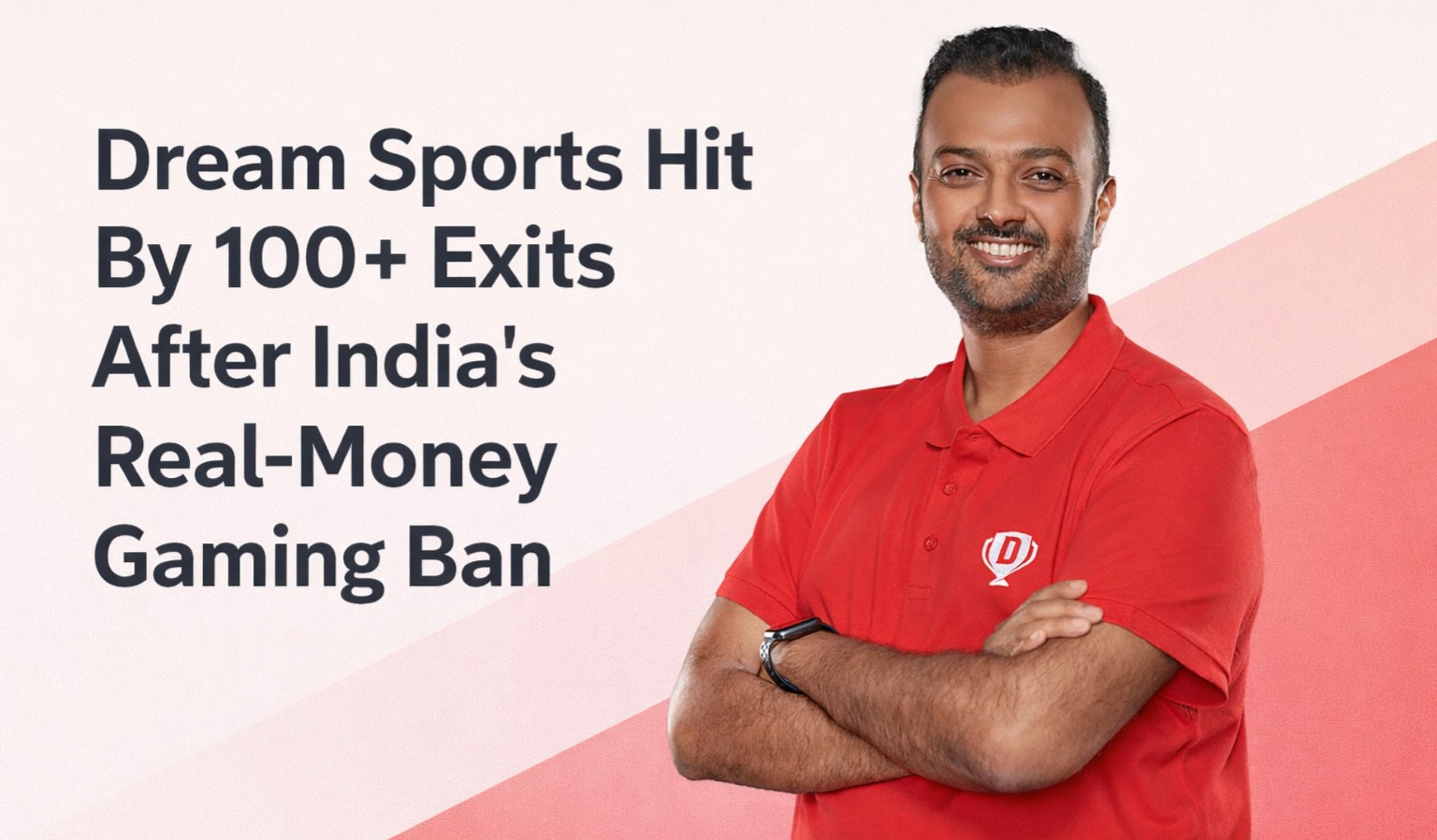
Dream Sports, the parent company of Dream11, has seen more than 100 employees leave after a major internal restructuring triggered by India’s ban on real-money online gaming, according to details reported on March 12. The company said the overhaul came after the new law sharply hit its core business and forced it to rethink how it operates.
The pressure point is clear. After the government’s online gaming law came into force in August 2025, games that allowed users to deposit money with the expectation of winnings were prohibited. Dream Sports said the move wiped out around 95 percent of its revenue and all of its profits from the fantasy gaming side of the business.
That shock has now translated into a visible workforce churn.
Dream Sports Rebuilds After Gaming Ban Shock
As part of the reset, Dream Sports split its operations into eight independent startup-style units in December and redistributed a large part of its workforce across them. Around 700 employees were assigned to these new ventures based on their experience and interests. But roughly 15 percent chose to leave instead, taking the total number of exits to well over 100.
In the company’s explanation, the departures were not framed as a conventional layoff cycle, but as a consequence of a culture shift. Dream Sports said some employees were more experienced in running scaled businesses than in operating in an early-stage startup environment, and therefore chose to move on to larger companies or start ventures of their own.
That distinction matters because Dream Sports is trying to present this phase not simply as contraction, but as reinvention.
The company said its attrition is only slightly above the roughly 10 percent level it saw before the ban. It also said it currently has close to 950 employees and is not hiring new staff for now, with its immediate focus on retaining the people who remain.
What has emerged is a company trying to move away from dependence on fantasy gaming and reposition itself more broadly as a sports entertainment platform. The new structure includes Dream11, FanCode, DreamSetGo, Dream Cricket and Dream Sports AI. The AI arm includes Dream Play and RushLine, while other units include Dream Money, Dream Horizon and the Dream Sports Foundation.
This is a substantial pivot for a company that spent years building scale on the back of fantasy sports. Now, instead of one large operating engine, Dream Sports is betting on multiple focused verticals, each expected to function with the speed and discipline of a startup.
The company has also taken visible cost-control steps. It shifted its headquarters from Bandra Kurla Complex to Worli earlier this year, saying the new Dream Sports Stadium office brings teams from its various brands together for the first time and is expected to improve collaboration and operational efficiency.
Earlier comments from CEO Harsh Jain also suggest the company knew the transition would not suit everyone. He had said bonus lock-in timelines were removed for employees who joined in recent years, allowing those who wanted to leave to exit with pro-rata payouts. His message was direct: Dream Sports wanted people fully committed to what he described as “startup mode.”
Founded in 2008 by Harsh Jain and Bhavit Sheth, Dream Sports was last valued at $8 billion after raising $840 million in 2021 from investors including Falcon Edge, DST Global, D1 Capital, Redbird Capital, Tiger Global, TPG and Footpath Ventures.
That background makes the current moment more striking. A company once seen as one of the biggest names in Indian fantasy sports is now rebuilding under regulatory pressure, with its original revenue model severely damaged and its future tied to whether its new businesses can mature fast enough.
The broader significance goes beyond Dream Sports. The Promotion and Regulation of Online Gaming Act, 2025 effectively halted fantasy gaming formats dependent on paid participation, forcing several gaming companies to either shut down or radically alter their business models. In Dream Sports’ case, that has meant fewer employees, a new structure, tighter costs and a much broader identity than the one that made it famous.
For now, the company’s story is no longer just about fantasy sports. It is about survival after regulation, and about whether a scaled consumer-tech business can successfully return to startup mode when the market gives it little choice.
Also Read: Suniel Shetty steps into startup spotlight with ‘Bharat Ke Super Founders’