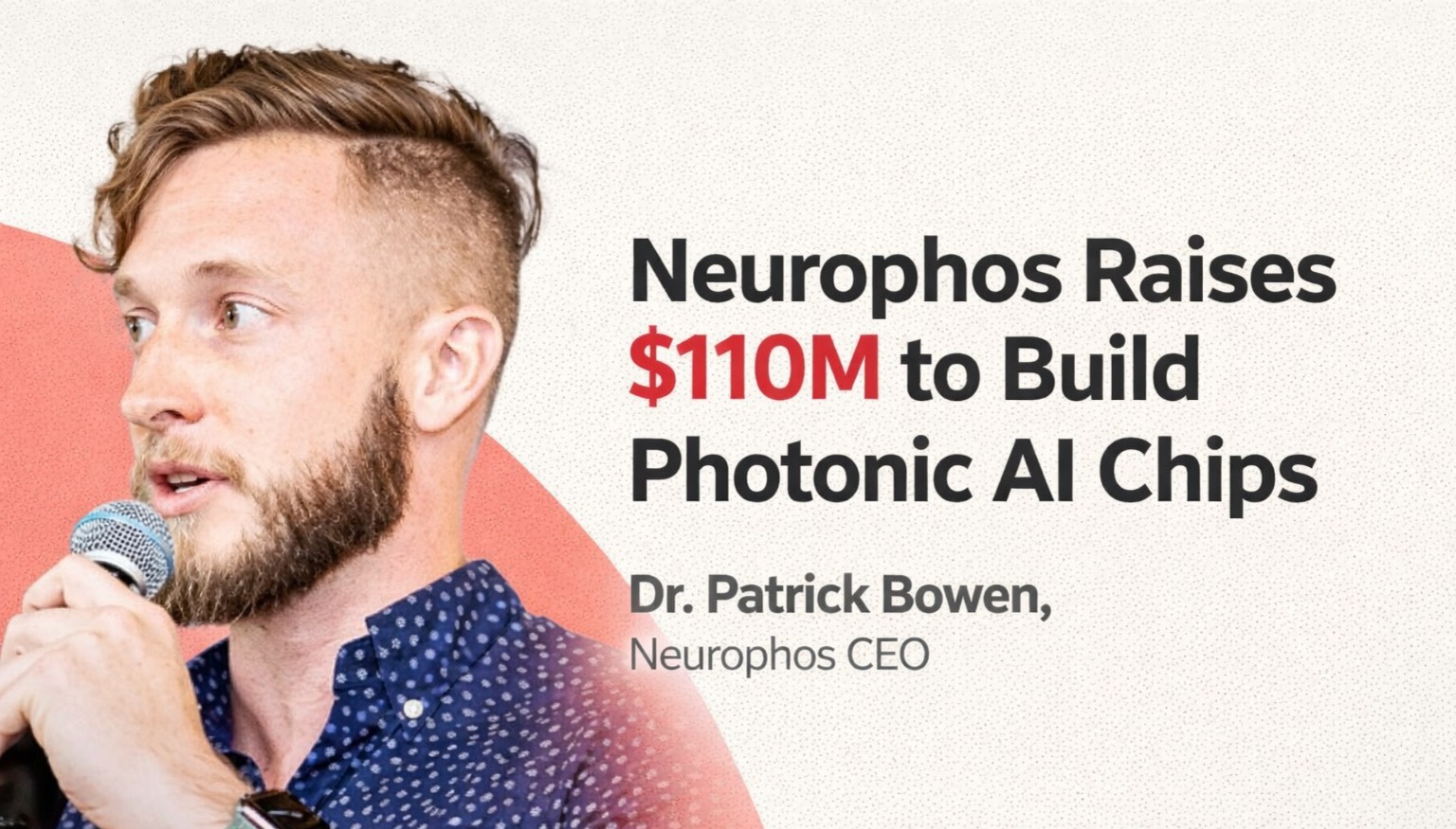
Austin-based photonics startup Neurophos has raised $110 million in a Series A as it bets that the next big leap in AI infrastructure won’t come from squeezing more transistors onto silicon, but from doing more of the heavy math with light.
The round was led by Gates Frontier (Bill Gates’ venture firm), with participation that includes M12 (Microsoft’s venture fund), Carbon Direct, Aramco Ventures, Bosch Ventures, Tectonic Ventures, Space Capital, and others. Photonics Spectra described the raise as oversubscribed and said it brings Neurophos’ total funding to $118 million.
Neurophos’ pitch is straightforward: AI inference (running trained models) is turning into a massive power-and-compute sink, and today’s data centers, dominated by silicon GPUs are hitting uncomfortable limits.
The company says its approach can deliver a step-change in performance-per-watt by shrinking optical components dramatically and packing them densely onto a chip.
What Neurophos is building?
At the core of Neurophos’ design is a “metasurface modulator” that the company says can act like a tensor-core-style processor for matrix-vector multiplication, a foundational operation in AI workloads, especially inference.
Neurophos describes its device as roughly “10,000 times” smaller than traditional optical transistors, which is crucial because optical components have historically been too large and too hard to manufacture at scale.
That miniaturization matters for a practical reason: the more computation you can keep in the optical domain, the less you’re forced to bounce back and forth between optics and electronics, where conversion overhead can eat power and space.
Neurophos CEO and co-founder Dr. Patrick Bowen put it plainly in comments reported by TechCrunch: shrinking the optical transistor lets you “do way more math in the optics domain” before converting back to electronics .
The Performance Claims
Neurophos is making eye-catching comparisons, while still framing them as the company’s own claims.
Neurophos says its chip can run at 56 GHz, reaching a peak 235 Peta Operations per Second (POPS) while consuming 675 watts. In the same comparison, the company contrasts Nvidia’s B200 at 9 POPS and 1,000 watts.
Separately, Photonics Spectra reports that Neurophos’ OPU integrates more than 1 million micron-scale optical processing elements on a single chip, and that this “delivers up to 100× the performance and energy efficiency of current leading chips,” positioning the product as a “practical drop-in replacement for GPUs in data centers”.
The company is also candid that photonic chips aren’t a new idea, the industry has long known that light can run cooler and move fast, but has struggled with component size, manufacturing, and conversion requirements. Neurophos’ bet is that extreme miniaturization changes the economics and the engineering.
A Duke University research thread that now points at data centers
One of the more unusual parts of Neurophos’ story is how it traces back to academic work on metamaterials.
TechCrunch links the company’s lineage to Duke University research led by professor David R. Smith, known for using metamaterials in early “invisibility cloak” demonstrations (limited to concealing objects from a single microwave wavelength). Neurophos is described as being spun out of Duke University and Metacept, an incubator run by Smith.
That thread matters because Neurophos says it’s applying metamaterials know-how to a more commercial, urgent problem: scaling AI compute without letting power consumption spiral.
Microsoft’s interest, early customers and a long road to shipping
Neurophos says it has already signed multiple customers, though Bowen declined to name them, and that companies including Microsoft are “looking very closely”.
But even with strong investor backing, Neurophos isn’t pretending this is a quick sprint. TechCrunch notes the company expects its first chips to hit the market by mid-2028.
That timeline lands in a market where Nvidia is the incumbent force, and where other photonics-focused companies exist, with some (TechCrunch mentions Lightmatter) pivoting toward interconnects rather than full compute. In other words, Neurophos isn’t just selling better hardware; it’s trying to convince data centers to adopt a new compute paradigm.
How Neurophos says it will manufacture photonic compute at scale
A major historical knock against photonic compute has been manufacturability. Neurophos claims it can address that by building chips with standard silicon foundry materials, tools, and processes a notable point, because anything that can ride existing fabs and supply chains has a better shot at scaling.
Where the new money goes next?
The company says the fresh funding will accelerate development of its first integrated photonic compute system, including data center-ready OPU modules, a full software stack, and early-access developer hardware . It’s also expanding its Austin headquarters and opening a San Francisco engineering site.
Microsoft’s Dr. Marc Tremblay, corporate vice president and technical fellow of core AI infrastructure, said in a statement: “Modern AI inference demands monumental amounts of power and compute… We need a breakthrough in compute on par with the leaps we’ve seen in AI models themselves”.
Neurophos is entering one of the costliest areas in the world of artificial intelligence, which is scaling inference, or how much power every rack can deliver. Neurophos’s backstory is that photonics is a technology that’s always had the potential for better performance but needed a miniaturization push that its metamaterial-based modulators now offer.
Whether those claims hold up in real-world deployments will take time and the company itself is signaling that the real test arrives closer to mid-2028 . But the size of the Series A, the named strategic interest, and the focus on data center-ready modules make the direction clear: AI’s next hardware wave may not be just “more silicon,” but entirely new ways to compute.
Also Read: Teen duo turns Thekua into ₹1 Cr brand with Shuddh Swad