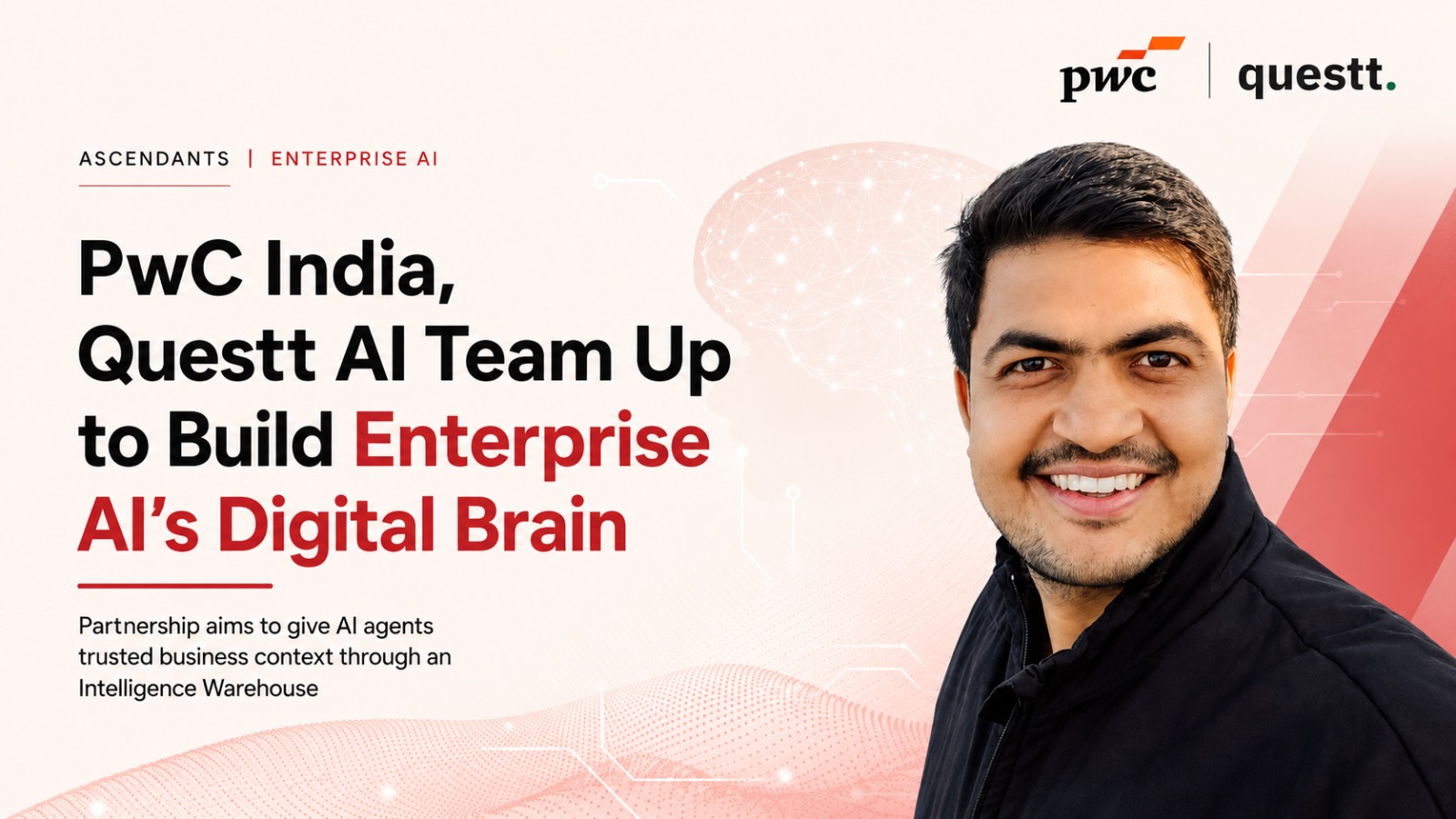
Gurugram, July 15, 2026: PwC India and Questt AI have entered into a partnership aimed at helping companies build a trusted knowledge foundation for enterprise artificial intelligence.
At the centre of the collaboration is Questt AI’s Intelligence Warehouse, or IW, a platform designed to organise a company’s operational knowledge into a persistent and searchable layer. The companies describe this layer as a “digital brain” that can help AI agents understand how an organisation works instead of relying on isolated data or incomplete signals.
The partnership addresses a practical challenge facing businesses that want to use AI agents for important operational decisions. Although AI models can process large volumes of information, they may not understand a company’s internal structures, decision frameworks, processes, metrics and institutional knowledge. Much of that context remains scattered across systems, teams and the experience of senior employees.
Without this organisational context, AI-generated recommendations may still require significant human review. PwC India and Questt AI intend to help companies bring fragmented information, business rules, previous decisions and institutional judgement into a governed knowledge layer that authorised AI systems can query.
Moving enterprise AI beyond access to data
Sanjay Dawar, Partner and Leader, One Consulting at PwC India, said AI agents need more than access to corporate data to produce meaningful business results.
According to Dawar, an agent must also understand how the organisation operates, including knowledge distributed across processes, systems and experienced business leaders. He said the combination of PwC India’s transformation capabilities and Questt AI’s platform could give organisations a more consistent and trusted layer of institutional intelligence.
The approach is intended to preserve not only information, but also the reasoning and context behind business decisions.
Sachin Arora, Partner, AI Advisory at PwC India, compared the need for organisational context to the maps people use when navigating an unfamiliar city. He said enterprise AI agents similarly require institutional memory that records knowledge, reasoning and decision-making processes. Without that foundation, he cautioned, AI agents may produce unreliable answers and cannot be trusted with business-critical decisions.
Questt AI’s Intelligence Warehouse is designed to turn this institutional memory into a structured and queryable model. The objective is to give AI agents a reliable understanding of the organisation before they are deployed across business functions.
PwC India to support implementation and organisational change
PwC India’s role will extend beyond introducing the technology. The firm plans to work with business leaders and subject-matter experts to capture institutional knowledge, adapt it to the requirements of individual industries and redesign workflows around AI-enabled methods of working.
This distinction is important to the partnership’s stated approach. Rather than placing AI tools on top of existing processes without changing how work is organised, the companies plan to examine how workflows can be redesigned to make practical use of enterprise AI.
PwC India will contribute industry knowledge, functional experience and change-management capabilities across areas including finance, supply chain, marketing and operations. Questt AI will provide the technology used to capture and govern the underlying enterprise knowledge.
Questt AI focuses on knowledge held by experienced employees
Akhil Singh, founder and chief executive of Questt AI, said the missing element in many enterprise AI projects is not model capability but company-specific context.
He said important operational knowledge often remains with people who have managed businesses for years. Questt AI’s platform is designed to capture that knowledge through engagement with employees, rather than depending only on information extracted from existing corporate data systems.
Singh said the PwC India partnership would help deploy this knowledge layer within enterprises while supporting the wider organisational change needed for adoption. He also said the platform could establish a company’s digital knowledge foundation within weeks, allowing future AI agents to use that context from the beginning of their deployment.
Building a shared foundation for future AI agents
The collaboration reflects a shift in enterprise AI projects from experimenting with individual tools to developing a common knowledge foundation that can support multiple AI agents.
Under the proposed model, companies would not need to recreate organisational context each time a new agent is introduced. Instead, different agents could draw from the same governed representation of business processes, rules and institutional knowledge.
PwC India and Questt AI said the partnership is intended to support AI adoption at scale while improving the accuracy, consistency and relevance of AI-assisted business outcomes. The companies have not disclosed financial terms, customer names or specific deployment commitments.
Also Read: From a Stranded Shipment to a Magnet-Free Motor: Vimag Labs Takes on EV Supply Risk