

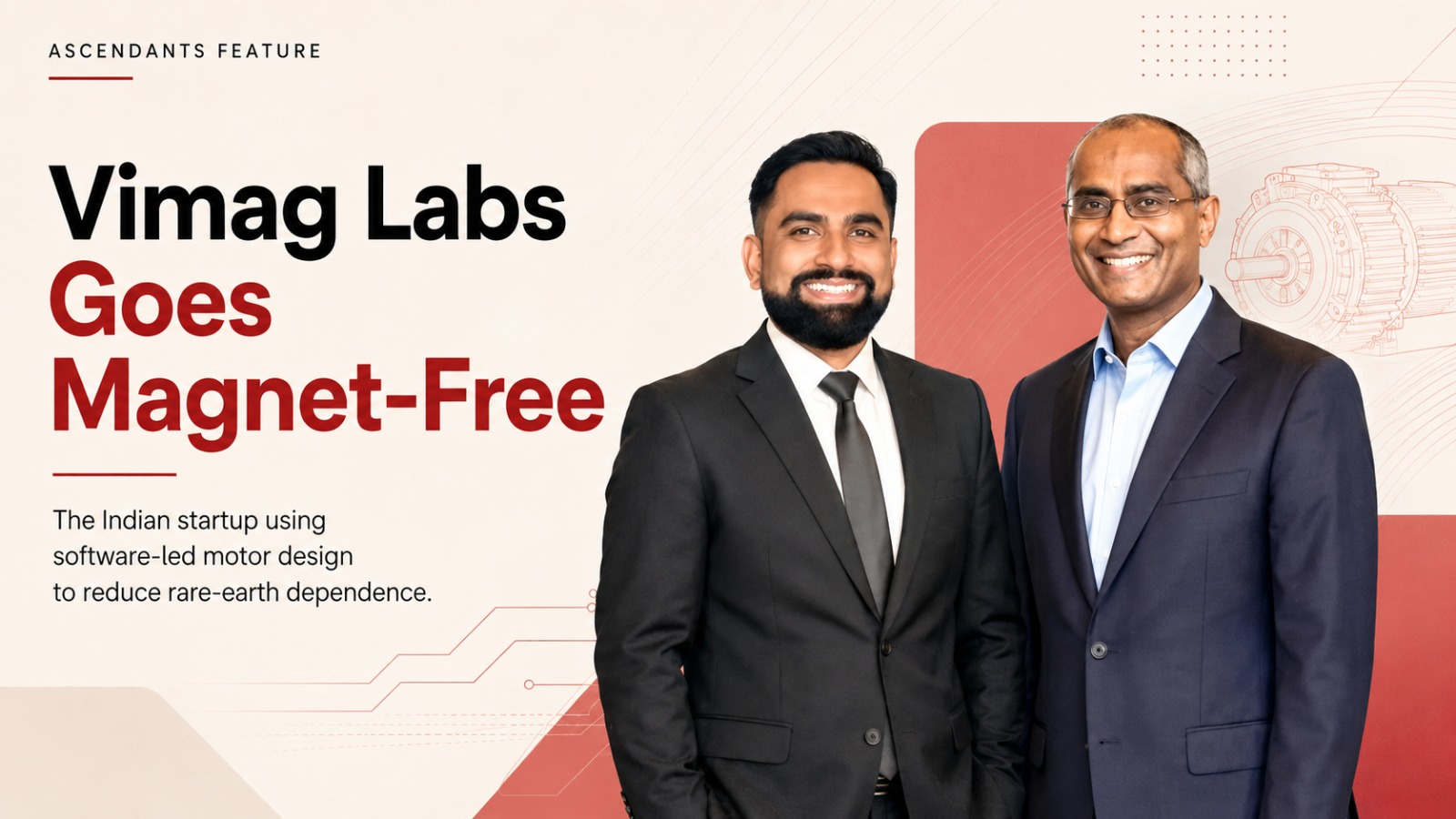
Bengaluru: The idea behind Vimag Labs’ magnet-free electric motor did not begin with a planned research breakthrough. It emerged from a supply-chain failure.
During the first wave of the Covid-19 pandemic in 2020, a shipment of magnets needed for the Bengaluru startup’s prototype motors was held at a locked-down port in Shanghai. The shipment remained stuck for three months, leaving the company without a component that was central to its development work.
For Manish Seth, chief executive and co-founder of Vimag Labs, the delay exposed a deeper weakness in the electric-vehicle industry. A manufacturer could design a motor, build a team and prepare a prototype, yet still be brought to a halt by the absence of imported permanent magnets.
Seth, who had previously worked on manufacturing facilities for companies including Volkswagen, Ford and General Motors, decided to pursue a motor that would not need rare-earth magnets at all. That decision led to what the startup now calls its Virtual Magnet Synchronous Motor, or VMSM.
Why permanent magnets matter to electric vehicles
In an electric vehicle, the motor and its control system play a major role in determining torque, acceleration, efficiency and driving range. Many high-performance EV motors use permanent magnets made from materials such as neodymium, iron and boron.
The supply chain for these magnets is highly concentrated. Figures cited by India Today from the International Energy Agency place China’s share at roughly 90 per cent of global rare-earth mineral supply and about 94 per cent of the magnets used in high-power electric motors.
This concentration creates a risk for vehicle manufacturers outside China. Export restrictions, price movements or shipping disruptions can affect production even when other parts of the vehicle are ready.
Alternative motor technologies already exist, including induction motors and switched-reluctance motors. Ferrite magnets can also reduce the use of rare-earth materials. However, Seth argues that these options can involve compromises in motor size, power, torque or efficiency.
Vimag Labs is attempting to avoid that trade-off by using a combination of conventional materials and software-controlled electromagnetic fields.
A motor that creates its magnetic field through software
Instead of installing permanent magnets inside the rotor, Vimag Labs uses copper coils and steel. The coils become electromagnets when they receive precisely controlled electrical power.
The company describes this arrangement as a “software-defined magnet”. Its firmware controls the magnetic field inside the motor and adjusts it while the motor is operating.
Power is transferred within the motor without relying on conventional brushes or slip rings, according to Seth. The company’s architecture uses electromagnetic induction to energise the rotor coils, while software manages the strength and behaviour of the resulting field.
In practical terms, the motor does not carry a fixed magnetic field created by a permanent magnet. It produces the field electronically when required.
Vimag Labs says this approach can deliver performance comparable to a Permanent Magnet Synchronous Motor. Seth also claims that real-time control of the magnetic field can improve efficiency and provide a modest increase in vehicle range.
Those performance claims have not been accompanied by publicly disclosed test data in the material available for this report. They should therefore be understood as statements from the company rather than independently established results.
Software could change how a motor ages
Permanent magnets can lose strength after prolonged exposure to heat or as they age. Once that happens, restoring motor performance may require physical repair or replacement.
Vimag Labs says its electronically generated magnetic field can be adjusted through software. Seth believes this could allow the company to tune motor behaviour over time and introduce improvements through over-the-air software updates without replacing the underlying hardware.
The same flexibility could help engineers modify the motor for different vehicle requirements. A two-wheeler, commercial three-wheeler, passenger car or heavy vehicle may require a different balance of torque, speed and efficiency. Software control could allow part of that behaviour to be changed without redesigning every mechanical component.
However, the additional electronics also make integration more complex. Seth said fitting the system into a vehicle can take about four months, compared with roughly two months for a conventional permanent-magnet motor, because other vehicle components must be adapted to work with it.
Reducing dependence rather than increasing mineral production
India has rare-earth deposits, but extracting usable material is only one part of the challenge. Refining rare-earth ore involves complex chemical processing and can produce hazardous waste, including radioactive thorium.
Building a large domestic refining ecosystem would require significant time, investment, technical capability and environmental safeguards. Seth estimates that developing such an ecosystem in India could take around 15 years.
Vimag Labs is taking a different route. Instead of trying to create an alternative rare-earth supply chain, it is attempting to remove rare-earth magnets from the motor design.
The company says its motor can currently be produced in India using copper, steel and conventional power electronics. That does not make the system free from international supply-chain exposure, since it still depends on semiconductor components. It does, however, shift the dependency from rare-earth magnets to electronics.
Seth expects semiconductor availability and manufacturing capacity to expand over time, while rare-earth supplies may remain more constrained and politically sensitive.
Commercial trials have started, but customers remain unnamed
Vimag Labs has secured five Indian patents related to its motor platform. At present, the company believes the technology makes the strongest economic case in drivetrains rated above roughly 3 to 5 kilowatts. That makes it better suited to electric scooters, motorcycles, three-wheelers and larger vehicles than to low-speed electric bicycles.
Seth said the company is testing its technology with a manufacturer ranked among India’s five largest electric two-wheeler sellers. He also referred to discussions with another company among the top two in the segment.
Vimag Labs has also worked with what Seth described as a premium Indian heritage brand that has entered the EV market. The company says it has partnered with a powertrain supplier active in the commercial three-wheeler sector and is co-developing an EV platform with a major Indian passenger-car manufacturer.
In Europe, it is working with a Tier 1 automotive supplier on possible applications in premium European and American electric cars, according to Seth.
These partnerships and trials indicate commercial interest, but the absence of customer names and published validation results makes it difficult to assess the stage or outcome of each programme.
From prototypes to production
Seth said Vimag Labs’ products have entered real-world use and can be purchased, although production remains limited. The company expects to ship between 1,000 and 10,000 motors by the end of 2026.
That is a broad target range, reflecting the uncertainty that often accompanies the early manufacturing stage of a hardware startup.
The company previously raised $5 million in a Series A funding round led by Accel and is preparing for another investment round. It has also partnered with manufacturing-automation company Jendamark to develop specialised assembly lines.
Vimag Labs employs 22 engineers across design centres in India, the United States and Europe. Seth said its development process incorporates the ISO 26262 automotive functional-safety framework and United States cybersecurity requirements.
The next bottleneck may be the chip
Although the motor does not use permanent magnets, it still relies on microcontrollers supplied by global semiconductor manufacturers such as Texas Instruments, STMicroelectronics and Renesas.
Most commercially available motor-control chips have been developed for conventional permanent-magnet motors. Vimag Labs must therefore use general-purpose computing resources to operate its different control architecture.
To address that limitation, the company plans to design an application-specific integrated circuit, or ASIC, tailored to its virtual-magnet system.
Vimag Labs estimates that a custom chip could reduce the bill of materials for the motor’s electronics by nearly 90 per cent. This remains an internal projection, and the company has not disclosed a completed chip or independent cost assessment.
Designing proprietary silicon would also require substantial investment, specialist talent and access to semiconductor manufacturing capacity. It could lower costs in the long term, but it introduces another demanding development programme alongside the task of scaling motor production.
Beyond scooters and three-wheelers
The startup is developing prototypes for electric trucks and heavy buses, where high torque is required without excessive motor weight.
Its research also includes alternative conductor materials that could reduce dependence on copper, vehicle-to-grid power systems and high-voltage silicon-carbide electronics. The company is exploring whether parts of its power-electronics work could be applied to cooling systems for artificial-intelligence data centres.
Seth has also referred to discussions with the Ministry of Electronics and Information Technology regarding possible magnet-free systems. Potential defence applications are being considered, although the company is prioritising the expansion of its commercial products before entering a sector with longer development and certification timelines.
A promising idea that still faces a manufacturing test
Vimag Labs has identified a genuine industrial vulnerability: high-performance electric vehicles depend heavily on a supply chain concentrated in one country.
Its answer is not to replace one rare-earth supplier with another. It is to redesign the motor so that permanent magnets are no longer required.
The concept is technically ambitious and strategically relevant.
Yet the company’s larger claims, including higher efficiency, improved range, lower electronics costs and adoption by major manufacturers, will ultimately need to be demonstrated through published performance results, vehicle certifications and sustained production volumes.
For now, Vimag Labs has moved beyond a laboratory idea. It has patents, prototypes, funding, industry trials and early production plans. The next stage will determine whether its software-created magnetic field can perform not only inside a motor, but also under the cost, reliability and scale pressures of the global automotive industry.
Also Read: Pankaj Pawar Takes Charge as Jio Platforms CEO Ahead of Proposed IPO
















