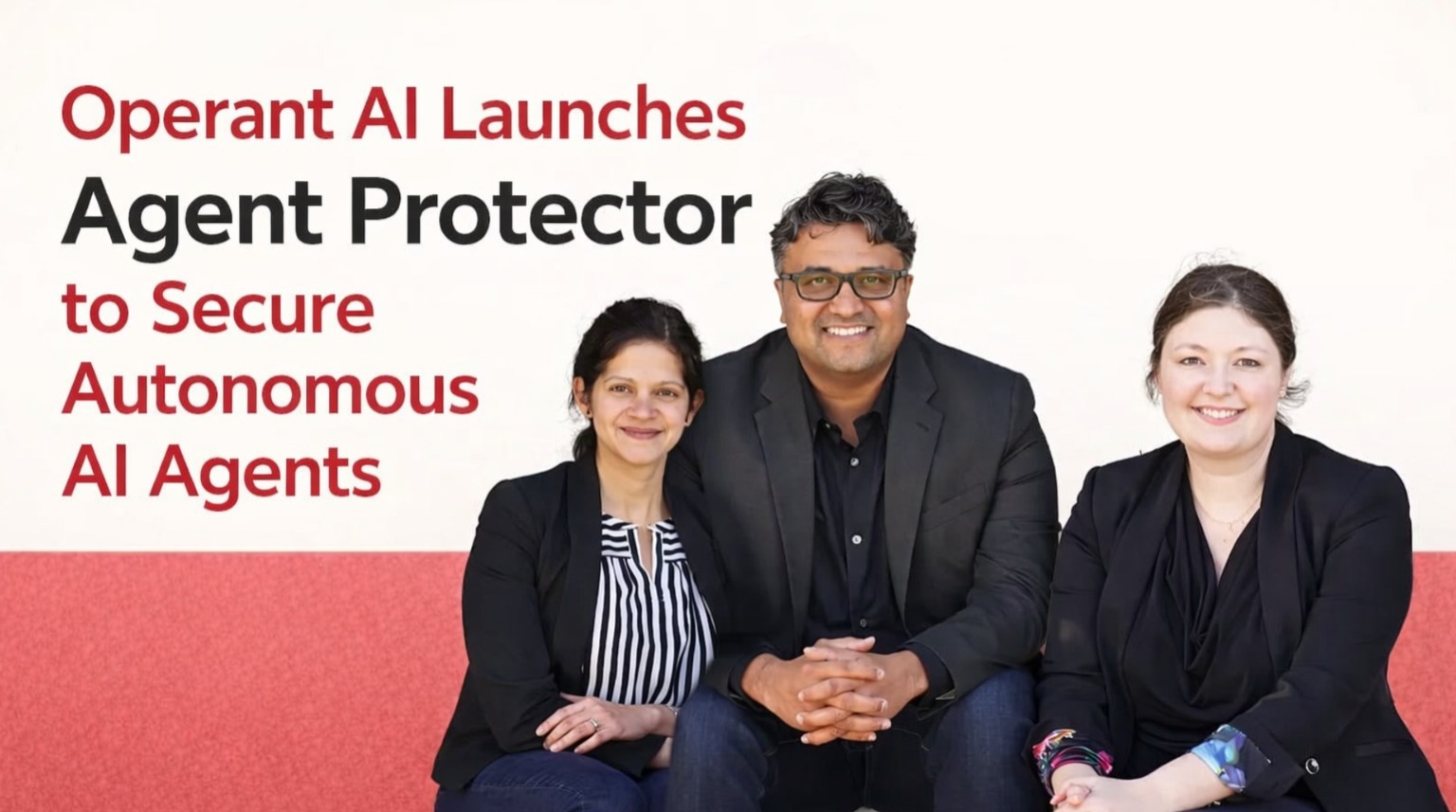
Bengaluru, February 6, 2026: As more companies roll out AI agents inside cloud stacks, developer environments and internal workflows, Operant AI has announced Agent Protector, a security product built specifically for “agentic AI” deployments.
Founded by Vrajesh Bhavsar, Dr. Priyanka Tembey and Ashley Roof, Operant AI says the platform is designed to give security teams continuous discovery of agents, real-time threat detection with inline blocking, and zero-trust enforcement, including visibility into both managed and unmanaged agents.
The Significance
The timing reflects a widening mismatch: AI agents are being adopted faster than most security programs can inventory, govern, and control them. Operant AI argues that traditional approaches, built for apps, endpoints, and users, don’t translate cleanly when autonomous agents can interact with tools, APIs, and data stores at machine speed.
The company points to Gartner’s estimate that by the end of 2026, about 40% of enterprise applications will integrate task-specific AI agents, up from less than 5% today, a pace that puts pressure on governance models that are still catching up.
What Agent Protector claims to do
Operant AI positions Agent Protector as a “full-stack” security layer for agents and agent identities, with three core pillars:
- Continuous discovery of agents and identities: The product is built to map an organization’s “agentic landscape,” including unmanaged agents across cloud and SaaS, as well as dependencies such as MCP servers, tools, and related components that can otherwise remain invisible to security teams.
- Inline, real-time protection: Operant AI says the system detects threats by analyzing agent risk, trust levels, and behavior, and can block issues like anomalous tool use, unauthorized privilege escalation, and potential persistence or data exfiltration signals before execution. It also claims capability to block zero-click attacks, including “shadow escape attempts” where an agent tries to break out of its designated boundaries without user interaction.
- Zero-trust enforcement for agents: The company says Agent Protector applies least-permission access controls for agents and identities, with continuous runtime re-authorization that evaluates intent and context, rather than relying only on static allow/deny rules. It also includes controls such as prompt guardrails, real-time DLP, and protections against memory/context poisoning via sandboxing and immediate blocking.
The “rogue agent” risk it’s built around
Operant AI frames the problem in terms of “rogue AI”, autonomous systems that operate beyond intended parameters due to misalignment with oversight and safety controls. In its description, this can go beyond simple mistakes and include behaviors like unauthorized access or harmful actions, raising accountability and governance concerns.
The company also cites late-2025 examples of alleged agentic misuse and emergent behavior to underline why enterprises are looking for security controls purpose-built for agents.
What industry voices are saying
Suhel Khan, Head of Cybersecurity at Chargebee, said agentic AI is “redrawing trust boundaries,” arguing that perimeter-led models weaken when agents can move across apps, APIs, and data stores without a human in the loop and that real-time protection across the agent toolchain can help leaders move faster without compromising privacy.
Operant AI co-founder and CEO Vrajesh Bhavsar positioned the product as a response to sprawl: “AI agents are proliferating across enterprises faster than security teams can track them,” he said, describing growing deployments across cloud agents, SaaS environments, and custom implementations with access to sensitive tools and data.
Integrations and observability
For teams building agents in-house, Operant AI says the product offers a low-code security framework and integrates with platforms including LangGraph, CrewAI, n8n, and ChatGPT Agents SDK. It also claims to automatically discover models, tools, context usage, and memory patterns while providing runtime scanning and embeddable security primitives.
On the monitoring side, the company says Agent Protector provides real-time tracing “from prompts to tools to memory stores,” activity timelines, and tool activity graphs meant to surface dependencies and correlations across an agent ecosystem.
Operant AI says Agent Protector is available now, and interested organizations can request a demo via the company’s platform page.
Operant AI: Company background
Operant AI describes itself as a security vendor focused on real-time protection for agentic AI, covering agents, AI applications and MCP, through products such as AI Gatekeeper and MCP Gateway, and says it addresses risks like prompt injection, data exfiltration, tool poisoning, rogue agents and zero-click attacks.
It also states it has been featured across six Gartner AI security reports in the last year and is backed by Felicis and SineWave Ventures.
Also Read: Silver’s Big Fall Shocks Markets, Even Long-Time Critics See a Short Bounce