HYDERABAD: Online shopping has made doorstep delivery routine. Once the package is opened and the product is used, however, households are often left to decide what to do with the bottle, wrapper, carton or blister pack.
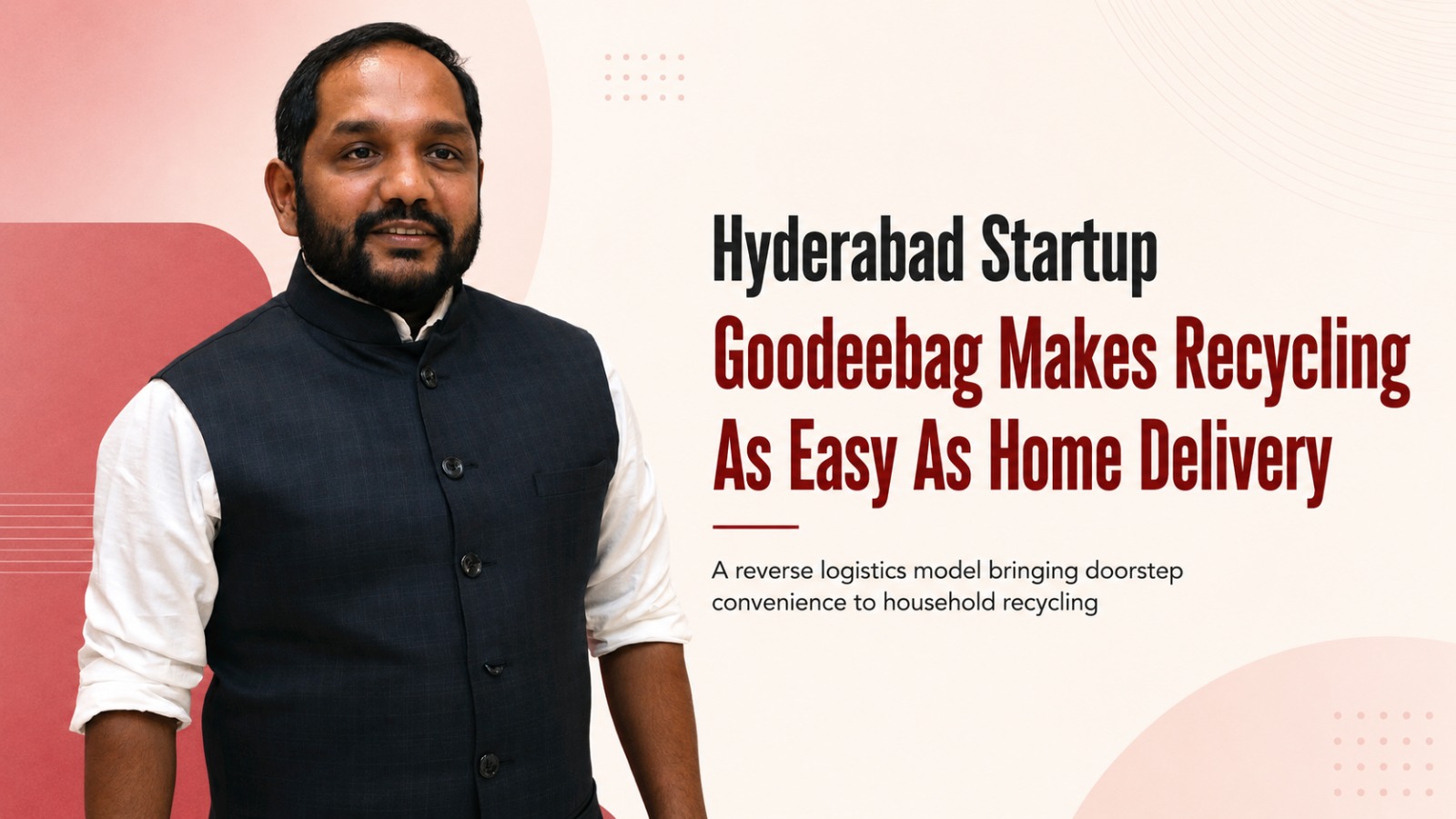
That gap became the starting point for Goodeebag, a Hyderabad startup founded by logistics professional Abhishek Agarwal. The company applies delivery-style coordination to the return journey of recyclable dry waste, collecting discarded materials from homes and moving them back into the recycling chain.
Turning delivery logistics in reverse
Agarwal began developing the idea in 2022 after questioning why the efficiency used to deliver consumer goods could not also be used to collect them after disposal.
He spent the following years working through the practical details of the model, including household collections, material sorting, recycler requirements, customer behaviour and the development of the company’s app. Agarwal said operations began by the end of 2025.
The system is designed around a simple journey. Goodeebag collects recyclable dry waste from households, transports it to its sorting centres and then supplies the separated material to authorised recyclers. The company sells the scrap by weight, while participating customers receive points that can be redeemed through the grocery section of its app.
For Agarwal, the larger problem is that the movement of a product is carefully tracked until it reaches the buyer, but the same organised chain often ends once the product or its packaging is discarded.
Goodeebag’s model attempts to create that missing return route through a formal, technology-supported collection network. Building it required Agarwal, who did not come from a waste management or materials science background, to learn how different recyclable materials are classified and where each category must be sent.
Nearly four tonnes handled each day
Goodeebag currently carries out about 200 to 250 household pickups every day. Collections from individual homes account for roughly 800 kilograms of recyclable material.
When waste collected from apartment communities and institutional partners is included, the company processes close to four tonnes a day across 11 to 12 parts of Hyderabad. Its service areas include Gachibowli, Narsingi, Kokapet, Hafizpet and Begumpet.
The collected material is sorted at eight centres before being transported to recycling facilities. According to the company, the recovered waste is eventually used to make products such as planters, dustbins and eyewear frames.
A small request for households
Customers are not charged to use the Goodeebag app, but the company asks them to keep recyclable items reasonably clean.
Food-contaminated packaging does not need to be thoroughly washed, Agarwal said. A quick rinse is enough before it is handed over for collection. This small step helps prevent recyclable material from becoming unsuitable for sorting and further processing.
The pickups are carried out using 18 company-owned electric rickshaws. The decision to use electric vehicles also addresses a major cost in the business, since transport forms a significant part of the company’s daily operations.
Solving the volume problem
Goodeebag first concentrated on gated communities and high-rise apartment buildings near Gachibowli. The company soon encountered a basic challenge: a single household produces only a limited quantity of recyclable dry waste each week.
That volume is not enough on its own for recycling businesses that require large quantities of material separated by category. Goodeebag therefore began aggregating waste from many homes and communities before sending it onward.
Its team also went door to door to explain the collection model to residents. Customers were encouraged to hand over clean recyclable plastic and paper in return for points, groceries, money or other incentives offered through the system. The company has 80 employees involved in segregating and managing the collected material.
The approach rests on aggregation. A few kilograms from one home may appear insignificant, but combining material from hundreds of households creates the scale required for sorting, transport and recycling.
Goodeebag’s progress also highlights a practical reality about household recycling: willingness alone may not be enough. People are more likely to participate when collection is convenient, instructions are simple and there is clarity about where the material goes.
By bringing recyclable waste collection to the doorstep, the Hyderabad startup is trying to make disposal as organised as delivery. Its wider test will be whether that convenience can encourage more households to keep dry waste out of mixed garbage and return it to productive use.
Also Read: India’s Highest-Paid CEOs in FY25