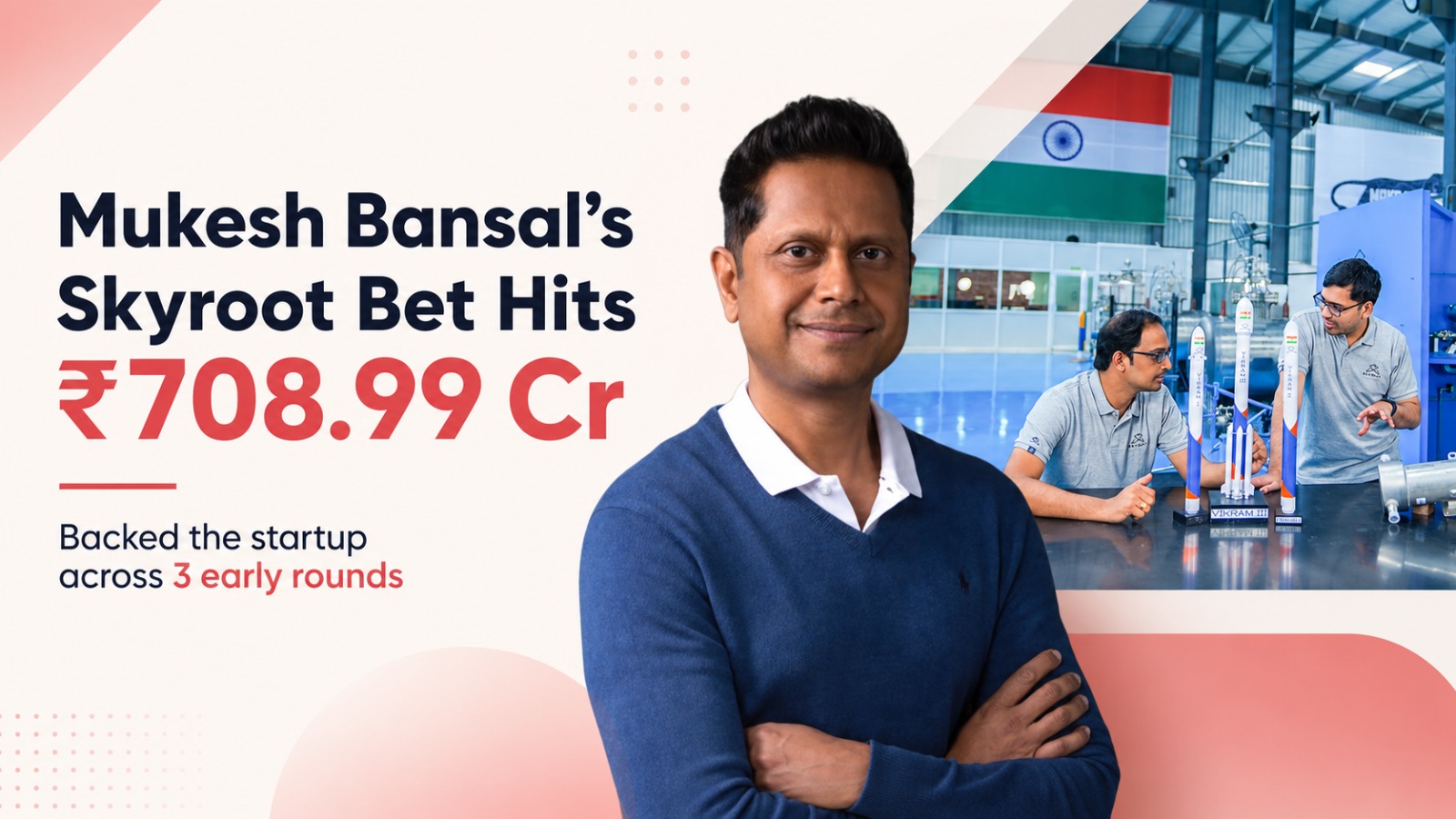
Mukesh Bansal’s (Founder: CureFit, Myntra, Nurix) early bet on Skyroot Aerospace has come into sharp focus after the company’s successful orbital launch of Vikram-1 over the weekend. Long before India’s private space ecosystem gained regulatory momentum, Bansal backed former ISRO scientists Pawan Kumar Chandana and Naga Bharath Daka, investing ₹5.15 crore in July 2018 as the company’s only investor.
It also brings renewed attention to one of the earliest and most consequential investment decisions in the company’s journey.
On 23 July 2018, Mukesh Bansal invested ₹5.15 crore in Skyroot Aerospace. At the time, he was the only investor backing the two former ISRO scientists.
The investment did not come through a conventional fundraising process. Pawan later recalled during a CNBC Young Turks interview that he was still learning the basics of raising money when he approached Bansal.
“I remember googling how to raise capital. I didn’t even know what equity was. I sent a LinkedIn message to Mukesh Bansal,” Pawan said.
That LinkedIn message would lead to a relationship spanning multiple funding rounds, years of regulatory uncertainty and one of the most striking early-stage investment outcomes in India’s deep-technology ecosystem.
Three rounds of sustained conviction
Bansal did not stop after his first investment.
In April 2019, he invested another ₹5.15 crore. Once again, he was the only investor in the round.
He returned for a third time in November 2020, investing a further ₹2 crore. In that round, Bansal wrote the largest cheque.
Across the three rounds, his total investment in Skyroot Aerospace stood at ₹12.30 crore. His ownership in the company reached a peak of approximately 28.1%.
The pattern of investment is significant. This was not a single speculative cheque followed by passive ownership. Bansal repeatedly committed capital as the company moved through its earliest and most uncertain years.
His first two investments were made before the Union Cabinet approved India’s Space Sector Reforms on 24 June 2020.
The first cheque, in fact, was invested almost 24 months before that approval.
It would take another two years for IN-SPACe to become operational on 16 August 2022 and provide a single-window mechanism for launch clearances.
Bansal’s investment therefore preceded both the policy reforms and the institutional framework that would later support private participation in India’s space sector.
From ₹12.30 crore to ₹708.99 crore
Based on Skyroot Aerospace’s Series C funding round on 7 May 2026, the combined realised and unrealised value of Bansal’s investment is approximately ₹708.99 crore.
That value consists of two parts.
Bansal sold shares worth about ₹105.17 crore across two transactions.
EatFit acquired shares worth approximately ₹27.31 crore in 2023. Temasek purchased another ₹77.86 crore worth of shares in 2024.
Following these transactions, Bansal retained a 5.67% stake in Skyroot Aerospace.
At the valuation established during the company’s Series C round, that residual shareholding is worth approximately ₹603.82 crore.
Adding the ₹105.17 crore realised through share sales to the ₹603.82 crore value of the remaining stake brings the total investment value to approximately ₹708.99 crore.
Against the ₹12.30 crore invested across three rounds, this represents a return of about 57.6 times the original capital.
Based on the investment and transaction dates, the return translates into an estimated XIRR of approximately 84%.
The numbers are remarkable, but they tell only part of the story.
A bet placed before the path was clear
Early-stage investing always involves uncertainty. Skyroot Aerospace presented an additional layer of risk.
Bansal was backing two technical founders attempting to build an ambitious space company at a time when the regulatory environment for private space activity in India was still evolving.
There was no operational single-window launch clearance system when he wrote his first cheque. The formal space-sector reforms were still nearly two years away.
Even after those reforms were approved, it took until August 2022 for IN-SPACe to become operational.
Bansal’s decision was therefore based primarily on his belief in the founders and their ability to execute, rather than on the comfort of an already established policy framework.
That conviction remained visible across all three rounds.
He was the sole investor in 2018, the sole investor again in 2019 and the largest investor in the November 2020 round.
A relationship built on mutual trust
The relationship between Bansal and the Skyroot founders appears to have extended beyond capital.
Bansal has repeatedly spoken about his early belief in the team.
“I’ve believed in the Skyroot team since the early days,” he has said.
He also invited Pawan to become the first guest on his SparkX podcast series, reflecting the trust and respect built over the company’s journey.
For Pawan, the experience of moving from engineering to fundraising came with its own learning curve.
One of his most memorable observations captures that challenge with humour: “Raising capital is rocket science. Especially in DeepTech.”
The line is light-hearted, but the company’s funding history shows how difficult the process can be. Before institutional investors, policy reforms and major funding rounds arrived, the founders needed someone willing to believe in an idea whose commercial and regulatory path was still being formed.
Bansal took that risk.
Vikram-1 launch puts the early bet in perspective
Skyroot Aerospace’s successful orbital launch of Vikram-1 over the weekend gives that early investment story fresh relevance.
The company has now set itself the audacious goal of carrying out a launch every month.
For the Skyroot team, the successful launch represents the outcome of years of technical work, fundraising and persistence.
For Bansal, it underlines the value of backing founders before their path becomes obvious to the wider market.
His ₹12.30 crore investment has produced a combined realised and unrealised value of approximately ₹708.99 crore. Yet the more important part of the story may be the timing.
The first cheque arrived before India’s space reforms, before IN-SPACe became operational and before Skyroot had the institutional validation it has today.
That is what genuine early-stage conviction looks like: recognising the potential of a team when the ambition is clear, but almost everything else remains uncertain.
Also Read: Revolut Secures Australian Banking Licence, Plans Nearly $400 Million Expansion