Story Of Humans&: In a market sprinting toward autonomous agents that can “do it all,” a newly launched frontier AI lab is arguing for a different endgame: AI that makes people better at working with each other.
Humans& (often styled as humans&) has emerged from stealth positioning itself as a “human-centric frontier AI lab” built around collaboration, trust and relationships, not replacement. The company says the next chapter of AI should start with “people and their relationships,” acting as a kind of connective tissue that strengthens organisations and communities.
That philosophy is now being backed with unusually large early capital. Humans& has announced a $480 million seed round at a $4.48 billion valuation, a headline-making debut for a company described as only a few months old.
A seed round sized like a later-stage war chest
The seed round was led by SV Angel and co-founder Georges Harik, with participation from Nvidia, Jeff Bezos, and GV (Google Ventures), among others.
What stands out isn’t just the cheque size, it’s the signal. Big seed rounds like this are typically reserved for teams with a rare blend of frontier research credibility and product-building experience, especially when the work ahead demands enormous compute and a long runway. Humans& itself frames the moment as a pivot away from the industry’s rush toward autonomous systems, and toward tools that work inside human workflows and teams.
The founding team: a cross-lab “supergroup”
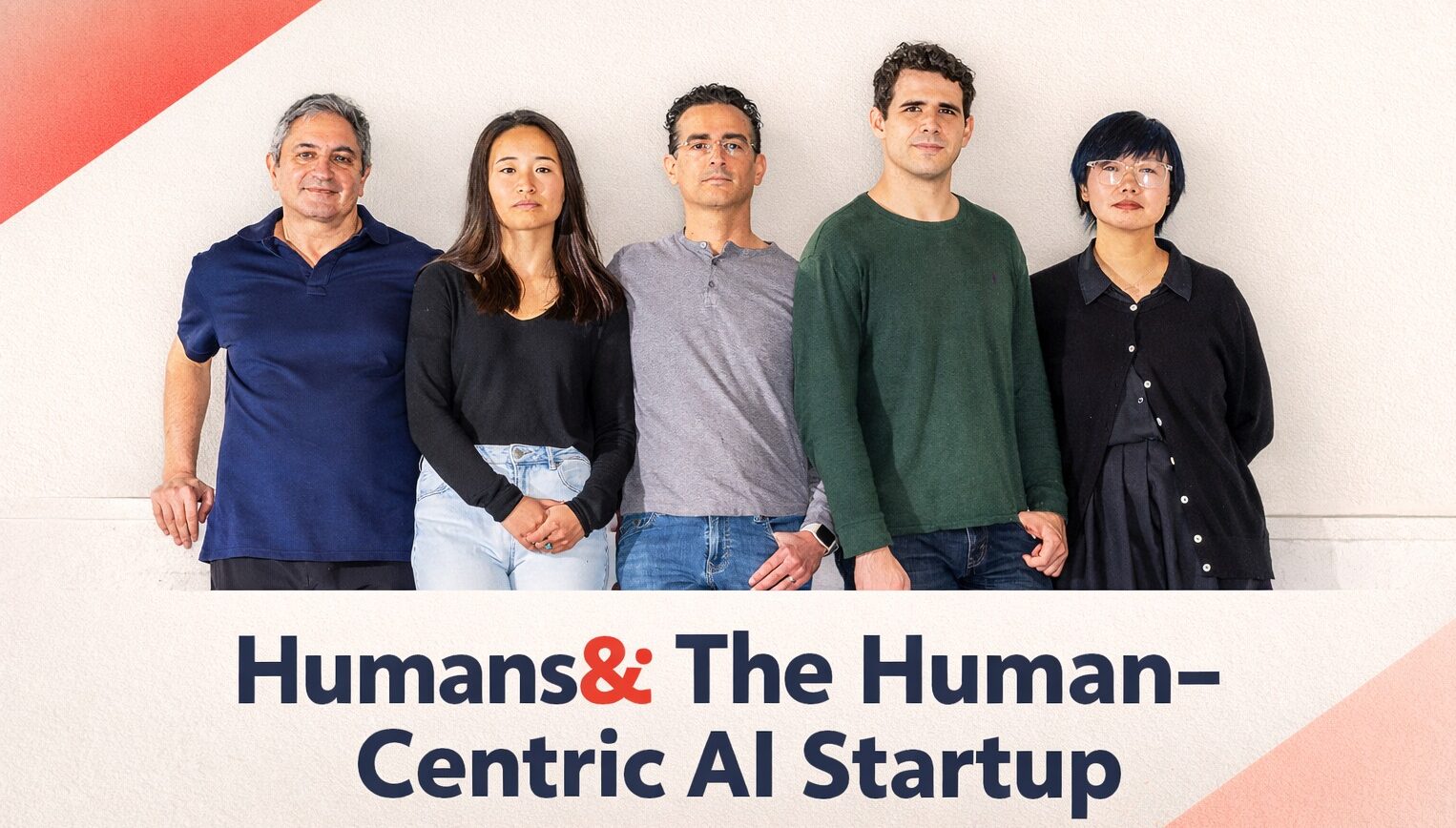
Humans& is founded by a group of researchers and builders whose backgrounds span several of the world’s most influential AI labs and institutions. The named co-founders include:
- Andi Peng, described as a former Anthropic researcher who worked on reinforcement learning and post-training across Claude versions 3.5 through 4.5.
- Georges Harik, described as Google’s seventh employee who helped build the company’s first advertising systems.
- Eric Zelikman and Yuchen He, described as former xAI researchers who helped develop the Grok chatbot.
- Noah Goodman, a Stanford professor of psychology and computer science.
Beyond the founding group, Humans& says it has about 20 employees, including people from OpenAI, Meta, Reflection, AI2 and MIT.
This “all-star pedigree” is repeatedly cited as a core reason the company has been able to raise at this scale so early, investors are buying not only a mission statement, but a track record of shipping models and products that reached mass adoption.
What Humans& is trying to build?
Humans& is pushing back on a subtle but important assumption in today’s AI hype: that progress equals autonomy.
The company’s public messaging argues that while models are getting better at reasoning, coding and acting with increasing independence, real-world progress still comes from human connection, understanding each other, building trust, and coordinating work.
Instead of treating AI as a separate “agent” that goes off and completes tasks alone, Humans& wants to design AI as something that lives closer to how people already collaborate.
One way the startup describes its direction is strikingly simple: an AI-powered version of instant messaging, software that helps people coordinate, communicate and solve problems together.
The Technical Bet
Humans& is also clear about what it believes must change under the hood to make “collaborative AI” real.
The company points to innovations needed in long-horizon and multi-agent reinforcement learning, memory, and user understanding, areas where current systems often struggle when tasks become messy, multi-step, and dependent on evolving context.
Two ideas show up repeatedly in the descriptions of what the team is exploring:
- AI that asks for the information it needs and remembers it.
- Humans& describes work on programming chatbots to proactively request relevant details from users and store them for future use, moving beyond single-session interactions toward ongoing, assistive relationships.
- Multi-agent collaboration for human teams.
- The company also points to multi-agent systems, where multiple AI assistants can coordinate on multi-step work, mirroring the way human teams divide responsibilities.
Humans& has suggested it wants its software to handle “long-horizon activities”, complex tasks that can take hours or more, while also supporting multi-agent collaboration and proactively asking workers for needed inputs.
A philosophical line in the sand: “complementary,” not “autonomous”
One of the clearest windows into Humans&’s worldview comes through a quote attributed to co-founder Andi Peng, contrasting her motivation with autonomy-first positioning elsewhere in the market. Peng is quoted as saying: “That was never my motivation. I think of machines and humans as complementary.”
That sentence does a lot of work. It frames Humans& not as “anti-automation,” but as “pro-human”: the aim is to design AI that strengthens how people collaborate, rather than building systems that mainly showcase how long they can run unattended.
The enterprise adoption gap
The launch lands at a time when businesses are excited about generative AI, yet many still struggle to embed it into day-to-day operations. Humans& is essentially betting that the biggest opportunity is not only smarter models, but better interfaces, better memory, and better integration into how humans already coordinate work.
Humans& describes its goal as building AI that can serve as a “deeper connective tissue,” strengthening organisations and communities while rethinking both model training at scale and human-AI interaction.
What’s next?
For now, Humans& is still early, but unusually well-funded for this stage. The company has said it is building neural networks intended to make workers more productive, and it has hinted at long-horizon and multi-agent capabilities as key pillars.
The real proof, of course, will be discovering whether the company can take a compelling philosophy and turn it into a product that people use, versus one that feels more like a tool they “use every now and then.”
If it works, it won’t just be another AI assistant. It could be a new category: AI designed not to replace the team, but to become the team’s glue.
Also Read: AssetPlus raises ₹175 crore to deepen technology stack