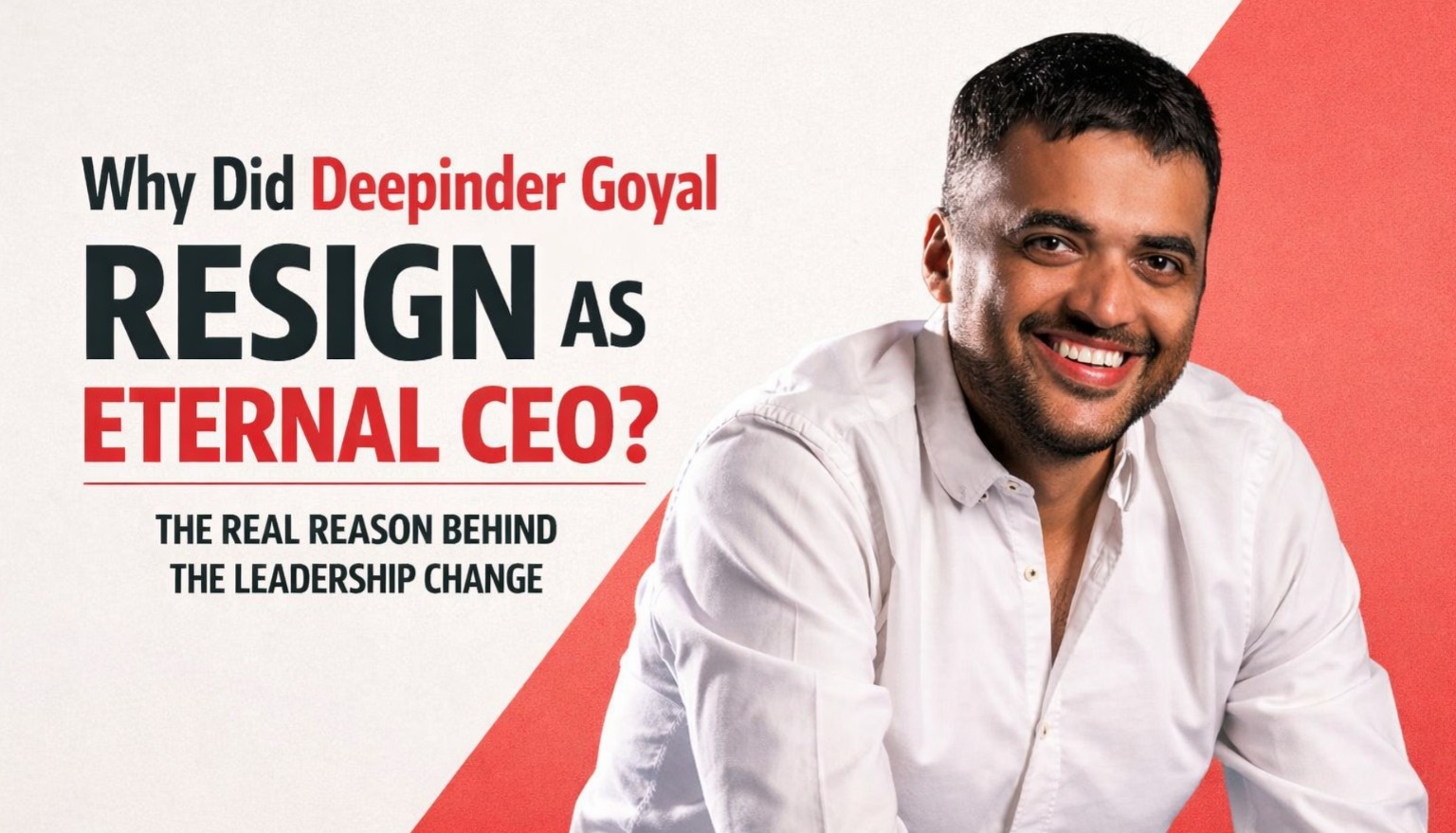
Deepinder Goyal has stepped away from the Group CEO role at Eternal, telling shareholders he wants room to pursue “significantly higher-risk” ideas that do not fit the risk profile or strategic scope of a listed company. Blinkit chief Albinder Dhindsa will take over as Eternal’s new Group CEO and run day-to-day execution, while Goyal is set to remain on the board as Vice Chairman, subject to shareholder approval.

The shift, announced through a shareholder note that Goyal also shared publicly in screenshots, frames the move as a choice about focus and governance rather than a break from the company he built. In the letter, he says Eternal must stay “focused” and “disciplined” on areas of growth that align with its current businesses and that a public-company CEO in India is expected to deliver that focus without distraction.
Why did Deepinder Goyal resign as Group CEO?
Goyal’s point is clear: he’s been drawn to these new bets that are more exploratory and riskier, the sort of thing that, in his own words, is better off being done not as a listed company. In his shareholder communication, he says that these ideas are not within Eternal’s strategic scope, that he would have implemented them in the company if that were the case.
He also points to the practical reality of running a public company: even if he could juggle Eternal and outside exploration, the legal and governance expectations attached to a CEO role “demand singular focus,” making a dual-track approach hard to justify at the top.
In other words, Goyal isn’t describing a loss of interest in Eternal, he’s describing a structural decision: keep Eternal tightly aligned to its risk profile and public-market responsibilities, and carve out personal bandwidth for experiments elsewhere.
What changes and what doesn’t?
Operationally, the biggest change is where the “centre of gravity” sits. With Dhindsa as Group CEO, the responsibility for execution, operating priorities and business decisions moves decisively to him.
At the same time, Eternal’s messaging is careful to signal continuity. Goyal has said he will continue to play an active role in long-term strategy, organisational culture, leadership development, ethics and governance, areas he describes as his increasing focus.
There is also a direct employee and shareholder alignment element built into the transition: as part of the handover, Goyal’s unvested ESOPs will revert to the ESOP pool, which the company positions as a way to strengthen leadership incentives and retention without incremental shareholder dilution.
Why Albinder Dhindsa and why now?
Dhindsa is not a surprise successor in the context of Eternal’s current growth narrative. He has been leading Blinkit and is credited in the shareholder messaging with steering the quick-commerce business from acquisition to breakeven, building out team culture, supply chain and operating rhythm.
Dhindsa’s backstory also fits the company’s “operator” emphasis. NDTV notes he is an IIT Delhi mechanical engineering graduate, founded Grofers in 2014, rebranded it as Blinkit in 2021, and it was acquired by Zomato in 2022.
The timing of the leadership switch also lands amid heightened attention on Blinkit and quick commerce economics. A market wrap carried by TS2/Techstock (citing multiple outlets) reported Eternal posted a consolidated net profit of ₹102 crore for the October-December quarter, with revenue from operations surging to ₹16,315 crore (as cited there), alongside commentary that Blinkit-led expansion is central to the story investors are watching.
Eternal reiterated a quick-commerce margin target of 5% to 6% of net order value, while acknowledging competition remains intense (as attributed there to the Financial Express).
A revealing flashback: when Goyal once told Dhindsa to “leave”
One detail resurfacing alongside the announcement is an older account of how hard the Blinkit integration period was and how blunt Goyal can be about leadership transitions.
On the Raj Shamani podcast, Goyal said that soon after Zomato acquired Blinkit, he asked Dhindsa to leave, telling him, “You will not be able to cut it.” Goyal said this happened twice during that phase, describing his approach as prolonged coaching followed by direct confrontation if progress stalls.
Zomato acquired Blinkit (then Grofers) in 2022 for ₹4,447 crore in an all-stock deal.
In the context of today’s succession, that flashback does two things at once: it underlines how turbulent the post-acquisition period may have been and it makes Dhindsa’s rise to the top job look less like a ceremonial promotion and more like a hard-earned endorsement.
From Goyal’s own framing, this is not an exit from Eternal, it’s a redistribution of attention. He’s positioning himself as the long-term steward on strategy and governance, while handing the “run the machine” mandate to the person currently most associated with the group’s biggest growth engine.
And on the “why,” the cleanest verified answer is the one he gives shareholders: he wants to pursue higher-risk experimentation outside the boundaries of a listed company, and he believes India’s public-company CEO role demands single-minded focus.
Also Read: Who Is Pratham Mittal? Shark Tank India 5’s New Campus Judge