Twelve years of the Modi Government. Twenty-five years of Narendra Modi in public life. Seventy-five years of the boy whom Hiraba raised with her own hands.
On this occasion, countless articles have celebrated the schemes he launched, the projects he completed, and the millions he helped lift out of poverty.
All of that matters.
But pause for a moment.
Governments have always announced schemes. Leaders before him also built roads, launched programs, and drafted policies.
What, then, made these efforts resonate so deeply?
Management experts will tell you that his discipline is extraordinary.
Administrators will point to his relentless work ethic and tireless schedule.
Political observers will praise his organizational ability.
Those who follow wellness will speak of the strength he draws from yoga.
Spiritual masters may say he is guided by a divine force.
Others will simply call him fortunate.
Perhaps all of them are right.
Yet the deeper question remains.
Why do some hands, though no different from anyone else’s, leave an imprint on history?
Why do some feet continue walking when others stop?
Why do some individuals possess the ability to transform not only circumstances, but the destiny of an entire nation?
In our search for strategies, ideologies, and systems, we often overlook the foundation upon which all greatness is built.
India has a word for it.
Sanskara.
It is one of those rare words that refuses to be translated.
It is not merely “values.”
It is not merely “culture.”
It is something deeper than both.
A Sanskriti can be inherited. A value can be taught.
A Sanskara is etched into the soul.
It is not a moral checklist. It is not a rulebook of do’s and don’ts. India has countless disciplines like yoga and meditation to shape behavior.
Nor is Sanskara something encoded in one’s DNA. If it were, every child born to the same parents would possess the same temperament, the same strengths, the same resilience, and the same destiny.
So what, then, is Sanskara? And what does it have to do with twelve years of the Modi Government?
Perhaps the closest description is this: Sanskara is the sacred meeting point of character, thought, and conduct.
The word itself comes from the Sanskrit roots Sam and Kri – which means – to purify.
In the wisdom of the Vedas, Sanskaras are understood as a lifelong process of purification.
Like a silent sieve within us, they filter our emotions before they become words, our impulses before they become actions, and our ambitions before they become destinies.
Sanskaras are like the hidden balancing reservoir of a swimming pool.
Circumstances change. But Sanskaras endure.
They become the roots from which an entire life draws its strength. And perhaps that is where the real story of Narendra Modi begins.
The world has heard stories of the young boy who used to jump in village lake, of the student who organized a play against social discrimination, of the son who watched his mother labor tirelessly and his father sell tea at the railway station.
But beyond the stories lay something more profound.
A child who woke before dawn to care for cows.
A son who watched his mother serve those in need without expecting anything in return.
A young boy who learned to respect soldiers, saints, and seekers.
A life shaped not by privilege, but by service.
Not by entitlement, but by duty.
Those moments left impressions upon him.
And unlike many childhood memories, he never left them behind.
He carried them forward.
Perhaps that is why every major decision he has taken bears the imprint of a deeper filter.
The filter of Sanskara.
For when action is purified, self-interest gradually falls away.
And what remains is service.
That is why the last twelve years cannot be understood merely through statistics.
They must also be understood through the values that shaped the vision behind those statistics.
A nation where daughters stand taller.
Where dignity has become as important as development.
Where technology is no longer the privilege of the few, but the empowerment of the many.
Where heritage is celebrated, the environment protected, and national confidence renewed.
These transformations are not born from policy alone.
They emerge when conviction meets character.
When governance is guided by purpose.
When leadership is rooted in service.
The twelve years of the Narendra Modi Government should certainly be evaluated through achievements, outcomes, and measurable results.
But we should also recognize the invisible force that gave direction to those achievements.
That force is Sanskara.
The force that keeps a person standing when circumstances demand surrender.
The force that inspires an individual to dedicate himself to a purpose greater than himself.
Perhaps that is why some people are changed by the offices they occupy.
And some people change the very meaning of those offices.
Narendra Modi’s journey of seventy-five years, his twenty-five years in public life, and his twelve years as Prime Minister remind us of an eternal truth:
Great achievements are not built upon talent alone.
They are built upon great Sanskaras.
Policies find their place in history books.
Achievements eventually become statistics.
But Sanskaras live on through generations.
And perhaps that is the highest success any human life can ever attain.
He will always be remembered as,
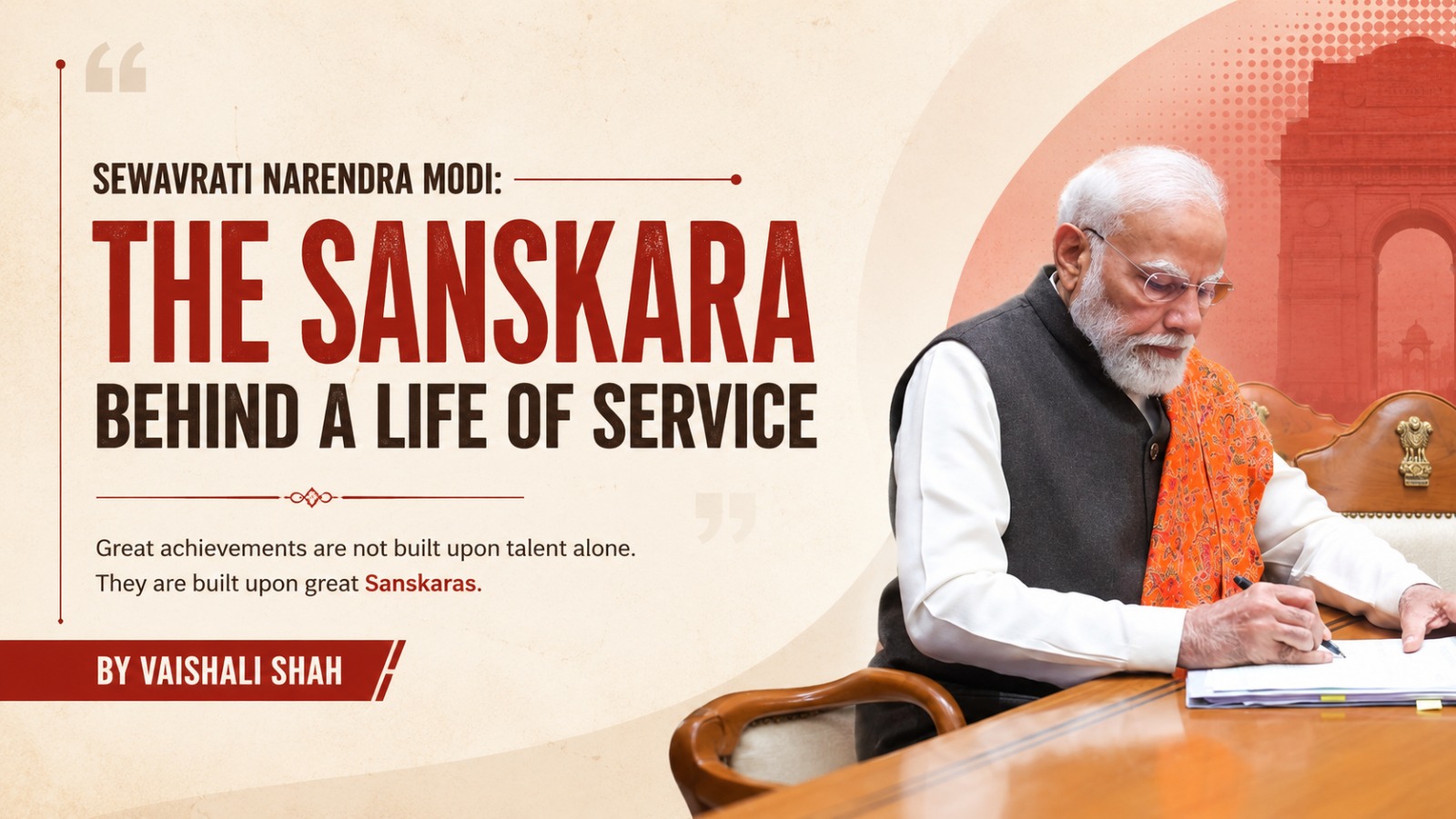
Sewavrati Narendra Modi: The Sanskara Behind a Life of Service
(By: Vaishali Shah, CEO, Moving Pixels and Author of Khudgarziyan)
Also Read: DK Shivakumar: India’s Richest Chief Minister with Declared Assets of ₹1,413 Crore