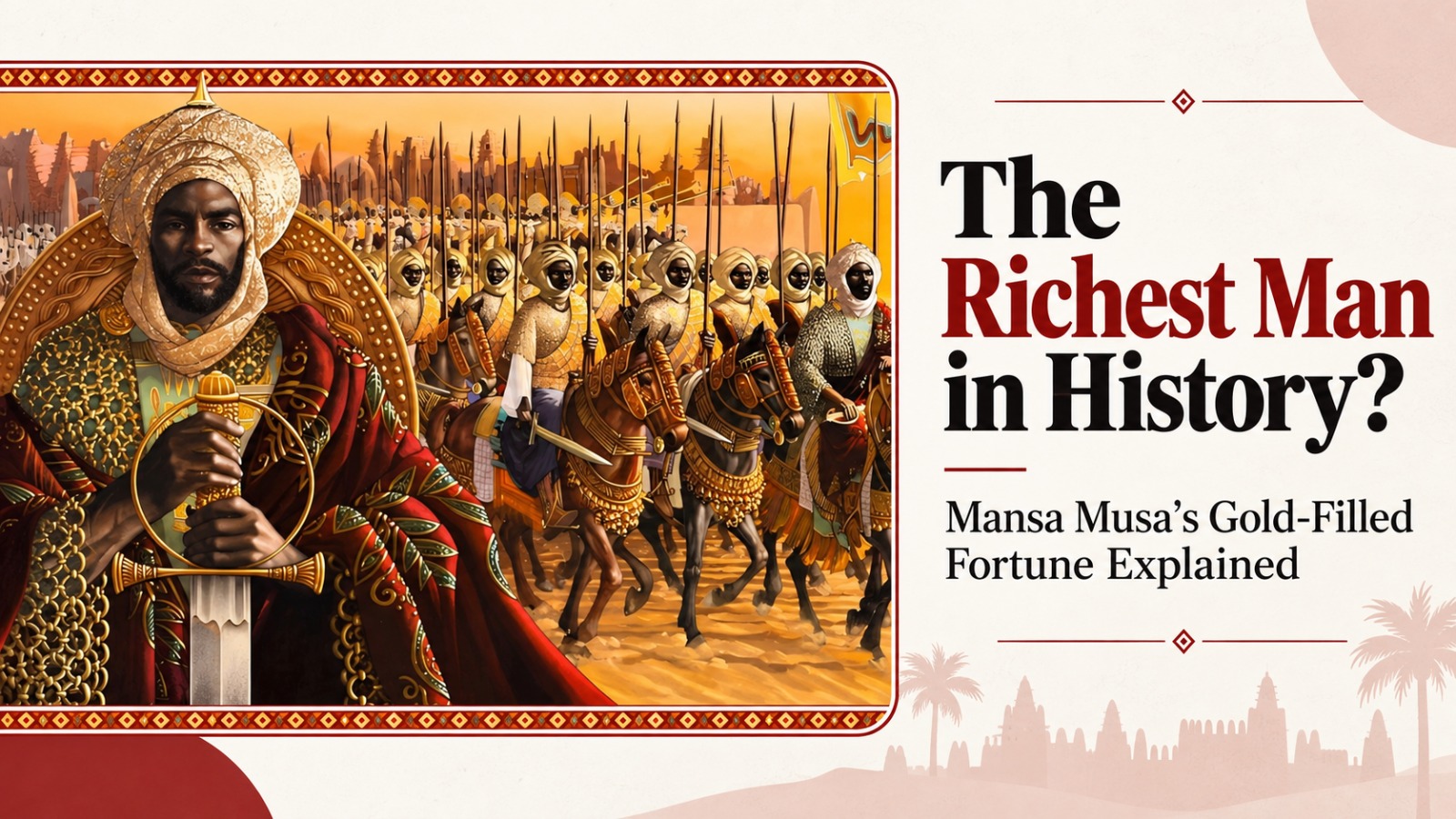
Long before Elon Musk, Jeff Bezos and other modern billionaires became symbols of extreme wealth, West Africa had a ruler whose riches became legendary across continents.
His name was Mansa Musa, the 14th-century ruler of the Mali Empire. His wealth was so immense that modern estimates have placed his fortune at hundreds of billions of dollars, although there is no reliable way to calculate his wealth in today’s terms.
What makes Musa’s story even more remarkable is not simply how much gold he controlled. It is the scale at which he displayed it. His famous pilgrimage to Mecca in 1324 included tens of thousands of people, thousands of enslaved people and a reported caravan of camels carrying gold.
The journey would eventually become one of the most famous episodes in the history of medieval West Africa.
Born Into The Keita Dynasty
Musa Keita was born around 1280 into the Keita Dynasty, the ruling family of the Mali Empire. The title “Mansa” means king or sultan in Mandinka, giving rise to the name by which history remembers him, Mansa Musa.
He became ruler of Mali in 1312, inheriting an empire that was already wealthy and connected to important regional markets.
Mali’s riches were closely tied to commodities that were highly valuable during the medieval period, particularly gold and salt. The empire also benefited from the ivory trade and the commercial activity taking place across its major trading centres.
How Musa Turned Mali Into A Major Power
Musa expanded the territory under Mali’s control through a combination of conquest and diplomacy. During his reign, the empire incorporated 24 cities, including Timbuktu, which was already an important trading centre.
At its height under Musa, Mali stretched for nearly 2,000 miles, reaching from the Atlantic Ocean toward present-day Niger. Its territory covered areas corresponding to parts of modern Senegal, Mauritania, Burkina Faso, The Gambia, Guinea-Bissau, Guinea and Ivory Coast.
The scale of the empire gave Musa access to enormous natural and commercial resources.
The British Museum has described the Mali Empire as supplying almost half of the Old World’s gold during the period of Musa’s reign. Gold, however, was not his only source of wealth. Salt mines and the ivory trade also played an important role in the empire’s economy.
The Journey That Made Mansa Musa Famous
Musa’s reputation for extraordinary wealth spread far beyond Mali after he travelled to Mecca in 1324.
The pilgrimage took him thousands of miles across the Sahara and through Egypt. His travelling party was reportedly enormous, with around 60,000 people accompanying him. The group included members of his royal court, soldiers, merchants, griots and camel drivers, alongside 12,000 enslaved people.
The caravan also needed huge quantities of supplies for the journey.
But it was the gold that attracted the greatest attention.
Arab chroniclers described between 80 and 100 camels carrying gold dust, while hundreds of attendants were reportedly carrying four-pound rods of solid gold.
The display was difficult to ignore. Even members of Musa’s travelling party were reportedly dressed in gold brocade and fine Persian silk.
Did Musa Really Disrupt Cairo’s Economy?
One of the most enduring stories from Musa’s pilgrimage concerns his stay in Cairo.
He reportedly spent around three months in the Egyptian city, distributing gold with extraordinary generosity. The sudden amount of gold entering the local economy is said to have pushed down its value and affected gold prices in the region.
The impact was reportedly felt for more than a decade.
Musa’s spending became so closely associated with the economic disruption that the Cairo episode remains one of the most striking parts of his historical legacy.
He was also reportedly forced to borrow money from Egyptian lenders on his journey home after spending much of the gold he had carried with him.
His Spending Was Not Universally Admired
Musa’s generosity abroad did not necessarily win universal approval at home.
Research into Malian oral history by Lucy Duran has noted that griots were reluctant to praise Musa in some historical songs because of concerns over the amount of Mali’s wealth that had been spent on people outside the empire.
That detail offers a different perspective on Musa’s famous generosity. His spending may have impressed foreign observers, but it could also be viewed as excessive by people closer to his own empire.
Timbuktu’s Rise As A Centre Of Learning
Musa’s legacy was not limited to military expansion and gold.
His support for education, libraries and schools helped establish Timbuktu as a major centre of learning. The city became associated with the Sankore centre of learning and accumulated an extensive collection of manuscripts over the centuries.
Musa also became associated with major architectural projects.
During his pilgrimage, he reportedly met the Andalusian poet, scholar and architect Abu Es Haq es Saheli. Musa later brought him back to Mali, where he was reportedly paid 200 kilograms of gold to design a mosque.
A Golden Image On A European Map
Musa’s reputation eventually reached Europe.
The Catalan Atlas, produced in 1375 by Spanish cartographer Abraham Cresques, depicted Musa seated on a throne and holding a gold nugget. The image helped reinforce Europe’s association of Mali and Timbuktu with extraordinary wealth.
By then, Musa had become more than a powerful West African ruler. He had become a symbol of wealth on the wider medieval world stage.
What Happened After Mansa Musa?
Musa died around 1337 at the age of about 57. His son succeeded him, but the empire did not retain the same level of stability and influence under his rule.
Over time, smaller kingdoms broke away, weakening Mali’s power.
Yet Musa’s reputation survived.
Centuries later, he continues to appear in discussions about the wealthiest people in history. Some modern estimates have placed his fortune between $400 billion and $500 billion, but these figures remain highly uncertain.
There is a simple reason for that. Musa’s wealth was tied to control over land, gold, salt and an entire empire, making it nearly impossible to convert his resources into a meaningful modern net worth.
What can be established more clearly is the extraordinary scale of his influence. Mansa Musa controlled a wealthy West African empire, expanded its territory, supported centres of learning and became famous across the medieval world after a pilgrimage marked by an enormous display of gold.
His exact fortune may never be known. His place in history, however, is much harder to forget.
Also Read: iPhone 18 Pro Pre-Orders Open: Prices, Burgundy Color, Storage and Trade-In Offers