

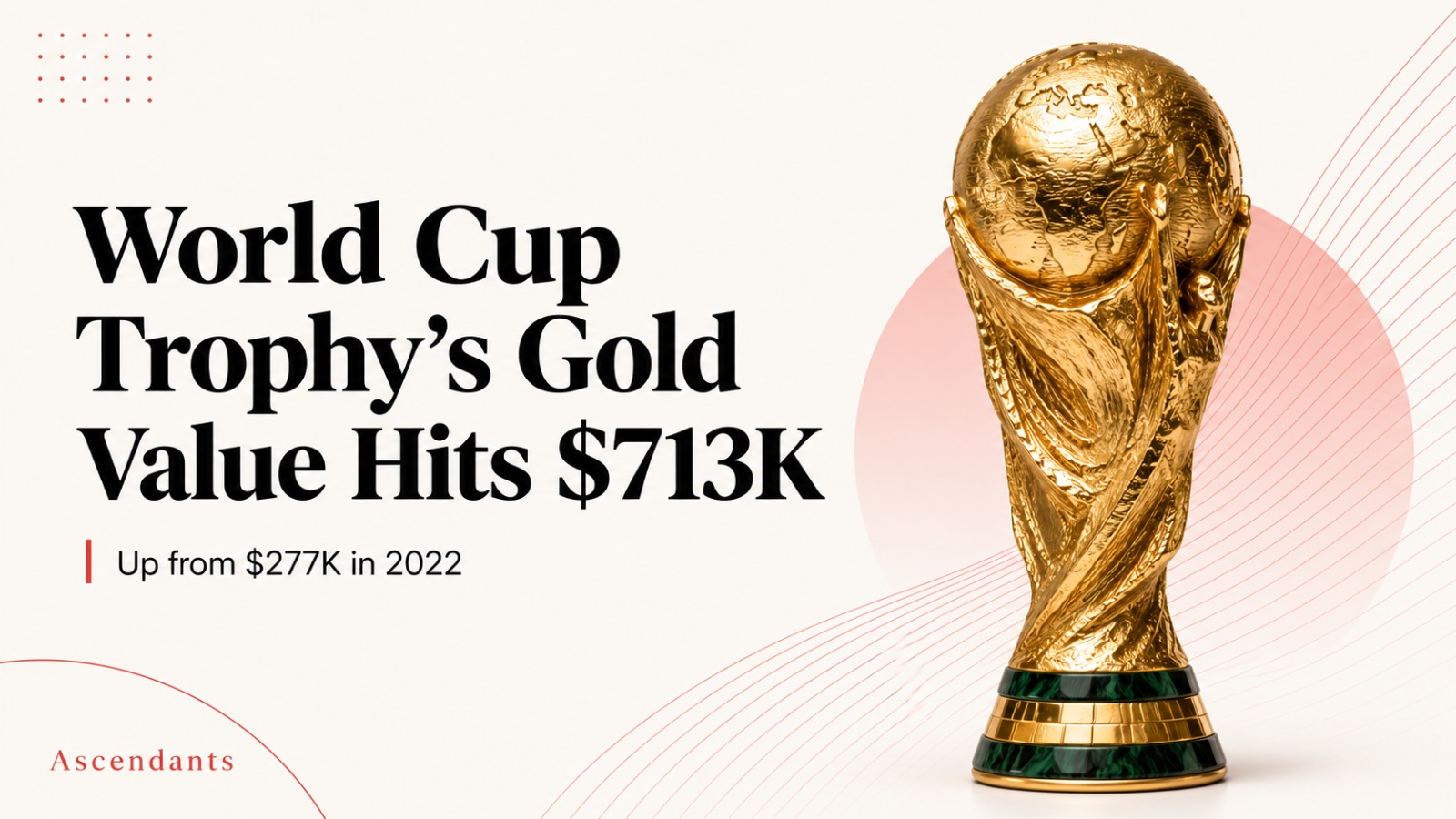
As the 2026 FIFA World Cup gets underway, the iconic FIFA World Cup Trophy has reached a new milestone in terms of its raw material value. According to data from LSEG, the trophy’s gold content is now worth approximately US$713,000, a sharp increase from around US$277,000 during the 2022 World Cup.
The increase represents a rise of roughly 157 percent over the four-year period, reflecting the significant rally in global gold prices. Although the trophy’s appearance has remained unchanged, the growing value of the precious metal used in its construction has substantially boosted its intrinsic worth.
The FIFA World Cup Trophy is made of 18-carat gold and stands approximately 36 to 37 centimetres tall. Weighing more than six kilograms, it remains one of the most recognisable and celebrated symbols in international sport.
A Symbol Whose Worth Extends Beyond Metal
The trophy’s soaring gold value highlights the dramatic changes in both commodity markets and the economics of global football. When the current trophy was introduced in 1974, its production cost was estimated at around US$9,390. Adjusted for inflation, that amount would be roughly US$130,500 today.
Comparing those figures with the trophy’s current gold value demonstrates how significantly its underlying material worth has grown over the decades. However, the trophy’s importance extends far beyond the value of the gold from which it is made.
Its status as the ultimate prize in world football has elevated it into a cultural and historical icon. As a result, the trophy is often associated with valuations that far exceed the value of its physical materials.
Also Read: US Directive on Anthropic Models Sparks Fresh Debate on AI Sovereignty in India
The Difference Between Valuation and Market Value
The FIFA World Cup Trophy is frequently cited as being worth more than US$20 million. While such figures reflect its historical significance, rarity, and global recognition, financial experts point out that these valuations can be misleading when viewed from a traditional market perspective.
Unlike artwork, collectibles, or other valuable assets that can potentially be sold, the World Cup Trophy is not available for private ownership or commercial trade. FIFA retains full ownership of the original trophy at all times, preventing it from entering the open market.
As a result, analysts note that any theoretical selling price remains purely speculative. Despite its immense symbolic value, the trophy has no practical market value because it cannot legally be bought or sold.
Winners Take Home a Replica, Not the Original
A common misconception is that World Cup-winning teams permanently keep the famous gold trophy. In reality, FIFA maintains possession of the original trophy regardless of the tournament winner.
The champions are presented with the original trophy during the award ceremony and official celebrations. However, they do not retain it permanently. Instead, the winning nation receives a gold-plated bronze replica for long-term display.
This arrangement ensures that the original trophy remains under FIFA’s control and preserves its status as a unique sporting artifact.
The Legacy of a Design Introduced in 1974
The current FIFA World Cup Trophy replaced the Jules Rimet Trophy after Brazil secured its third World Cup title in 1970. Under the rules in place at the time, Brazil earned the right to keep the original Jules Rimet Trophy permanently.
To create a successor, FIFA organised a competition that was ultimately won by Italian sculptor Silvio Gazzaniga. His design debuted in 1974 and has remained unchanged ever since.
The trophy depicts two human figures lifting the Earth, symbolising the global nature of football and the achievement of becoming world champions. It also features a distinctive malachite base, where the names of tournament winners are engraved.
An interesting challenge awaits FIFA in the coming years. The current engraving format has space for champions only through 2030. Once that capacity is reached, football’s governing body will need to decide whether to modify the existing trophy or introduce a new solution while preserving one of sport’s most enduring symbols.
Today, the FIFA World Cup Trophy stands as a rare blend of craftsmanship, history, and sporting prestige. While its gold value continues to rise, its true significance remains rooted in what it represents to players, nations, and football fans around the world.
Also Read: FIFA Secures Record $2.8 Billion in Sponsorship Revenue for 2026 World Cup