Anthropic says Fable 5 and Mythos 5 access must be suspended for foreign nationals.
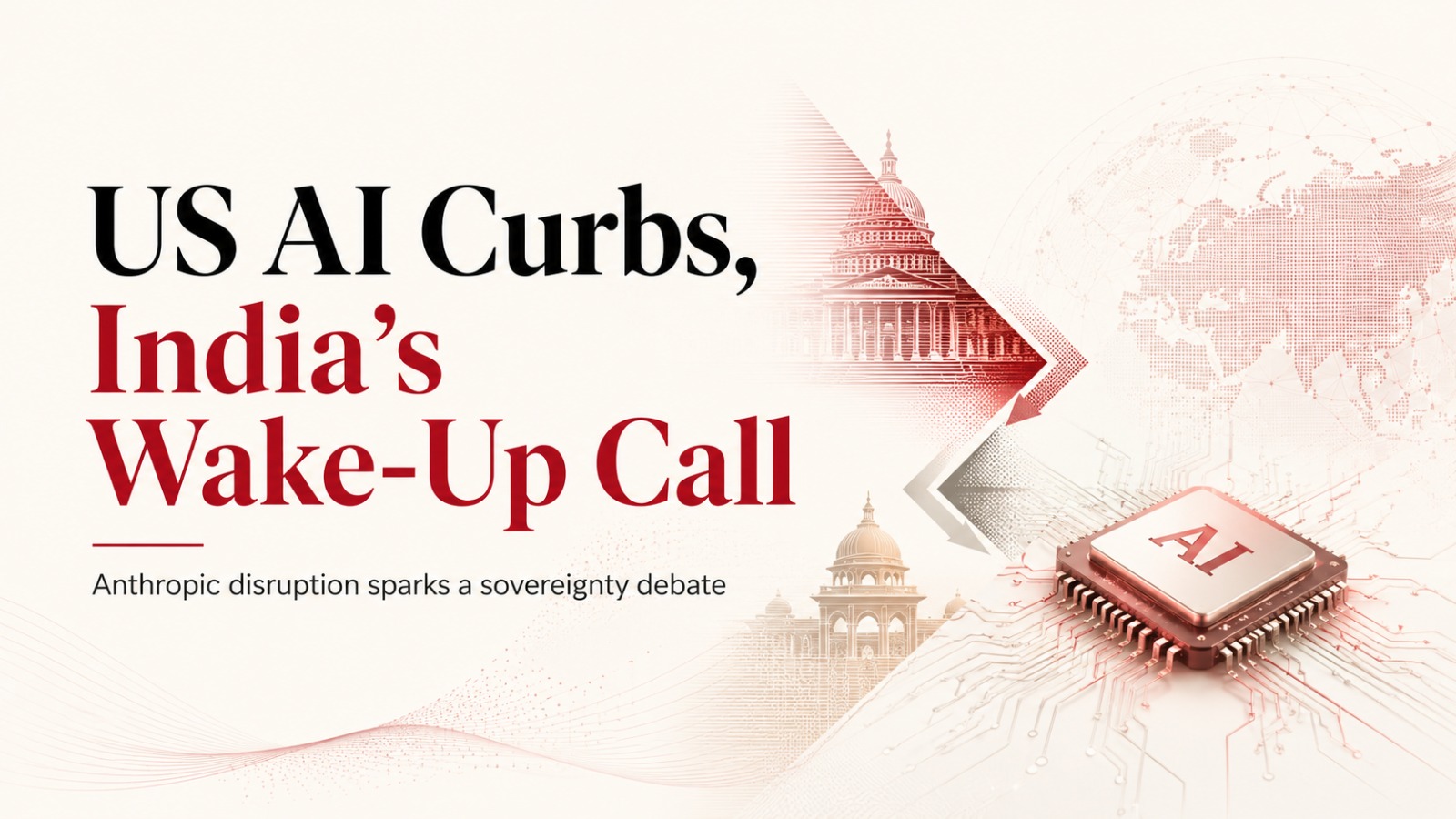
A new statement from Anthropic has triggered a wider discussion on technology control, national security and India’s dependence on foreign artificial intelligence systems.
Anthropic said the United States government, citing national security authorities, issued an export control directive requiring the company to suspend all access to its Fable 5 and Mythos 5 models by any foreign national. The order applies to foreign nationals both inside and outside the United States, including foreign national employees at Anthropic.
The company said the practical result is that it must abruptly disable Fable 5 and Mythos 5 for all customers to ensure compliance. Access to other Claude models, Anthropic said, is not affected.
Anthropic said it received the directive at 5:21 pm ET on June 12. According to the company, the letter did not provide specific details about the national security concern. Anthropic said its understanding is that the government believes it became aware of a way to bypass, or “jailbreak,” Fable 5.
The company said it reviewed a demonstration of the technique and found that it was used to identify a small number of previously known, minor vulnerabilities. Anthropic also said other publicly available models could discover the same vulnerabilities without needing such a bypass.
Anthropic defended its safety approach, saying Fable’s safeguards had been tested for thousands of hours before launch with the US government, the UK AISI, private third-party organizations and internal teams. It said those tests showed Fable’s safeguards were stronger than those of any previously deployed model.
The company added that no tester had found a universal jailbreak that could broadly bypass the model’s safeguards and unlock a wide range of cyber capabilities. Anthropic said perfect jailbreak resistance does not appear possible for any model provider today, which is why it had adopted what it described as a “defense in depth” strategy for Fable 5.
While Anthropic said it is complying with the legal directive, it also said it disagrees with the action. The company argued that a narrow potential jailbreak should not be enough reason to recall a commercial model used by hundreds of millions of people. It warned that applying such a standard across the industry could effectively halt new model deployments by frontier AI companies.
Sridhar Vembu calls it a wake-up moment
Reacting to the development, Zoho co-founder Sridhar Vembu described the move as significant, saying access to Mythos and Fable AI models had been disabled for everyone outside America.
Vembu framed the issue as more than a product disruption. In his view, the episode reinforces two lessons: technology has become the ultimate strategic weapon, and national sovereignty is now deeply tied to technological capability.
He also argued that globalization is effectively over and that Bharat must find its own path forward.
Vembu said the Indian government should immediately ensure that organizations in India embrace smaller AI models, including Indian and Chinese open-source models. His argument was direct: with effort, such models can be made useful, and India should not remain dependent on companies that may not be able or willing to sell critical technology when restrictions arrive.
He also cautioned against assuming that India can simply match the biggest global AI labs by spending its way into the race. Training the most advanced models, he said, requires enormous GPU budgets, and access to those GPUs is itself restricted. He argued that spending tens of billions of dollars of public money on this path would not be wise when that money has better uses.
Instead, Vembu pointed to alternative research approaches. He said Zoho has been pursuing less expensive R&D paths and remains patient, even though cutting-edge research takes time. He also mentioned Sarvam as one of the Indian companies working in this space.
Significance for India
The Anthropic statement and Vembu’s reaction together highlight a question India can no longer treat as theoretical: what happens when access to advanced AI systems can be switched off through national security decisions taken elsewhere?
For Indian companies, developers, researchers and public institutions, the immediate issue is continuity. If a foreign AI model becomes unavailable because of another country’s regulatory or security action, any product, service or workflow built around that model can be disrupted without much warning.
That does not automatically mean India can or should abandon foreign AI systems. But it does strengthen the case for a layered strategy. Indian organizations may need to avoid deep dependence on a single provider, keep viable alternatives ready, and build internal capability around smaller models that can be run, adapted and improved locally.
Vembu’s comments also bring attention to a practical reality of the AI race. The most powerful models are expensive to train, expensive to serve and dependent on hardware supply chains that are not equally available to all countries. For India, the question is not only whether it wants sovereign AI capability. The harder question is how to build it in a way that is affordable, resilient and useful at scale.
Smaller models may become a strategic choice
One of the clearest takeaways from Vembu’s response is his emphasis on smaller models. This is not only a cost argument. It is also about control.
Smaller open-source models can be fine-tuned for specific use cases, deployed closer to users, and adapted for local languages, sectors and regulatory needs. They may not match the most advanced frontier systems on every task, but they can still be valuable for enterprises, government departments and developers that need dependable tools under their own control.
For India, this could mean pushing adoption in areas where smaller models are already good enough: customer support, document search, internal knowledge systems, coding assistance, translation, compliance workflows and sector-specific assistants.
The larger point is that AI capability does not have to be measured only by who trains the biggest model. It can also be measured by who builds reliable, affordable and locally controlled systems that solve real problems.
Anthropic has said it believes the directive is based on a misunderstanding and is working to restore access as soon as possible. The company also said it would share more details within 24 hours.
Until there is more clarity, the episode will likely be read in India as another sign that AI is now part of the global security order. Access to advanced models is no longer just a commercial matter. It can be shaped by export controls, geopolitical trust, national security judgments and hardware restrictions.
For India, the lesson is not panic. It is preparation.
The country will need deeper R&D, stronger domestic AI companies, wider adoption of open-source systems, and a serious plan for reducing fragile dependence on foreign platforms. The Anthropic directive may eventually be reversed or clarified, but the larger warning will remain: in the age of AI, technological dependence is strategic dependence.
Also Read: IndiGo to Start Noida Jewar Airport Flights From June 15