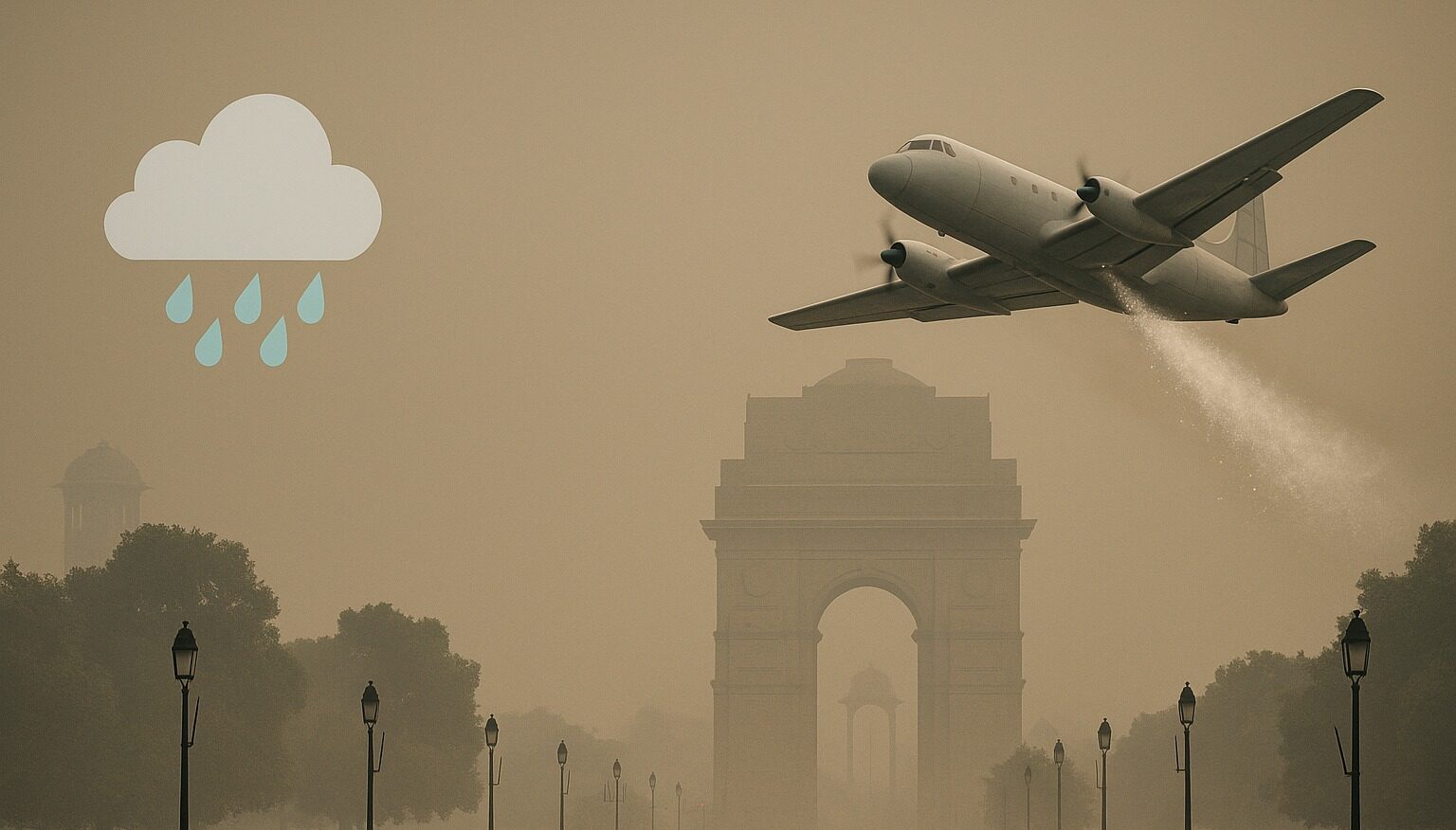
With showers likely in the capital ahead of a cloud seeding exercise planned for October 29, Delhi’s air-quality response has entered a tricky phase: if natural rainfall arrives, it could briefly wash out pollutants, yet it also sharpens the question of whether artificial rain is worth the spend, the risk, or the optics this winter.
What’s being planned and why it’s contentious?
Cloud seeding attempts to enhance precipitation by dispersing particles (commonly silver iodide or salts) into suitable clouds to accelerate droplet formation. It cannot create clouds from clear skies; it only works when “seedable” clouds with adequate moisture already exist.
Even then, outcomes vary widely, and gains are typically marginal and hard to attribute conclusively to the intervention rather than natural variability.
The debate is especially charged in Delhi because the winter atmosphere is famously dry and stable, with temperature inversions that trap pollution near the surface. Scientists caution that these conditions mean the city often lacks the very cloud setups that seeding requires, making success uncertain at best.
Why incoming natural rain matters?
If showers arrive before or around October 29, ambient pollution could dip for a day or two through wet deposition (pollutants washed out by rain). That would offer residents short-lived relief, yet also complicate any effort to judge whether subsequent air-quality changes came from cloud seeding or the weather itself. The scientific consensus highlighted by atmospheric experts is that any rain-led respite is temporary; pollution levels tend to rebound once dry, stagnant conditions return.
The numbers and the risks (as flagged by experts)
- Effectiveness: Global evaluations suggest only 5–20% precipitation enhancement under controlled conditions, with high variability and low attribution confidence.
- Seasonal fit: Delhi’s winter typically lacks moisture-rich, convective cloud systems required for meaningful results; in practical terms, that makes seeding “meteorologically futile” more often than not.
- Duration of relief: Even when rainfall occurs, AQI improvements often last 1-2 days before levels climb back in stable, inversion-prone conditions.
- Environmental caution: Repeated use of silver iodide raises concerns about accumulation in soil and water and potential ecological impacts, even if quantities per sortie are small.
- Cost: One attempt can run to ₹10-15 crore, a sizable outlay for a measure with contested return on investment.
Delhi’s pollution profile: the structural picture
The capital’s winter air-quality spikes are driven by a well-documented mix: vehicular emissions (≈40%), construction dust (≈30%), biomass and stubble burning (≈25%), plus industrial sources, then made worse by weak winds and inversions that prevent vertical mixing. Health impacts are severe: air pollution is linked with high disease burden nationally, and Delhi regularly tops global capital-city pollution rankings.
Policy calculus if it rains before Oct 29
- Attribution problem: Natural showers will make it nearly impossible to isolate any subsequent “effect” of seeding on AQI.
- Timing dilemma: If rain has already fallen, the marginal benefit from seeding soon after may be even harder to justify, given costs and the likelihood of another quick rebound in pollution.
- Public trust: Running high-profile experiments in a week with natural precipitation can blur accountability and feed a narrative of “quick fixes” over structural measures.
What experts recommend instead?
Specialists point to interventions with clearer, measurable payoffs:
- Transport: Fast-track electrification of buses, last-mile fleets, and two-wheelers; tighten inspection and maintenance for legacy vehicles.
- Construction dust: On-site suppression systems, strict site-level compliance, and penalties for violations, especially under GRAP.
- Agriculture: Scale up in-situ residue management (e.g., Happy Seeder, bio-decomposers) with real-time procurement incentives to curb burning.
- Industry & power: Enforce tighter stack norms for thermal plants and brick kilns; accelerate clean-power integration.
- Health & data: Continuous monitoring, targeted advisories, and surge capacity in hospitals during peak pollution weeks.
If skies open up naturally around October 29, Delhi will welcome a brief improvement in the air. But the larger question remains unchanged: is cloud seeding the best use of money and attention in a dry, inversion-heavy winter? The balance of expert evidence says no, particularly when structural steps promise steadier, more durable gains for the city’s lungs.
Also Read: IIT Roorkee’s New Solar Tech Targets 30% Power Efficiency