ChatGPT Ads: Summary of Key Findings
- Native AI Ads, New Format: OpenAI’s January 2026 rollout introduces bottom-of-reply ads in ChatGPT. These sponsored units are clearly labeled and appended after ChatGPT’s answer, contrasting with the interruptive ads of social media feeds and the keyword-triggered ads of search engines. This native placement aims to monetize without breaking conversational flow, but it tests the boundaries of user trust.
- Intent Over Interest Targeting: ChatGPT Ads leverages real-time conversational context to target user intent in the moment, rather than relying on historical profiles or broad interest categories. By “reading” the user’s query and recent messages, the AI can serve ads highly relevant to the task at hand (e.g. a travel query yielding a hotel ad). This represents a fundamental shift from traditional ad targeting, which uses past behavior or search keywords as proxies for intent.
- Early Conversion Potential and Interactive Ads: Initial projections and tests suggest mixed efficacy. Some analyses show ChatGPT referrals converting slightly below traditional search ads, likely due to trust and habit, while others see promise of higher conversion if the AI’s context-rich suggestions hit the mark. Crucially, ChatGPT’s ads can be interactive, users may chat with a sponsored recommendation (ask questions, customize options) right within the assistant. This in-chat engagement could boost conversion rates and even enable “zero-click” purchases without ever leaving the conversation.
- Strategic Market Impact: OpenAI’s move into advertising directly challenges Google’s search ad monopoly and encroaches on Meta’s social ad territory. With ChatGPT’s massive user base (hundreds of millions of users and billions of queries) and high-intent usage, advertisers see a new channel for discovery. A new discipline dubbed Generative Engine Optimization (GEO) is emerging as brands adapt their marketing to AI-driven platforms, optimizing content and strategy to remain visible in AI assistants’ recommendations. Established players like Google are racing to integrate ads into their own generative search (SGE), while brands and publishers grapple with how to appear in (or compete with) AI-generated answers.
- Trust and Transparency at Stake: The introduction of ads raises delicate ethical questions. OpenAI insists that ads will not influence ChatGPT’s actual answers and that user data won’t be shared with marketers, preserving neutrality and privacy. Safeguards (no ads for minors, no ads on sensitive topics, clear labels and user controls to opt out of personalization) have been put in place to uphold trust. Even so, analysts warn that any perceived bias or “answer tainting” for profit could erode user confidence. The long-term success of AI assistants will require a careful balance between monetization and the impartial, helpful tone that drove users to these tools in the first place.
- Outlook-Towards AI-Native Commerce: By 2027, conversational AI monetization could mature into a robust ecosystem. If the model holds, we may see ChatGPT and its peers become AI-native marketplaces where users not only get information but complete transactions in one loop. These “monetized attention loops” would turn assistants into one-stop shops, for example, advising on a purchase and processing the order on the spot. However, the sustainability of this model will depend on user tolerance for ads in an assistant, competitive pressure (some rivals touting themselves as ad-free alternatives), and regulators ensuring transparency. The next two years will be pivotal in determining whether AI chatbots can successfully marry utility with commerce without compromising their integrity.
ChatGPT Ads: The Architecture of Conversational Ads
ChatGPT’s advertising architecture centers on native, in-line promotions that appear within the chat interface itself, specifically, at the end of the assistant’s reply. Unlike a banner or pop-up, these ads are formatted as a natural extension of the conversation. They do not interrupt the user mid-query; instead, once ChatGPT has finished its answer, a clearly separated section labeled as “Sponsored” or “Advertisement” may follow. This placement is deliberate: it mirrors the style of an answer footnote or a gentle suggestion, aiming to feel helpful rather than disruptive.
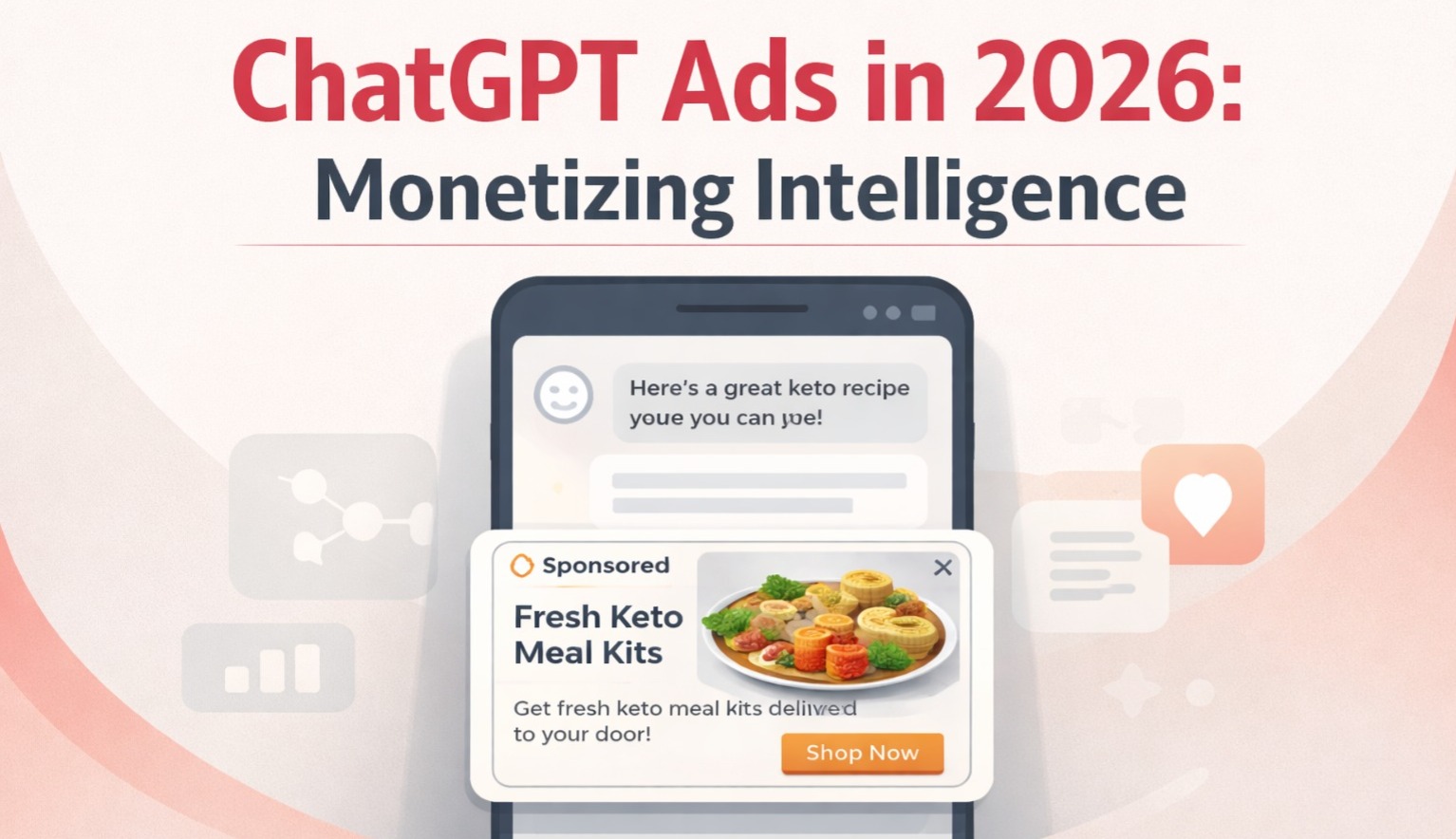
Figure: Example of ChatGPT’s native ad placement. After answering a user’s query (here, providing a dinner recipe), ChatGPT displays a sponsored recommendation, a product relevant to the conversation (e.g. a hot sauce ingredient). The ad unit is marked as sponsored and visually distinct (shaded background), appearing at the bottom of the reply. This subtle insertion contrasts with traditional ad formats that often break the flow of content.
This design stands in stark contrast to the interruption-style ads on social media and the index-based ads in search engines. On platforms like Instagram or Facebook, ads are interwoven into the content feed, you’ll scroll through posts and suddenly encounter a sponsored post that wasn’t explicitly asked for. Such ads compete aggressively for attention, often using vivid imagery or clickbait to divert the user’s focus.
They are effective in driving impulse engagement, but they inherently disrupt the user’s content consumption, essentially saying: “Stop what you’re doing and look at this ad.” In web search (Google being the prime example), ad placements are triggered by keywords and appear above or alongside organic results. They are separated from organic results by an “Ad” label, but in practice they mimic the look of search results.
These search ads are driven by the query text (“keywords”) and advertiser bidding; they rely on the user’s intent only insofar as the user’s search terms reveal it. The experience is one many users have come to accept – the first few links on a Google results page might be sponsored, and we’ve learned to either click them as relevant or scroll past if we’re skeptical. Still, they occupy valuable “top-of-page” real estate and can feel like paid gatekeepers to the information below.
In the case of ChatGPT’s conversational ads, the philosophy is different. The ad is meant to be a natural supplement to the answer, not a distraction from it. Visually, OpenAI has opted for a subdued presentation: a tinted background, a small icon or logo, and text that matches the tone of an assistant’s recommendation.

The sponsored content is “native” in that it tries to blend into the conversational format (much like a human assistant might add, “By the way, you could try …”). However, it is also explicitly labeled to maintain transparency. The psychological impact of this approach is nuanced. On one hand, inserting a sponsored unit right after an answer can leverage the trust the user has in ChatGPT’s guidance, if the AI just gave you a helpful answer, you might be predisposed to consider its follow-up suggestion.
On the other hand, that very dynamic is what gives some observers pause: users might conflate the assistant’s neutral advice with the advertiser’s message. The risk is that the line between unbiased answer and paid placement blurs in the user’s mind, potentially granting advertisers a veneer of authority they didn’t earn.
From an engagement standpoint, though, native conversational ads have an advantage: contextual relevance. Because they appear only when germane to the user’s query, they can theoretically provide value rather than annoyance.
If you just asked ChatGPT how to get rid of a wine stain, a small ad for a particular stain remover at the end of the answer could be seen as timely and even convenient, akin to a friend who, after giving advice, says “You might find product X useful.” This is very different from, say, scrolling through a news feed about your friends’ photos and being randomly served an ad for a stain remover you weren’t even thinking about. By tying the ad to the user-initiated context, ChatGPT’s implementation tries to align the advertiser’s interest with a genuine user need of the moment.
To better illustrate the difference, consider Google’s approach in its new Search Generative Experience (SGE). Google is testing integrating ads into its AI-generated search answers in 2025–26. In Google’s case, ads might appear within the AI’s answer section itself, often as a carousel of product offers or a sponsored listing embedded among the informational text.
It’s an approach still being refined, but early previews showed that even in a generative answer about, say, “best hiking backpacks for kids,” one of the first results could be a sponsored product listing, styled similarly to the organic AI suggestions. This effectively allows advertisers to “buy” a spot in what looks like the search engine’s advice. While clearly labeled, these ads sit inside the answer box, which has raised eyebrows about blurring content and ads.
The ads are presented as part of the AI’s compiled results, a hybrid of traditional search ads and AI recommendations. Users see the sponsored items in-line with organic info, a placement more intrusive than ChatGPT’s bottom-of-answer ads. Google’s approach leverages its existing shopping ad infrastructure, but it walks a fine line in terms of clarity.
Instagram’s ad placement, meanwhile, remains a feed-based insertion. As a user scrolls their feed or watches Stories, ads take over the screen at intervals, often indistinguishable from normal content until you spot the “Sponsored” tag.
The psychological effect of Instagram’s model is well-known, it capitalizes on passive consumption and visual allure, catching users when they are not actively seeking anything. ChatGPT’s model, conversely, targets active problem-solving moments. It’s more akin to the sponsored answers on Q&A sites or forums (where, for example, a query about car repair might have a “recommended mechanic service” as a footnote). The architecture here is about adjacency and relevance, rather than interruption.
In summary, ChatGPT’s conversational ads structurally differ by being native, intent-triggered, and appended rather than interjected. This architecture is designed to minimize annoyance and maximize utility – a user is more likely to accept an ad if it feels like it “belongs” with the answer they requested. However, by placing ads within a trusted answer stream, OpenAI assumes responsibility to keep a bright line between organic assistance and paid content.
The success of this architecture will depend on execution details: how prominently are ads labeled? Is the visual differentiation clear enough to avoid deception? And will users actually find these additions helpful, or see them as a betrayal of ChatGPT’s authentic voice? The early design suggests cautious optimism, a clever blending of form, but the real test will be user reaction as this goes live at scale.
Behavioral Decoding (Intent vs. Interest)
One of the most profound shifts introduced by ChatGPT’s advertising is in how ads are targeted. Traditional digital advertising often hinges on interest-based targeting – using a user’s past browsing history, demographic profile, or inferred interests to decide which ad to show. If you’ve been googling running shoes lately, don’t be surprised if every other website or social app shows you sneaker ads for days.
This model, while effective in certain cases, is fundamentally based on historical data and broad correlations: you showed interest in Topic X in the past, so you’re likely a good candidate for Product Y related to that topic. It’s the engine behind much of social media advertising (where what you’ve liked/followed/watched dictates the ads) and a fair share of search advertising (where your single search keyword triggers ads that advertisers have linked to that keyword via bidding).
ChatGPT flips much of this on its head by prioritizing real-time user intent gathered from the conversation itself. In a live ChatGPT session, the AI has access to the ongoing context, a running transcript of what the user has asked and how the assistant has responded. This window into the user’s immediate needs and goals is incredibly rich. For instance, consider a user interacting with ChatGPT: first they ask about “places to visit in Napa Valley,” then follow up with questions about hotel recommendations in a certain town, then maybe inquires about the weather during a planned month.
Even without any third-party cookies or profile, it’s obvious that this user is planning a Napa Valley trip. The intent (planning a vacation) and even specifics (needs lodging, possibly looking for deals or info) are plain to see in the conversation. ChatGPT could use that context to serve, say, a sponsored offer from a Napa Valley hotel or a wine tour company exactly at the moment the user is deciding where to stay or what to do. This is intent-based targeting in the purest sense: meeting the user at their moment of decision with something relevant.
This approach differs from interest-based advertising where the system might say, “User likes travel content generally, let’s show a generic airline ad at some point.” Instead, ChatGPT might discern what the user is trying to achieve right now and present an ad that aligns precisely with that goal. Advertisers have long prized “high-intent” environments, places where consumers signal they are in market for something (think of how valuable Google Search ads are for queries like “buy laptop online” – the intent to purchase is explicit).
ChatGPT may offer an even more refined lens on intent, because it’s not just a one-shot query but a conversation that reveals purpose, preferences, and context. The chatbot’s memory can carry over earlier parts of the dialogue: if you mentioned you have a tight budget two messages ago, the AI (and thus the ad targeting logic) knows that detail and could favor ads for budget-friendly options.
It’s important to note that OpenAI has stated it will not use personal data profiles or external tracking for ChatGPT ads, a relief for privacy advocates. All targeting is to be done in-session, meaning the ad selection looks at “what is this user asking about right now?” rather than “who is this user overall?”. That means no carry-over of your past chat history into ad targeting, no selling of your conversation logs to marketers, and no creepy feeling that the AI “followed you” from some other site. This is closer to how search engine ads work (query-dependent) but with an even deeper understanding of context. A search engine knows the keywords you typed; ChatGPT knows the whole paragraph of explanation you just got and your follow-up question.
The behavioral decoding in ChatGPT’s case is thus heavily focused on intent signals. For example, the words you use (asking “I need advice on buying a family car” clearly spells out intent to purchase a car), the questions you pose (“what’s the best financing for a mortgage?” indicates you might soon be a home-buyer), or even the tone (urgency, uncertainty, etc. could affect what kind of ad might be most useful, e.g., an urgent question might prompt an ad like “24/7 helpline, speak to an expert now”).
Traditional advertising did crude versions of this, e.g., searching “how to fix back pain” might trigger interest-based ads for pain relief patches because of keyword matching. ChatGPT can do it more holistically: if the conversation reveals you’ve tried a few remedies and are open to new solutions, an AI could infer a stronger intent to find a specific product to solve the problem, and thus an ad for a particular ergonomic chair or a targeted online physiotherapy service might be well-timed.
By prioritizing intent, ChatGPT’s ad system aims to solve a classic problem in advertising: relevance. Ads that align with what the user actually wants at that moment are far more likely to be welcomed (or at least not resented) by users. In theory, this could make ChatGPT’s ads more effective (higher engagement, better conversion) and less annoying than the interest-based ads that sometimes miss the mark (ever get ads for something you already bought last week?
That’s interest-based targeting stumbling). However, this strategy also leans heavily on AI’s ability to correctly read the conversation. If the AI misinterprets intent or context, it could serve an ad that feels wildly off or even offensive (imagine a sensitive personal query being met with a tone-deaf product pitch). Therefore, the precision of intent decoding is critical. OpenAI will need to ensure the AI (and underlying ad system) truly grasps what the user is after, a challenge given the nuances of human language.
Another behavioral aspect is user receptivity. When someone uses ChatGPT, they are typically in problem-solving or creative mode. They come with questions or tasks in mind, and they engage in an active dialogue. This frame of mind might make them more open to solutions presented in context, as opposed to a passive social media user who isn’t looking for anything specific.
In marketing terms, ChatGPT users could be further down the funnel (closer to decision) in many cases. For example, a user asking a chatbot “What budget laptop should I buy for video editing?” is likely quite serious about a purchase, whereas someone seeing a random laptop ad on Instagram might not have any immediate purchase intent. So the quality of user intent is different: ChatGPT taps into intent-rich, declarative user needs, while interest-based channels often work with latent, inferred needs. This may lead to better outcomes for advertisers if harnessed properly.
One thing that OpenAI and advertisers must handle carefully is personalization vs privacy. The promise not to use personal data beyond the conversation means each session stands alone. From a user trust perspective, this is great, you won’t feel like ChatGPT is creepily recalling that you searched for diapers last month. On the flip side, it means ChatGPT’s ads can’t leverage longer-term preferences unless the user brings them up in chat. It’s a more contextually “short-sighted” approach by design.
If a user consistently asks about eco-friendly products in multiple sessions, interest-based systems might learn that and always show green products, whereas ChatGPT’s next session with that user (treated afresh) would only know to show an eco-friendly sponsored option if the user again mentions sustainability in that conversation. This could actually reinforce the importance of immediate intent signals even more – the AI must rely on what it has now, making the accuracy of intent understanding paramount.
In summary, ChatGPT’s ad targeting represents a move from interest to intent, from casting nets based on who the user might be, to responding to what the user explicitly wants to do right now. It’s an evolution in behavioral targeting that could improve relevance and efficiency. The advertising industry has long talked about “right person, right moment, right message”, ChatGPT’s conversational context might finally deliver on the “moment” aspect with uncanny granularity.
If successful, this approach will feel like the AI is almost reading the user’s mind (or at least their agenda) and offering helpful suggestions that happen to be sponsored. If it fails or overreaches, it could feel manipulative (“Did ChatGPT suggest that product because it’s best, or because it was paid to?”). Achieving the former outcome is all about correctly decoding intent and aligning ads to it in a way that feels like enhanced assistance, not ad spam.
The Efficacy Gap
With any new advertising channel, the burning question for businesses is: Does it work better? The “efficacy gap” refers to how ChatGPT’s conversational ads might perform in driving user action (clicks, conversions, sales) compared to more established channels like search engine marketing (SEM) or social media ads.
Early expectations for ChatGPT’s ad format have been sky-high, optimists claim that an AI assistant that practically hand-holds the user through a decision could convert at rates never seen before in digital marketing. Skeptics counter that users might be hesitant or find ways to ignore the ads, making them no more effective than a typical sidebar ad on a webpage. So, what do we know so far, and what can we project about conversion rates and overall ad performance in ChatGPT versus traditional search ads?
Initial data and tests paint a mixed picture. On one hand, consider the typical click-through rate (CTR) and conversion rate (CVR) of search ads. Across industries, a decent Google Search ad might get a CTR on the order of a few percent (say 2–5% of users who see the ad will click it). Of those who click, perhaps a small percentage actually complete a purchase or desired action, conversion rates for many e-commerce search ads often range from 2% up to 10% in very intent-driven categories, with an average in the low single digits.
Now, in a scenario where ChatGPT seamlessly suggests a relevant product and even offers to help you purchase it, one might think the CTR would be very high (why wouldn’t you click if it’s exactly what you asked for?) and the conversion could be easier (fewer steps, since the AI can walk you through). However, early observations suggest users are still somewhat cautious. ChatGPT referrals so far have shown slightly lower conversion performance than organic search in some studies, likely due to the novelty and trust factor. One analysis of hundreds of e-commerce sites in 2025 found that shoppers coming from LLMs like ChatGPT bought less often than those coming from a search engine.
The hypothesis is that users often treat ChatGPT’s recommendation as a starting point, then go “confirm” on Google or a retailer site, resulting in ChatGPT losing the “last click” credit for the sale. In other words, people might ask ChatGPT for advice but still revert to traditional channels to finalize the decision, especially if they feel a need to verify information or see more options.
However, that gap appears to be closing as users grow comfortable with AI. In certain categories and reports, ChatGPT’s conversion metrics have been rapidly improving. By late 2025, some marketers noted that transactional queries (like users explicitly wanting to buy something) handled by ChatGPT were converting almost as well as similar queries on search engines. There are even optimistic data points: for example, when measuring defined “transactions” (like clicking an affiliate link and making a purchase), some internal tests have shown conversion rates from ChatGPT recommendations reaching 5–7%, on par with or even exceeding Google for those specific scenarios.
These pockets of success are usually where the use case is clear and the AI’s answer is trusted for instance, a user directly asking “What’s the best budget smartphone under $300 and can I buy it now?” might be quite likely to follow through on a purchase if ChatGPT gives a solid recommendation with a buy link. Contrast that with a more exploratory question like “What are some good smartphones under $300?” where the user might just browse suggestions and not be ready to click “buy” immediately.
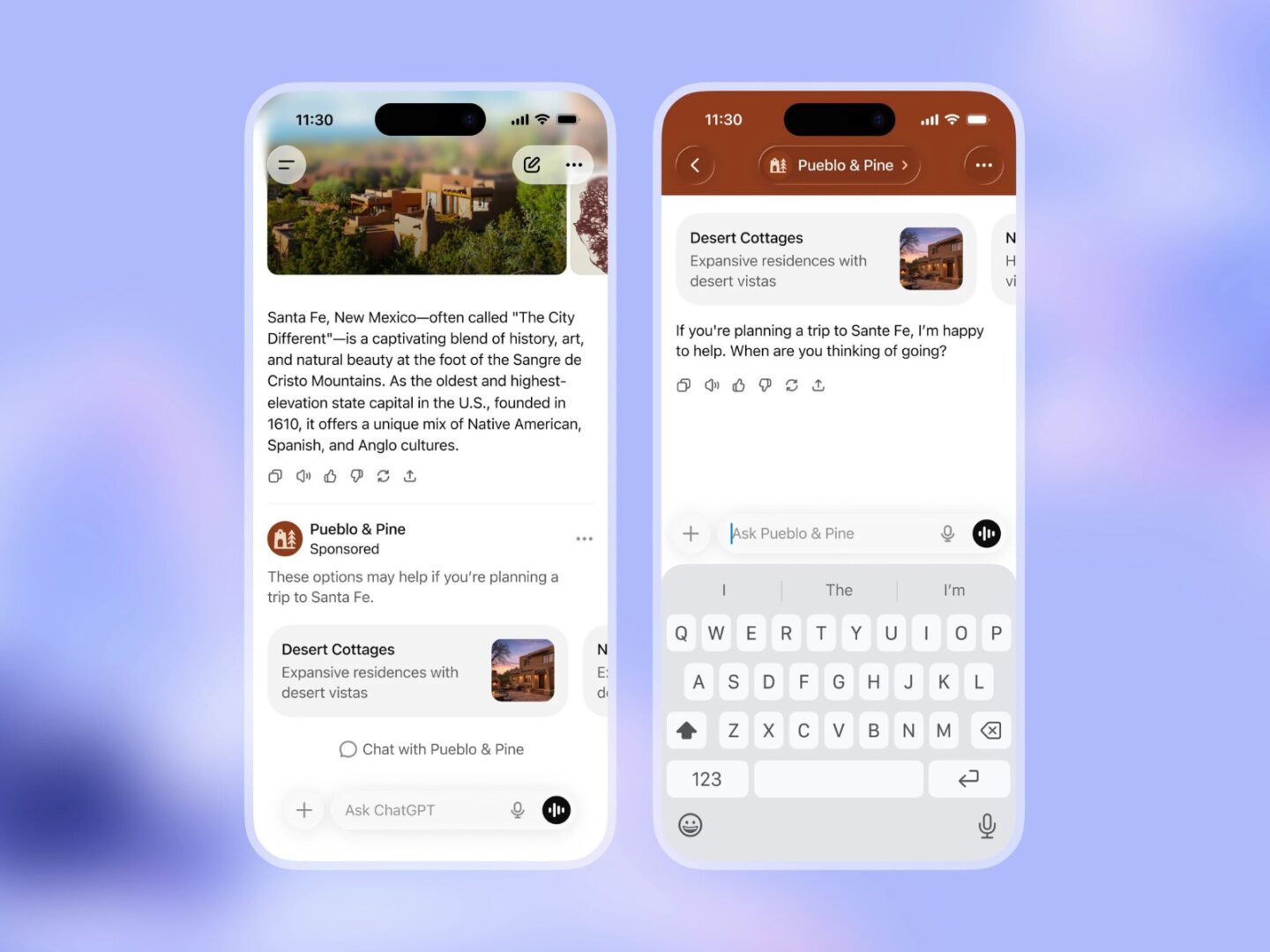
A pivotal advantage for ChatGPT’s ads is the emergence of Interactive Ads essentially ads that don’t end with the ad. In a traditional search ad, the flow is: user sees ad -> clicks ad -> lands on advertiser’s site -> maybe converts there. It’s a one-click handoff. In ChatGPT, OpenAI is experimenting with letting the user engage with the ad inside the chat. For example, if ChatGPT shows a sponsored listing for a hotel (with a prompt like “Pueblo & Pine Cottages – Sponsored”), the user could type right within the chat, “Is it available for March 10-12?” or “What does it cost per night?”.
The AI (through integration with the advertiser’s data or a plug-in) could respond instantly, e.g. “Yes, two cottages are available for your dates at $150/night. Would you like to book or see more options?” This turns an ad into a mini-conversation of its own. Essentially, the advertisement becomes an interactive agent. The implications for conversion are huge: it reduces the friction of having to click out to a website and navigate it yourself. Instead, ChatGPT handles the Q&A, the comparison, perhaps even the checkout steps.
Such interactive ad experiences could dramatically raise conversion rates because they keep the user in a guided funnel. Imagine an “ad funnel” where the AI addresses your objections or questions one by one. In marketing terms, it’s like having a salesperson immediately attend to you, versus just handing you a flyer.
Early tests of interactive ads (though limited) indicate that users who choose to engage with a sponsored suggestion often go much further towards conversion than those who bounce off a regular ad. For instance, if someone starts chatting with the sponsored hotel listing, the likelihood of them finalizing a booking is far higher than a typical click on a travel banner ad. This is intuitive – they’ve invested more in the process through interaction, and the AI has an opportunity to resolve doubts (availability, price, features) in real time.
The concept of Zero-Click Conversions is a logical extension of this. In the web world, a “zero-click search” refers to when a user’s query is answered directly on the results page, so they don’t click any result (Google’s info boxes are a classic example).
In commerce, a zero-click conversion would mean the user completes their purchase or desired action without ever navigating away from the platform. ChatGPT could enable exactly that. For example, after an interactive ad exchange, ChatGPT might integrate payment or account details (with user permission) to let you place an order for that hotel or buy that recommended gadget right within the chat.
The user would go from query to recommendation to follow-up questions to purchase confirmation all in one continuous chat flow. If achieved, this is the ultimate convenience for users – no forms, no switching apps or sites, just a conversational “yes, buy that one” and a goldmine for advertisers, who often lose customers during the jump between platforms (shopping cart abandonment, etc., are often due to friction in those transitions).
To see how ChatGPT’s ad conversions might stack up against search, let’s compare some key metrics side by side:
| Performance Metric | Traditional Search Ads (SEM) | ChatGPT Conversational Ads |
|---|---|---|
| Click-Through Rate (CTR) | ~3-5% on relevant queries (users click a few out of many results) | Potentially higher if the ad is highly relevant to query intent. However, initial CTRs might be tempered by user wariness of sponsored labels. As trust builds, CTR could meet or exceed search ads for intent-focused queries. |
| Conversion Rate (CVR) | ~2-5% average (from click to purchase), varies by industry and intent. Searchers often compare multiple sites, which can dilute conversion. | Early data shows slightly lower conversion than search (~10-15% lower in some studies), likely due to users double-checking info elsewhere. But with interactive ad engagement, conversion efficiency improves. In optimal cases (with in-chat booking/buying), CVR could surpass traditional rates because the funnel is streamlined. |
| Engagement/Time Spent | Low engagement with the ad itself, one click leads out to website; minimal interaction on the search platform beyond clicking. | High potential engagement. Users can ask the ad follow-up questions (multi-turn interaction). This keeps users on platform longer and provides advertisers more touchpoints to persuade (answering questions, customizing offers). |
| Path to Conversion | Click → external site → browse/decide → checkout. User leaves the search engine immediately upon clicking the ad; conversion relies on external site experience. | Conversational loop → optional in-chat action. The user might convert within ChatGPT (e.g. “Yes, book it for me”) if integrations allow, meaning a zero-click conversion from the standpoint of leaving the app. Even if the final handoff to an external site is needed, the user is more informed and primed by the chat interaction, likely making the external step quicker. |
| User Trust Factor | Moderate, users know search ads are ads, sometimes skip them. Trust in results has been eroding if ads feel too prominent. | To be determined, user trust in ChatGPT is high for answers, but it must transfer (carefully) to ads. If users feel ChatGPT only shows truly relevant sponsors and maintains honesty (not skewing answers), trust could remain high, aiding conversion. Missteps, however, could cause users to ignore or distrust the ads entirely. |
As shown above, ChatGPT’s ads have the ingredients to outperform traditional SEM in certain aspects, especially where interactivity and seamless conversion can be leveraged. The idea of never breaking the chain, going from a question to an answer to asking the ad “tell me more” to saying “okay, buy this”, is a marketer’s dream of a frictionless funnel.
It’s the kind of thing that could yield conversion rates far beyond the single-digit norms of today. Indeed, there have been bullish projections from industry analysts: some foresee AI-driven assistants eventually achieving conversion rates several times higher than typical web advertising in high-intent scenarios, precisely because the AI can nurture the lead and close the deal like a skilled salesperson.
However, those projections assume an ideal scenario. In reality, challenges remain. For one, measurement is tricky: if ChatGPT influences a purchase but the user completes it on another device or later, traditional analytics might undercount the AI’s impact (attributing it to “direct” or search traffic instead).
This “last click” measurement issue could initially make ChatGPT ads look less effective on paper than they truly are in guiding decisions, a gap that advertisers will need to account for by looking at surveys or multi-touch attribution. Moreover, the sample sizes of conversions from ChatGPT are still relatively small today compared to the goliath volume of Google searches, meaning any early percentage metrics could swing as adoption grows.
The concept of zero-click conversions also introduces a new paradigm: platforms like ChatGPT might need to integrate payment systems, handle refunds or customer service for purchases made in-app, etc. OpenAI’s strategy seems to be leaning that way, teaming up with e-commerce partners (there are whispers of Shopify plugins and the like) to handle the transaction layer.
If those pieces fall into place by 2027, we could witness a significant shift: where instead of the web’s conversion funnel being scattered across search engines, websites, and emails, it is consolidated into a single AI conversation. That would upend a lot of how marketers calculate ROI (return on investment) and how they allocate budgets. We might see ad budgets flow into conversational ads if they prove to convert more efficiently, even if the cost per ad is high, a higher conversion rate could mean better ROI.
In conclusion, the efficacy gap between ChatGPT’s ads and traditional SEM is not a static one, it’s narrowing and could reverse if conversational ads achieve their promise. At the moment of rollout, one can expect some underperformance in raw numbers as users acclimate (and perhaps are skeptical about ads in this new context). But the unique strengths of the format, contextual relevance, interactivity, and potential one-stop fulfillment are likely to drive superior outcomes in the long run.
It may not uniformly beat search ads for every type of query (for example, a broad informational search might still convert better on a visual webpage), but for commercial intents, we anticipate conversational ads becoming a powerhouse. The real proof will come as advertisers A/B test this channel. If brands start reporting that “ChatGPT drove a higher conversion rate at a lower cost than our search ads,” that will be the watershed moment prompting a reallocation of marketing dollars, and with it, a reconfiguration of the digital advertising landscape.
Market & Strategic Impact
OpenAI’s move to monetize ChatGPT with ads doesn’t just create a new revenue stream for itself – it potentially reshapes the competitive dynamics of the tech industry’s biggest players. In particular, Google’s core business model and Meta’s social advertising empire stand to be challenged. Let’s analyze the market impact and strategic responses likely in play, and introduce the rise of what many are calling Generative Engine Optimization (GEO) as a response to AI-based discovery.
Firstly, the sheer scale of ChatGPT’s usage means even a small diversion of attention from Google could translate into big money. By early 2026, ChatGPT was serving an enormous user base, some reports cite on the order of 800 million weekly active users (a number that rivals mainstream social networks) and billions of queries answered per day. These are not “web searches” in the traditional sense, but they often substitute for them.
Every time a user asks ChatGPT a question instead of typing it into Google, that’s one less opportunity for Google to show an ad. Multiply that by billions of questions, and you see why analysts have sounded alarm bells for Google. Alphabet’s Google makes the vast majority of its ~$200+ billion annual revenue from search advertising. It processes around 8–10 billion searches a day globally. If ChatGPT (or similar AI assistants) end up capturing even, say, 10% of those query volumes in the form of users asking the AI instead, and if ChatGPT can monetize those interactions, that directly siphons off potential ad clicks from Google’s platform.
This threat isn’t lost on Google. In fact, the rollout of ads in ChatGPT is often viewed as the opening shot in a new front of the Google vs OpenAI rivalry. Google has been developing its own conversational AI (Google’s Bard and the more advanced Gemini model, plus integrating AI answers into Search itself via SGE). Google enjoys some huge advantages: decades of relationships with advertisers, an entire ecosystem (AdWords, bidding systems, analytics) built around serving and measuring ads, and deep pockets to subsidize experiments.
It also still controls the primary gateway for billions of users to find information. In 2023–25, Google’s Search Generative Experience began to include ads in its AI answers (as shown earlier), and the company has signaled that its chatbot-style search results (like Gemini) will be monetized with ads as well. So we are heading toward a head-to-head competition: ChatGPT and others on one side, offering a fresh “assistant” paradigm, and Google on the other, trying to infuse its dominant search with AI features – both with advertising in the mix.
One direct outcome of ChatGPT’s ad introduction is to pressure Google’s strategy and revenue. Google cannot afford to have a large chunk of high-value queries (think lucrative categories like shopping, travel, finance) move to an environment it doesn’t monetize. Even if Google’s search volumes remain high, a shift in user preference could force it to accelerate innovation. Indeed, insiders have described Google issuing a “code red” when ChatGPT first surged in popularity and monetization is the next phase of that battle.
If advertisers find that spending on ChatGPT yields good returns (e.g., high conversion as discussed), they might start shifting some budget away from Google Ads. Google’s stock market valuation is built on assumptions of continued ad revenue growth; any sign of erosion due to AI competition could impact its financials and share price significantly. We can expect Google to respond by making its own AI-enhanced search more compelling: ensuring its answers are top-notch, possibly offering unique integrations (for example, Google could leverage Maps, YouTube, etc., in AI answers with sponsored local results or video ads).
Moreover, Google might highlight its broader ecosystem as a defensive moat. ChatGPT as of 2026 is mainly a text-based Q&A agent. Google can tie together search with Gmail, calendar, Android, etc. One could envision Google saying: our AI (Gemini/Bard) can not only answer your question but also, if you’re searching for a restaurant, cross-reference your Gmail for any discount coupons, check your calendar availability, and then present an ad or offer that fits perfectly into your life flow (all while assuring privacy, ideally).
In short, Google will try to play the game of offering personalized AI services plus ads, leaning on its wealth of user data, something OpenAI deliberately isn’t doing right now (since ChatGPT doesn’t use personal data for targeting). This difference in philosophy sets up an interesting strategic contrast: OpenAI bets on contextual relevance and user trust, Google could bet on personalized precision at the risk of being more invasive.
Now looking at Meta (Facebook/Instagram) and other social platforms: they have dominated interest-based advertising. If user behavior shifts such that more product discovery and recommendation-seeking happen in AI assistants rather than scrolling feeds, Meta could feel a pinch. For example, consider how many businesses advertise on Instagram to reach people who might be interested in, say, makeup or fitness gear.
They rely on the serendipity of catching eyeballs. If a significant chunk of those users instead are asking ChatGPT “What’s the best affordable fitness tracker?” and possibly clicking a sponsored result right there, that’s time not spent on Instagram and a missed impression for Meta’s ad ecosystem. It won’t happen overnight, but the attention economy could see a redistribution. We’re essentially talking about AI assistants becoming a new “destination” for eyeballs and decisions that used to occur on other platforms.
Meta’s likely response will be to integrate generative AI into its own products (which it has started doing in features and ad tools) but also to emphasize what AI can’t easily replace: the social proof and community aspect. For some purchases or discovery (like fashion trends, or which café to visit), people enjoy the social media browsing experience, seeing influencers, friends’ recommendations, etc.
Meta might capitalize on that by making their ads more “conversational” in their own way (for instance, click-to-message ads where you chat with a business in WhatsApp or Messenger, they’ve already been pushing those). In essence, Meta could say: “Sure, ask ChatGPT for facts, but if you want authentic human-based inspiration, our platforms are still the place.” Also, Meta has enormous troves of interest data that could still give it an edge in targeting for certain types of advertising that AI intent can’t match like brand awareness campaigns where you’re not targeting immediate intent but planting seeds.
Nonetheless, the potential market impact on incumbents is significant enough that one analyst quipped, “In the short term, OpenAI’s ads might annoy some users; in the long term, they might annoy Google and Facebook even more.” By bringing ads into ChatGPT, OpenAI is signaling that it wants a piece of the $500+ billion digital advertising pie, portions of which have been nearly monopolized by Google (search) and Meta (social) for years. Advertisers, notably, are excited by the prospect. Early commentary from marketing executives indicates they see ChatGPT ads as a way to reach consumers when they are asking for advice, a moment that is very hard to capture in other media.
If you can be the product a user sees exactly when they inquire “how do I solve X?”, that is perhaps the ultimate qualified lead. So even if ChatGPT’s audience is smaller than Google’s, its high-intent use case could command premium ad prices. This puts a competitive pressure on pricing and ROI, Google might have to offer better rates or more innovative ad formats to keep up, and Meta similarly might emphasize the superior reach or engagement of its ads to justify their value.
Enter Generative Engine Optimization (GEO)– a new discipline that has sprung up almost in real-time with the rise of AI answers. GEO is essentially the AI-era analogue to SEO (Search Engine Optimization). If historically companies obsessed over how to get their website to rank on the first page of Google (SEO), tomorrow they’ll obsess over how to get their content or brand mentioned by AI assistants like ChatGPT (GEO).
This has strategic implications: rather than worrying about backlinks and keywords for a web index, GEO involves ensuring that AI models have the right information about your brand. This might include feeding structured data via partner plugins, collaborating on knowledge panels, or even directly paying to be included (blurring into advertising).
For example, a travel company might invest in making sure ChatGPT’s knowledge is up-to-date about its latest tour packages, possibly by providing an API that ChatGPT plugins use. Additionally, some companies may try to game the system: just as some tried to game Google’s algorithm, they might attempt to game AI answers, perhaps by creating content that the AI often draws upon or by fine-tuning their language in product descriptions so that AI finds them “most relevant.”
One strategic shift for businesses is adapting to LLM-based discovery tools. Brands will need to monitor not just their Google rank but also how (or if) they appear in AI assistant answers. We might see new metrics: e.g., “share of voice in AI recommendations”, how often does your product get recommended when users ask relevant questions to ChatGPT, Bard, etc.?
This will drive a lot of behind-the-scenes maneuvers. Some forward-thinking brands are already forming internal teams for GEO, analyzing AI outputs and figuring out how to be the “chosen answer” (when the answers aren’t paid ads). If AI models cite sources, companies will fight to be cited. If AI models use external tools (like a travel plugin), companies will either need their own plugin or to be well-represented on whatever sources the AI trusts.
Interestingly, advertising in ChatGPT may accelerate the formalization of GEO. Once ads exist, it implies a market mechanism: companies could potentially pay for guaranteed placement (as long as it’s labeled). But there’s also the organic side – being recommended even when it’s not an ad. Companies will do what they can to maximize that. Just as the term “SEO” entered every marketer’s vocabulary in the 2000s, “GEO” might become a staple by the late 2020s. Workshops, consultancies, and software tools dedicated to analyzing AI outputs and optimizing for them are already emerging. Search marketing agencies are adding “AI search optimization” to their services.
Another market impact is on publishers and content creators. In the Google era, publishers optimized for clicks from search and got traffic that they monetized via ads or subscriptions. If ChatGPT provides answers directly (sometimes summarizing content from those publishers without a click), that could reduce traffic to external sites, a phenomenon already observed with search snippets.
Now throw ads into the mix: if ChatGPT is making money off an answer that was, in part, sourced from a publisher’s content (but the user never visits the publisher’s page), we might see tension similar to what news publishers have had with Google. OpenAI might face pressure to attribute and share value with content sources. Strategically, this might lead to more partnerships (we’ve seen OpenAI license content from certain providers to ensure data quality and placate them). It could also spur some content creators to try to “beat” ChatGPT by offering unique interactive content that an AI can’t replicate easily.
Finally, consider Microsoft’s role. Microsoft is a major investor in OpenAI and has integrated GPT-4 into Bing (with ads in the Bing chat experience already). Microsoft is clearly interested in using AI to erode Google’s search dominance, something it struggled to do with Bing alone. If ChatGPT’s model works, Microsoft benefits (it has a commercial agreement to share revenues) and can also apply similar approaches in its own products (Office 365’s Copilot, Windows, etc.).
This could spawn an ecosystem where not just web search, but many software interfaces incorporate “helper AI” that might surface sponsored suggestions relevant to your task (imagine working in Excel and the assistant suggests, sponsored, a financing service if you’re making a budget sheet, not far-fetched if monetization gets deeply baked in). Google, of course, will not sit idle and likely will mirror such moves in its Workspace and other products.
In sum, the strategic impact of ChatGPT’s advertising rollout is a catalyst for intensified competition and adaptation across the tech landscape. Google is being forced to innovate and carefully blend ads into its AI results to defend its cash cow.
Meta is watching to ensure it doesn’t lose too much user attention to AI assistants, perhaps by making its social discovery even more engaging or itself leveraging AI to maintain an edge in targeting. Advertisers and brands are salivating at a new channel but also scrambling to learn how to master it (hence the rise of GEO strategies). Consumers, interestingly, might benefit in the short term from this competition, we’re likely to see a burst of innovation in how ads are presented: more relevant, less obnoxious, maybe even useful ads, as each player tries to prove their AI can integrate marketing without turning off users.
The market could fragment initially (various AI platforms each with their own ad systems), but it might also consolidate if one approach proves much more effective. If ChatGPT, for example, consistently delivers better ROI to advertisers, ad budgets will shift, which then funds more AI improvements, creating a virtuous cycle for OpenAI/Microsoft.
If, conversely, users gravitate back to Google’s integrated AI search because they trust it more or find it more convenient, Google could maintain dominance and simply transplant its advertising heft into the AI format. We may also see new entrants – perhaps Amazon, which has immense commerce data, will get more aggressive with its own AI assistant and ads (they already have Alexa voice ads and Amazon’s search ads).
The concept of LLM-based discovery tools isn’t limited to Q&A assistants; it could be integrated in shopping sites, video platforms, anywhere content is served. So brands need to be nimble: the playbook of the 2020s will involve ensuring presence in a multitude of AI-driven contexts.
In a sense, we’re witnessing the early stages of a new marketing channel emerging – conversational AI marketing. Its relationship to existing channels is both complementary and competitive. Strategically, all players are hedging their bets: Google hedges by building its own AI, Microsoft by backing OpenAI while still running Bing, Meta by incorporating AI features but highlighting community, Amazon by possibly turning Alexa into a shopping concierge with ads, and so forth.
The only sure bet is that the status quo of the digital ad duopoly (Google-Facebook) is being upended. The pie will be more widely contested, and possibly expanded, if AI assistants drive more overall engagement time or even create new kinds of commercial queries that didn’t exist before (e.g., someone might ask an AI a highly specific question they wouldn’t have bothered to type into a search box, thereby creating a new opportunity for a niche product to be suggested).
For consumers and regulators, all this raises questions too, will this competition lead to better ad experiences or just more pervasive advertising in every corner of our tech? That remains to be seen, but certainly the strategic maneuvers in 2026-27 among the big tech companies will shape how we interact with information and commerce for perhaps the next decade or more.
Ethical and Trust Boundaries
When OpenAI announced it would introduce ads into ChatGPT, it was quick to reassure users: the core answers ChatGPT provides would remain unbiased and untethered to advertising interests. In their communications, OpenAI stressed principles like “answer independence”, meaning the AI’s answer to your question won’t be skewed or altered by the presence of a sponsorship. The ad, they promised, would be a separate, clearly labeled unit. This delineation is crucial, because the ethical boundary between providing helpful information and promoting a paid product needs to be bright and unmistakable. If users ever suspect that ChatGPT’s advice or info is influenced by who’s paying, the trust that the entire service is built on could collapse.
One immediate ethical concern is transparency. To OpenAI’s credit, the implementation is trying to be transparent: ads are labeled as such, and users will have controls (such as the ability to ask “Why am I seeing this ad?”, dismiss ads, or even opt out of personalized targeting). This mirrors the transparency tools in other platforms but is especially important in a conversational context. In a chat, everything appears in one stream of text bubbles, so distinguishing a sponsored bubble from a factual answer bubble is essential.
The use of labels and shading (as seen in the design mock-ups) is a step in that direction. The ethical bar, however, is higher than just labeling. Disclosure must be coupled with integrity. Users need to feel confident that if they ignore the ad, they’re still getting the best possible answer from ChatGPT, and if they do engage with the ad, it’s because it’s relevant, not because it was deceptively injected.
OpenAI has drawn some lines in the sand preemptively: for instance, no ads to users under 18. This is a notable stance, effectively saying they won’t commercialize conversations with kids or teenagers at all. That removes certain thorny areas (advertising to minors can be fraught with legal and moral issues) and it’s likely a wise move to avoid any hint of exploiting vulnerable users. They’ve also said no ads related to sensitive topics like health, politics, or mental health. This suggests that if you ask ChatGPT about a medical issue or a personal crisis, it won’t suddenly show an ad for a pharmaceutical or a counseling service.
The rationale is clear: those are domains where impartiality is paramount and commercial influence would be especially controversial (imagine if an AI seemingly recommended a specific drug while you’re asking about symptoms, that would rightly raise alarms about conflict of interest). Keeping ads out of these areas is a form of ethical safeguard to maintain trust that critical or sensitive advice is not being compromised.
However, just because those overt sensitive categories are off-limits doesn’t mean there aren’t gray areas. For example, what about financial advice? OpenAI hasn’t explicitly said they’d block, say, stock trading ads or loan ads when discussing personal finance, they might choose to, but it falls in a gray zone.
Likewise, what counts as “health”? Would fitness or wellness products be considered health (probably yes, they might block those ads around health inquiries)? There will need to be ongoing policy refinement as unpredictable user queries meet advertiser offerings. The company will likely err on the side of caution initially to avoid PR fiascos, e.g., an early scandal of “ChatGPT suggested a questionable product to a depressed user” could be devastating.
The trust boundary also relates to data usage. OpenAI has made a promise that user conversations will not be shared with advertisers or used to build marketing profiles. This is a fundamental privacy commitment. Technically, it means when an advertiser buys an ad, they aren’t getting to target specific individuals based on past chat behavior (beyond context), nor will they receive data like “User X clicked your ad and here’s what they asked ChatGPT before”. This differs from many online ad systems that do share some data back with advertisers (e.g., in web ads an advertiser may know what site or article an ad was shown on, or get tracking info).
In ChatGPT’s case, an advertiser might only know broad strokes like their ad was shown for a conversation context about “travel planning” perhaps. This limitation is good for user privacy, but interestingly it might limit how much advertisers can optimize or how comfortable they feel spending (advertisers love data feedback). Yet from an ethical standpoint, it’s absolutely vital. If users feared that everything they tell ChatGPT – which can be very personal or sensitive, might be siphoned off to advertisers, it would chill their willingness to use it freely. OpenAI’s stance effectively is: the ad system can read the conversation (since that’s how it targets relevant content), but none of that info leaves our black box.
Only the relevant ad gets served, and that’s it. Users are also promised the ability to turn off even that contextual targeting (personalization), meaning you’d just get generic ads if you prefer – another nice-to-have, though if the ads become too generic, their value drops. It’s a balancing act between personalization (for relevance) and privacy (for trust).
Now, let’s consider the long-term risk to neutrality. Once advertising enters the picture, even with the best of intentions, there is a financial incentive that could, over time, erode principles. Today, OpenAI can say “We won’t let ads influence our answers.” But what about subtle influences?
For example, if certain topics consistently lead to lucrative ad clicks, will there be pressure to nudge users toward those topics or to shape the conversation flow to create an ad slot? Perhaps not overtly, but even internal bias could creep in. Suppose recommending products becomes normalized, will ChatGPT sometimes recommend a product as part of an answer (organically, not as a separate ad) because it “knows” that often helps users… and by coincidence that product might be an advertiser?
These are hypothetical scenarios that underscore why guardrails and transparency need to be continuously reinforced. Ideally, OpenAI will institute strict firewalls: the team/development that works on the AI’s answer generation is separate from the ads team, and policies forbid any meddling with answer quality or content for revenue reasons. They’ve basically said that in principle. But as the revenue from ads grows, the corporate pressure could mount. Public companies (OpenAI might IPO in the future) face investor demands to increase profits, and we’ve seen in social media how algorithms slowly twisted to favor engagement (to show more ads) at the cost of perhaps user well-being.
A key ethical question: Will ChatGPT optimize for time spent (like social media did) or strictly for user satisfaction? OpenAI’s messaging is that they won’t optimize for time spent or ad clicks at the expense of user experience. We’ll have to hold them to that. If chat answers start getting artificially prolonged or if the assistant starts posing follow-up questions of its own just to keep you engaged (and see more ads), that would be a red flag.

Another area is manipulation and user autonomy. AI systems are persuasive by nature of being interactive and knowledgeable. If not careful, an AI could upsell or steer users in ways that feel like overreach. For example, you might ask for a recipe and get a good one, great. But what if the AI then really pushes the sponsored ingredient: “Would you like me to order this spice mix for you? Many users have liked it.” Is that helpful or does it cross into manipulation? Some might appreciate the convenience; others might feel the AI is being too pushy on a commercial agenda. Drawing that line will be tricky. It involves designing the tone of sponsored content to be informative but not coercive.
If the AI’s normal helpfulness crosses into salesmanship, trust could degrade. Users might think, “Is it helping me or selling to me right now?” One philosophy might be to let the user always initiate engagement with the ad (i.e., the ad is presented but the AI doesn’t act on it unless prompted). That’s largely how it’s planned: the ad shows, and the user can click or ask about it if they want. The AI isn’t supposed to say, “So, do you want to buy it? Huh? Do ya?” on its own. Maintaining that respectful distance is key.
Ethically, there is also the issue of fairness and bias in which ads are shown. If ChatGPT is truly conversation-contextual, it might end up showing a limited set of advertisers (whoever fits that context and is paying). Smaller companies might worry they’ll be outbid by big ones, leading to a sort of bias where the AI predominantly suggests big brand solutions. It’s similar to how Google’s ad auctions can favor companies with deep pockets. Users might unknowingly be getting a slanted picture of available options (“sponsored = often the highest bidder”).
If a user asks for “best budget smartphone”, and an ad pops up for a well-known brand’s mid-range phone because that brand pays for placement, did the user miss out on a potentially better or cheaper option from a lesser-known brand that can’t afford ads? The neutrality of answers and ads interplay here. One possible mitigation is that ChatGPT could still mention various options in the answer but then have a sponsored one highlighted separately.
As long as the organic answer is comprehensive and not censored, the ad is just an extra. But if the ad essentially becomes the answer (for instance, the AI might give a brief generic response and the detailed suggestion is the sponsored one), then neutrality is compromised. It will be important for OpenAI to monitor and ensure that the presence of ads isn’t diminishing the quality of the non-sponsored content delivered.
User trust in ChatGPT has been high because it was not perceived as having an agenda, it was just a clever machine trying to help. Now there’s an agenda creeping in: revenue. Even if users consciously know the difference, subconsciously it could introduce doubt. Especially if any scandal or mistake happens, say a story breaks that an ad was shown inappropriately or that someone was misled by an ad in ChatGPT.
The media and public could quickly pounce with “ChatGPT can’t be trusted; it’s shilling for companies.” OpenAI has to avoid that by a combination of policy, technological filtering (robust checks so that scammy or low-quality ads don’t get through, for instance), and user education. It may need to clearly communicate how it selects which ad to show (e.g., “based on your query about running shoes, we have a sponsor in that category – here it is”). There’s an argument for an ethical guideline akin to editorial independence: treat the AI’s main output like editorial content and ads like advertising content, and never the twain shall meet.
This model has long existed in journalism (good newspapers have a wall between editorial and advertising). If OpenAI can uphold a similar standard, it bodes well for trust. Perhaps they’ll even have an internal ethics review board to oversee ad practices.
Another potential trust issue: what if advertisers start influencing the AI in indirect ways? For example, could a company pay to have their product organically mentioned more by the AI (not as an ad, but within answers) under the table? OpenAI would likely refuse such deals as it would be blatantly unethical.
But one could imagine more subtle things, like advertisers sponsoring certain “knowledge panels” or data sources that the AI draws from. This is speculative, but the point is, once money flows, people will try to find creative angles. OpenAI will need to guard the purity of its knowledge base and answer generation process. This is why many in the community will watch closely if answers start to seem less neutral.
We should also mention user psychology and dependency. If ChatGPT becomes a heavily monetized platform (even with just one ad per reply), over time could it change user behavior? Perhaps users become more transaction-oriented with the AI, or conversely, tune out anything that looks like an ad (banner blindness, but in chat form).
If the latter, then the ad efficacy goes down and OpenAI might be tempted to make ads more ingrained (which would then hurt trust more a vicious cycle). If the former (users actually embracing the convenience of in-chat commerce), one has to ensure users are still making informed choices and not just blindly following the AI’s first suggestion because it’s easy. There’s an ethical duty to ensure that the AI will, for example, still mention in its non-sponsored answer if a non-sponsored solution is clearly better for the user.
Say you ask for a software recommendation and the best one is a free open-source tool, while a decent one is a paid product that happens to sponsor ads, a trustworthy AI should tell you about the free one in the answer, even if it then shows a sponsored link for the paid one as an alternative. As a user, if I see the assistant mention “You could use OpenTool (free) or SuperSuite (paid, more features). [Then ad: Try SuperSuite with 20% off]”, I feel it gave me the unbiased picture and I see the ad as just an option. If, instead, the assistant answer glosses over the free solution and I mainly see the paid suggestion in the sponsored unit, I’ve possibly been misled by omission.
OpenAI’s leadership is well aware of these nuances. Sam Altman (CEO of OpenAI) had historically voiced misgivings about mixing ads with deep AI interactions, even calling it “unsettling” at one point. Now that the company is going down this path, they will be measured against their promises to do it in a user-first way. Will they manage to generate revenue without “selling out” the user’s trust?
Many skeptics point out that tech companies often start with noble restraint and then gradually, under pressure to monetize, they push the boundaries (look at how Facebook’s use of personal data escalated over time). OpenAI’s relative transparency in launching this (with a public explanation of principles) is encouraging. Also, the subscription tiers remaining ad-free (Plus, Pro users get no ads) is a good sign, it means they are not forcing ads universally, acknowledging that some users will prefer to pay to avoid any conflict of interest.
Looking a bit further out, there are also regulatory and societal perspectives. Regulators may eventually step in to set rules for AI advertising, especially if there’s any hint of manipulation or harm. Truth-in-advertising laws, which apply to search ads or social ads, would presumably apply to AI-served ads too. For example, if an ad claim is misleading, who is responsible, the advertiser or OpenAI? Likely the advertiser, but OpenAI might have to vet ads carefully to avoid hosting deceptive content, especially because users might attribute more credibility to something seen in ChatGPT.
The company has said it will block certain categories of ads (like political ads, presumably, given the sensitive topics exclusion), which preempts some issues. Politically or ideologically, an AI with ads could become a target if, say, it’s accused of preferentially showing ads from certain companies or countries. OpenAI might need to consider fairness – ensuring a variety of advertisers get exposure, not just one dominant partner, to avoid the appearance of favoritism or monopolization in certain advice domains.
In conclusion, maintaining ethical integrity and user trust as ads roll out in ChatGPT is a tightrope walk. The promises made – no influence on answers, privacy protection, user control, and limited scope of ad topics – are all positive steps. The real challenge is enduring: as revenue pressures mount, will OpenAI stick to these principles rigorously? Trust is hard to earn, easy to lose. The first months of this rollout will be critical in setting precedents. If done right, users might hardly mind the ads, viewing them as just occasional helpful suggestions with clear labels.
If done poorly, even a single high-profile incident of perceived “corruption” of answers could sow doubt in millions of users. That doubt is exactly what Google, for example, would love to instill (Google’s CEO said something along the lines of “we have to get this right, or people will lose trust in AI outputs”). In an environment where multiple AI assistants will compete, trust could become a key differentiator. the one that is known to be clean and unbiased might win loyalty, while one that’s seen as ad-ridden or manipulative will be abandoned.
OpenAI is effectively setting an industry standard here: if it can prove that an AI assistant can incorporate ads responsibly, it could define best practices for all others to follow. The boundaries must be clear and respected. Users will likely tolerate the monetization if they continue to feel respected and not exploited. The company’s fortunes (and indeed the broader acceptance of AI assistants in daily life) may hinge on keeping that social contract intact: “We, the AI, will serve you first and foremost and yes, we’ll show you a sponsored tip now and then, but only in ways that benefit, or at least do not harm, your experience.” The coming years will test how well that promise holds up under the weight of commercial interests.
Strategic Outlook for 2027
Projecting a year or two into the future, we find ourselves asking: will this experiment in AI monetization fundamentally change how we interact with technology and commerce? By 2027, the landscape of AI assistants and advertising will likely have evolved through several phases of adjustment by companies, regulators, and users. Let’s consider a few key projections and scenarios, keeping a forward-looking yet critical lens, much in the spirit of a Wired or Economist analysis peering into the near future.
1. Will the model hold? The early monetization model of ChatGPT (ads for free users, no ads for paid tiers, strict neutrality of answers) will be tested by market forces. If it proves financially successful without driving users away, it could become the de facto standard for AI services. By 2027, I anticipate that most mainstream AI assistants (whether from OpenAI, Google, Amazon, or startups) will have some form of advertising or sponsored content, unless they are explicitly subscription-only premium products.
ChatGPT’s approach might hold, but possibly with refinements: for example, more interactive ad formats as discussed, maybe sponsored tool integrations (imagine in a coding assistant, a sponsored cloud service snippet suggestion), and more sophisticated targeting that still abides by privacy rules. There is a chance, however, that user pushback could force modifications. If in 2026 we see a lot of user complaints or a stagnation in ChatGPT’s usage growth because people dislike ads, OpenAI might have to tweak the strategy – perhaps limiting ad frequency or inventing new ways to make them less intrusive (maybe ads that you can proactively pull in rather than are pushed every time).
2. Rise of AI-Native Commerce Ecosystems: We are likely to witness the emergence of AI-native marketplaces. OpenAI itself might not want to build an Amazon-like store, but through partnerships and plugins it could become a gateway to purchase almost anything via conversation. By 2027, a user might routinely do their shopping by telling an AI assistant what they need, getting a few personalized suggestions (some organic, some sponsored), and completing the purchase through the assistant which coordinates with vendors behind the scenes.
This is a sort of concierge economy, your AI as the concierge for all services. Companies like Amazon, which dominate e-commerce, won’t sit idle: expect them to have their own AlexaGPT or similar, offering voice/chat shopping that may include promotions (Amazon already has a huge ads business on its site – those could manifest as voice “We have a deal from Brand X on this item” in an AI conversation). Essentially, conversational commerce will become mainstream. We might see new players too: perhaps specialized AI shopping assistants (some could even be white-labeled for retailers).
In these AI-native commerce loops, advertising and purchasing blur. Is it an ad if my AI says “Would you like me to order your usual toothpaste? It’s on sale”? It’s helpful, it’s commercial, but maybe not a paid ad – or maybe it is if Colgate paid for that mention. The definition of “ad” may broaden. Platforms will need to ensure they keep user consent and clarity in those loops.
The optimistic scenario is these loops are very user-centric: you get what you need faster and easier than ever. The pessimistic scenario is it becomes an all-consuming “attention loop” where the AI is always trying to monetize every interaction subtly – a nightmare of commercialization. Given the backlash that could cause, I suspect the successful model will lean more toward optional monetized interactions rather than making every query an upsell opportunity.
3. Impact on traditional search and SEO: By 2027, we might see Google’s traditional search usage notably declined (especially among younger users who prefer chat interfaces or multimodal AI). As a result, the SEO industry will largely pivot to GEO (Generative Engine Optimization). Companies will optimize content not just for one AI but for multiple, e.g., making sure their info is in the training data or plug-in ecosystem of OpenAI, Google, Anthropic, etc. We’ll likely have seen at least one high-profile case of a brand complaining that AI assistants are not mentioning them (maybe a travel site lamenting that ChatGPT’s travel plugin bypasses their site, or a consumer brand upset that AI often recommends a competitor).

These complaints might lead to new paid inclusion models, in other words, some companies may pay to ensure their content is accessible to AI (beyond just ads). This treads into ethical territory again, but from a strategic view, content providers and AI platforms will have new symbiotic or sometimes adversarial relationships. For instance, news organizations might either block AI from using their content (if they feel they aren’t getting credit) or partner with AI to have their articles summarized with a citation (and maybe a sponsored context if it’s an e-commerce content site like a review site).
4. AI Assistants vs. Walled Gardens: As every major tech firm deploys AI assistants, we might get “walled garden” effects. Perhaps ChatGPT suggests you buy from Microsoft Store partners, Google’s AI suggests you buy from Google Shopping or YouTube merchandise, Amazon’s suggests from Amazon itself.
This competition could shape monetization strategies (maybe OpenAI remains more neutral and willing to send traffic anywhere, which could be a competitive advantage if users sense it’s brand-agnostic; whereas if a rival always pushes its own ecosystem, users might notice the bias). Then again, average users might not care as long as they get a good deal easily. By 2027, user loyalty might shift from specific websites to whichever AI assistant they trust to handle things. That’s a huge power shift – akin to how people moved from individual websites to Facebook feeds for content, now to AI assistants for answers.
5. “Monetized Attention Loops” in mature LLM interfaces: This phrase captures a scenario where the AI tries to keep you engaged in a cycle of content and commercial action in a way that maximizes revenue per user. Social media perfected the infinite scroll to keep your attention for ad impressions; an AI could attempt a conversational equivalent. For example, after helping you with one task (and showing an ad), it might proactively suggest another related task or topic to discuss (with possibly another ad down the line). Done ethically, this could be seen as the assistant being thorough or anticipating needs. Done cynically, it’s the AI not knowing when to let go because as long as you chat, there’s money to be made. By 2027, we’ll likely have identified metrics like “Average Revenue per Chat Session” or “User Engagement Duration” for AI platforms, and those will drive design.
The concern is whether AI assistants fall into the same trap as social media, optimizing for engagement (because engagement yields opportunities to monetize) at the cost of user well-being or productivity. Perhaps one assistant differentiator will be “I get you what you need in 2 minutes and let you go (with maybe one ad),” while another tries to engage you for 20 minutes with a more immersive experience (and shows multiple ads). Different users might prefer different styles.
I would not be surprised if by 2027 there’s also a rising market for ad-free AI experiences as a premium or even as open-source alternatives. For instance, maybe an open-source LLM running on your device (or a paid subscription service focused on privacy) will explicitly say: we will never show ads or commercial bias and some segment of users might flock to that for certain queries, much like some people moved to DuckDuckGo for an ad-light search experience.
OpenAI’s own stratification (ad-free for Plus/Pro) is evidence they acknowledge one size won’t fit all. Perhaps they will expand their offerings: a higher-priced tier that might even give extra assurance of data not being used even for internal targeting, or special industry-specific versions with no ads for professional use.
6. Regulatory landscape in 2027: By then, governments may have enacted initial regulations on AI transparency. It could be that an AI must disclose when content is sponsored in a standardized way (maybe a spoken cue for voice AIs, or a consistent icon, etc.). There might be rules about data usage that enshrine what OpenAI voluntarily did (no selling user data).
If there were any consumer harms or legal disputes in 2026 related to AI ads (imagine someone suing saying the AI’s sponsored recommendation caused them some loss or was negligent), that could result in case law or regulation clarifying liabilities. We may see something analogous to the rules for influencers (they have to tag #ad when promoting something) – AI might have to verbally or textually indicate sponsorship very clearly. OpenAI’s current approach likely already meets that, but standardization could come.
7. Consumer adaptation: By 2027 consumers might be quite acclimated to AI assistants in daily life, and by extension, to those assistants occasionally pitching products or services. The novelty will have worn off. People might develop their own mental filters (“I trust ChatGPT’s answers, but I take its ads with a grain of salt unless I already know that brand,” someone might say, similar to how we treat Google ads now). Or perhaps, if the model works extremely well, people will actually find themselves comfortable making purchases via AI suggestion, more so than via random web ads, because at least the suggestion came when they wanted it.
There is a potential that conversational ads increase consumer confidence if done right, because they can immediately get answers to questions about the product. That two-way interaction might lead to fewer cases of buyer’s remorse (you could thoroughly interrogate a product via the AI before buying). If that happens, advertisers will trumpet the higher quality leads they get from AI, maybe fewer clicks, but those who do engage are serious and well-informed, thus converting at high rates and with satisfaction. This could actually pressure other ad formats to get more informative or interactive to compete.
8. The bigger picture: “The Monetization of Intelligence” as we titled this isn’t just about ChatGPT – it’s about a shift where AI itself becomes the new battleground for monetizing human attention and intent. By 2027, intelligence (artificial intelligence that is) will be embedded in our cars, our appliances, our work software, etc. We should watch for the spread of advertising into those realms too. Will your smart fridge recommend a certain grocery brand’s product (because of a sponsorship) when it notices you’re low on milk? It could. Will your car’s AI navigation recommend a sponsored pit stop or restaurant as you drive? Possibly, if not by 2027, then soon after.
This raises the question of how far this will go and whether there will be a consumer breaking point or a new equilibrium of acceptance. Society may need to decide which AI contexts are okay to monetize and which are not. We usually don’t see ads in paid products (like if I buy a car, I don’t expect ads on the dashboard screen – although some automakers have flirted with that idea). If AI becomes akin to an extension of ourselves, will we accept it constantly trying to sell us something?
I suspect by 2027 we’ll have a clearer segmentation: fully ad-supported AIs (free, ubiquitous, maybe in smart home devices given away cheaply, like how TVs nowadays sometimes come subsidized by data-driven ads), versus premium ad-free AIs (as part of, say, enterprise software or subscription packages). The market will have both, and users will self-select based on preference or ability to pay.
In any case, the economics of intelligence will be well established: companies will realize that controlling the AI interface is extremely lucrative, because it’s not just capturing clicks, it’s capturing decisions. The assistant that helps you decide holds sway over where the money flows.
Monetized attention loops, then, in a mature form might look like this: a continuous cycle where your AI learns your patterns, anticipates needs, suggests products or content (some sponsored, some organic) to fulfill those needs, executes the transactions or engagements, learns from the outcomes, and then the cycle repeats.
Each loop is an opportunity to monetize (either via direct sale, affiliate commission, or ad impression). The challenge for AI providers is to do this in a way that feels like a service, not exploitation. If they succeed, consumers might actually prefer this loop to the old model of hunting for things themselves. If they fail, people will seek refuge in less commercialized tools.
In summation, by 2027 I envision a world where AI-driven advertising is an entrenched part of the digital economy. ChatGPT’s advertising evolution is likely the template that others will refine. The model – if it holds – will demonstrate that you can insert monetization into machine intelligence without completely losing user faith, provided you do it carefully.
We’ll likely see increased revenue figures reported from AI ad segments (perhaps by 2027 OpenAI or its partners will be boasting multi-billion dollar ad revenues, reflecting how quickly marketers have embraced it). We’ll also likely see a few bumps along the road: perhaps some controversies or regulatory challenges that shape the norms.
One thing is certain: the genie is out of the bottle. Intelligence, especially artificial, has become a commodity to monetize. The hope is that this monetization of intelligence can be channeled in ways that fund innovation and make AI widely available (OpenAI’s justification is that ads help keep a free tier for broader access), rather than in ways that corrupt the intelligence or deceive the user.
If the former, the next few years could usher in a golden era of truly personalized, helpful digital assistants that deftly and transparently weave in commerce when it’s welcome, a sort of symbiosis of utility and advertising. If the latter, we might see a fracturing of trust and a retreat from AI assistants, or at least constant battles to keep them honest.
For now, the trajectory seems to be one of cautious optimism from OpenAI and cautious interest from users and advertisers. By 2027, we’ll know if that caution was sufficient or if the monetization drive took on a life of its own. As we watch this space, one can’t help but recall the arc of previous tech disruptions: initially hailed as empowering and benign, later marred by unintended consequences of commercialization.
The stake here, an AI that billions may use as an extension of their mind makes getting it right all the more critical. The world will be watching how ChatGPT’s advertising evolution unfolds, and whether “intelligence” can be monetized in a way that truly benefits all parties involved, not just the ones paying for the ads.