While electric vehicle makers race to replace engines and build charging networks, one New York startup is taking a quieter but strikingly different path. Instead of changing vehicles, it is changing the fuel itself. The pitch is bold: real gasoline, made without oil, produced directly from the air.
For years, the clean energy debate has been framed as a choice between sustainability and practicality. Electric vehicles cut emissions, but they depend on charging infrastructure, grid stability, and long supply chains that are still far from universal. Outside major cities and wealthy markets, those limits remain real.
At the same time, fossil fuels are deeply woven into transport, logistics, and emergency systems worldwide. Replacing them overnight is not realistic. That tension has created room for technologies that work with existing systems rather than against them.
A Rooftop Machine That Turned Heads
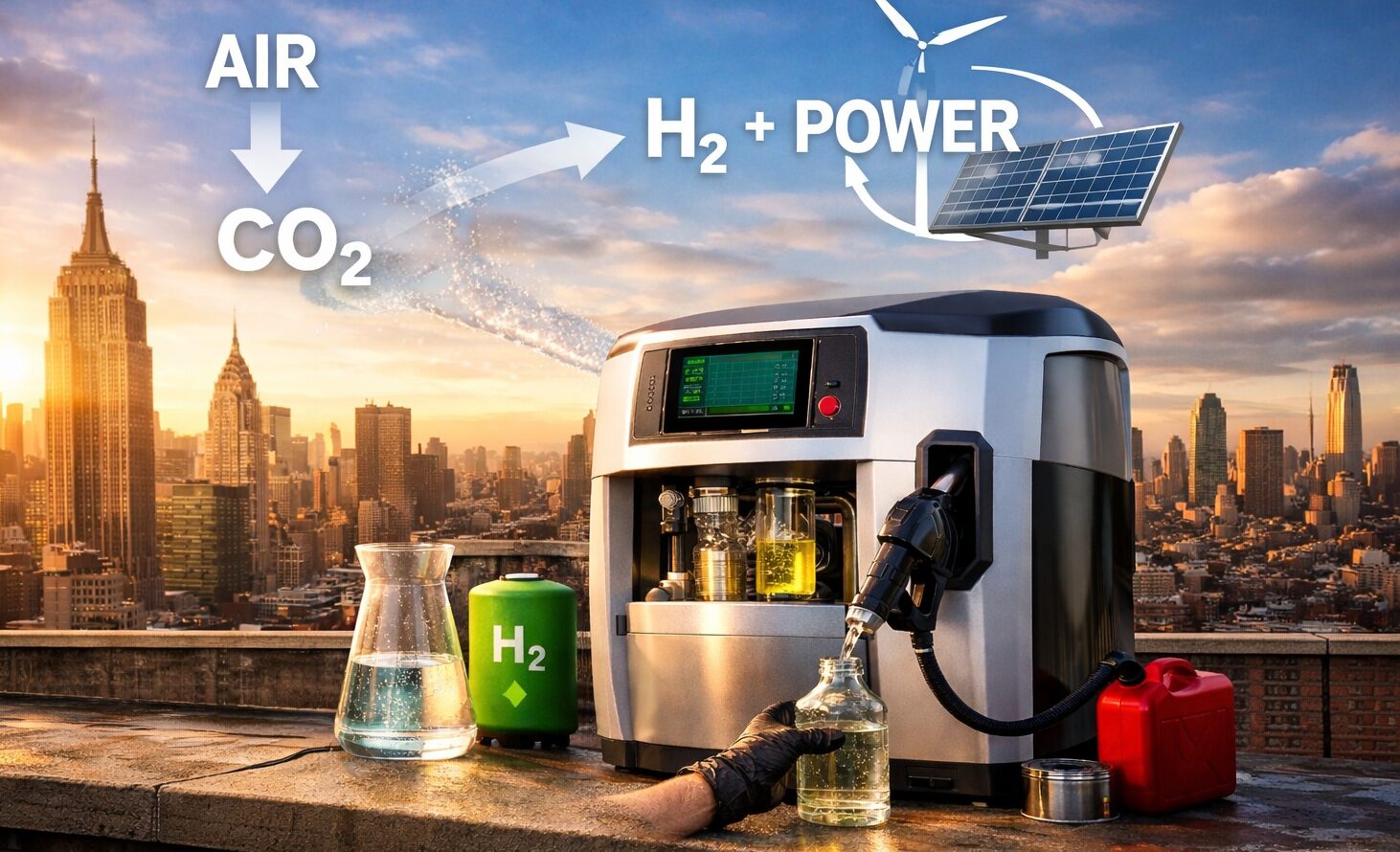
That idea took physical form in May 2025 on a rooftop in Manhattan’s Garment District. A compact machine, no larger than a household appliance, began producing usable gasoline on site. There was no refinery, no oil tanker, and no underground fuel line. Just air, water, and electricity.
The machine was built by Aircela, a New York based startup founded in 2019. Co-founded by Eric Dahlgren, the company is positioning itself not as a consumer brand, but as a business focused energy solution. Its target is not drivers at charging stations, but industries and operators who still rely heavily on liquid fuel.
Fuel From Air, Designed for Today’s Engines
Aircela’s technology combines direct air capture of carbon dioxide with on-site fuel synthesis. The system pulls CO₂ from ambient air, extracts hydrogen from water, and uses electricity to convert both into liquid gasoline.
The result is not a fuel substitute or blend. It is chemically equivalent to conventional gasoline. It contains no sulphur, no ethanol, and requires no engine modifications. Vehicles, generators, and machinery can use it immediately, with existing refuelling systems.
That compatibility is the core of Aircela’s strategy. No new vehicles. No new infrastructure. No behaviour change. The fuel fits into what already exists.
Also Read: Indian IT Majors Absorb ₹4,645 Crore Impact From New Labour Codes
A Business Model Built on Local Production
Unlike large synthetic fuel plants that depend on massive capital investment and centralised production, Aircela is pursuing a distributed model. Its machines are designed to produce fuel where it is needed, cutting out transport, storage, and long supply chains.
Early use cases are expected in off-grid locations, remote industrial sites, and operations where fuel delivery is costly or carbon-intensive. The company has not released figures on production cost or efficiency, but it describes the system as modular, allowing deployment to scale gradually.
For businesses operating far from refineries or ports, fuel independence is not just environmental, it is operational.
Backed by Climate Capital and Oil Experience
Aircela’s investor list reflects its hybrid position between clean tech ambition and traditional energy realities. Supporters include Maersk Growth, the investment arm of A.P. Moller-Maersk, which sees potential applications in long-haul shipping. Other backers include Chris Larsen, co-founder of Ripple Labs, and Jeff Ubben, an investor and ExxonMobil board member known for his focus on energy transition.
In a company statement, Maersk’s Head of Energy Transition, Morten Bo Christiansen, said the working prototype marked an important step toward low-emission fuel production based on direct air capture.
The public debut was attended by New York City Councilmember Erik Bottcher and New York State Energy Chairman Richard Kauffman. Aircela says limited commercial deployments are expected before the end of the year.
Carbon Neutral Promise Comes With Conditions
Aircela describes its gasoline as carbon-neutral, but that claim depends entirely on how the system is powered. If renewable electricity is used and hydrogen is produced via green electrolysis, lifecycle emissions could approach zero. If fossil-based power supplies the system, the climate benefit drops sharply.
The company has not yet released independent third-party assessments or detailed data on fuel yield, energy efficiency, or operating cost. For now, the demonstrations prove feasibility, not large-scale economics.
Synthetic fuel production is energy-intensive. The International Energy Agency estimates that hydrogen electrolysis alone requires roughly 50 to 55 kilowatt-hours per kilogram, before accounting for carbon capture and fuel synthesis.
A Bridge, Not a Final Destination
Globally, more than 1.4 billion internal combustion vehicles are still on the road, according to the International Energy Agency. Replacing them all with electric alternatives will take time, capital, and policy alignment that many regions lack.
By producing fuel that works with existing fleets, Aircela avoids many of the barriers facing electrification. No chargers to build. No grids to upgrade. No vehicles to replace.
The company is not presenting its technology as a permanent solution to fossil fuel dependence. Instead, it is positioning itself as a bridge. In a world where the energy transition is uneven and urgent, Aircela is betting that changing the fuel may sometimes be faster than changing the machine.
Also Read: What Makes a Currency Strong and Which One Truly Rules the World