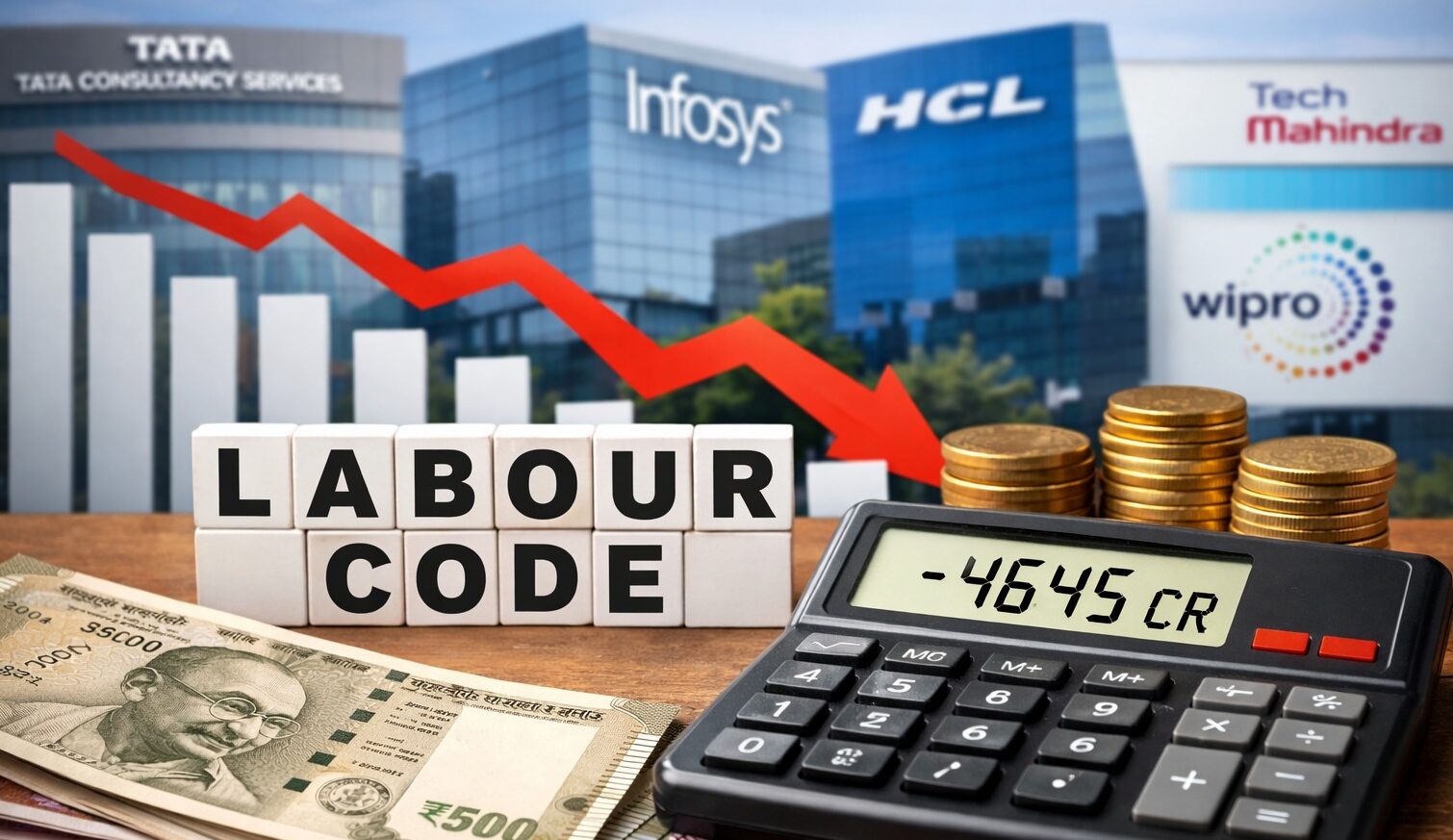
India’s largest information technology services companies have taken a significant short-term hit to profitability following the implementation of the country’s new labour codes. During the December quarter of FY26, the sector’s top five firms collectively absorbed a one-time cost of ₹4,645 crore, or nearly $500 million, after revising employee benefit calculations to comply with the updated regulations.
The impact was felt most sharply by Tata Consultancy Services, Infosys, HCL Technologies, Wipro, and Tech Mahindra, which together form the backbone of India’s IT services industry. The additional expense stemmed from changes in statutory obligations related to employee retirement benefits, primarily gratuity and provident fund contributions.
Revised Pay Structure Drives Higher Statutory Costs
The new labour codes require companies to restructure salary components so that basic pay accounts for at least 50 percent of total compensation. This change increases the base on which statutory benefits are calculated, resulting in higher long-term obligations for employers.
To align with these requirements, IT companies were required to reassess and recognise accumulated employee benefit liabilities. The accounting adjustment led to exceptional charges during the quarter, even though the underlying workforce size and compensation levels remained largely unchanged.
Also Read: Maruti Suzuki Commits Rs 35,000 Crore for New Mega Manufacturing Plant in Gujarat
Company-Wise Impact Highlights Scale of Adjustment
Among the five firms, Tata Consultancy Services recorded the highest charge, with incremental costs estimated at around $238 million. Infosys followed with an impact of approximately $143 million, while HCL Technologies reported a hit of about $109 million. Wipro and Tech Mahindra faced comparatively smaller charges of roughly $33.3 million and $30 million, respectively.
These costs were recorded as one-time adjustments and directly affected operating profitability for the quarter.
Margins Narrow Across the Board
The additional employee benefit expense led to a noticeable decline in operating margins across the sector. TCS reported an operating margin of 25.2 percent for the quarter, while Infosys posted 18.6 percent. HCL Technologies reported a margin of 18.4 percent, followed by Wipro at 17.6 percent and Tech Mahindra at 13.1 percent.
Overall, the labour code adjustments resulted in a margin compression of approximately 260 to 320 basis points for the leading IT firms during the quarter.
Differing Views on Future Financial Impact
While the charges were largely classified as non-recurring, companies have expressed varying views on whether the labour code changes could have a lasting effect on margins.
TCS has indicated that the cost is unlikely to repeat unless further clarifications or amendments to the labour regulations are introduced. Infosys, however, has acknowledged that there could be a modest recurring impact of around 15 basis points on margins going forward as payroll structures fully stabilise under the new framework.
These differing perspectives reflect the broader adjustment phase as companies integrate the regulatory changes into long-term compensation and workforce planning.
Large Workforce Amplifies Sector-Wide Effect
The five IT majors together employ more than 1.5 million people, making the industry one of India’s largest formal employers. Even minor changes in statutory calculations therefore translate into substantial financial implications when applied across such a vast workforce.
The labour code implementation is expected to influence human resource policies beyond immediate financial adjustments, prompting companies to fine-tune salary structures, benefit disclosures, and compliance processes.
Preparedness Softens Impact for Some Firms
Not all companies were affected equally. Wipro reported one of the lowest impacts among the top firms, attributing it to earlier alignment of compensation structures with evolving regulatory norms. The company has indicated that it does not expect any material impact beyond the one-time adjustment already accounted for.
This suggests that prior preparedness and proactive payroll structuring can reduce exposure to regulatory transitions.
Short-Term Pain, Long-Term Clarity
While the immediate profitability impact has been substantial, the new labour codes are intended to bring greater clarity and consistency to employment practices across sectors. The framework standardises benefit calculations, improves transparency in employment terms, and strengthens social security coverage.
For India’s IT sector, the December quarter marked a financial reset rather than a structural disruption. As companies absorb the one-time costs and adjust their systems, the focus is expected to return to demand recovery, operational efficiency, and long-term growth.
Also Read: DGCA Slaps ₹22.2 Crore Penalty on IndiGo Over December Flight Disruptions