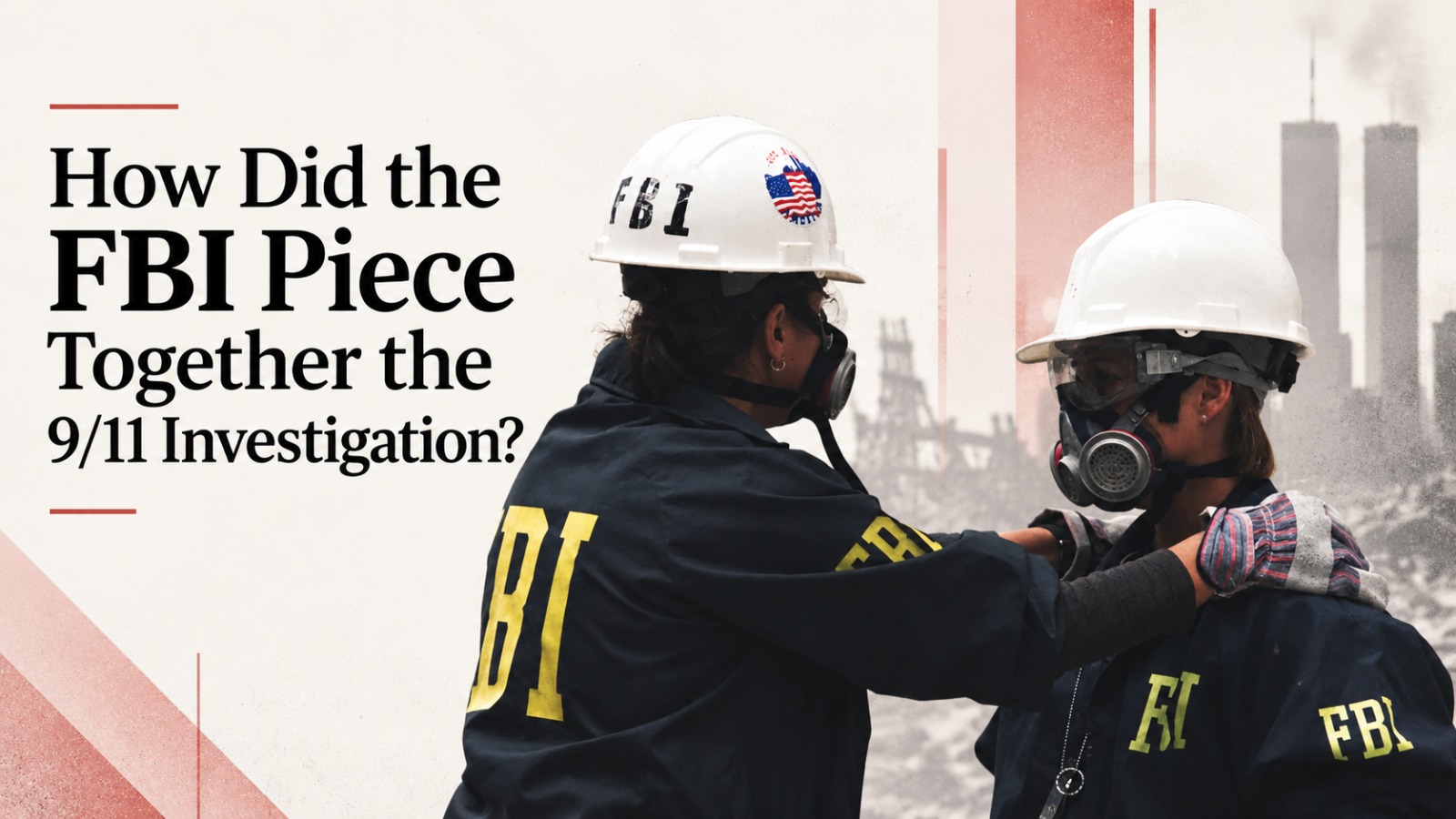
The investigation, code-named PENTTBOM, became the largest case in FBI history, drawing in more than half of the bureau’s agents at its peak as investigators worked across three crash sites and pursued leads around the world.
The September 11 attacks killed 2,976 people and injured thousands more, setting off what would become the largest investigation ever undertaken by the Federal Bureau of Investigation.
Four commercial airliners were hijacked in a coordinated terrorist attack. Three were deliberately flown into buildings, striking the twin towers of the World Trade Center in New York and the Pentagon in Arlington, Virginia. The fourth aircraft crashed in rural Pennsylvania.
For the FBI, the scale of the response was unprecedented.
The bureau gave its investigation the code name PENTTBOM, short for Pennsylvania, Pentagon, and Twin Towers Bombing. At the height of the investigation, more than half of all FBI agents were working to identify the hijackers and their sponsors while also trying to prevent another attack.
Investigators eventually worked through more than half a million investigative leads, including several hundred thousand tips submitted by members of the public. The three attack and crash locations also became the largest crime scenes the FBI had ever handled.
Flight 11 struck the North Tower at 8:46 a.m.
The first strike described in the FBI’s account came at 8:46 a.m., when American Airlines Flight 11 crashed into the North Tower of the World Trade Center in New York City.
It had begun as a clear morning on the East Coast. What followed was a carefully planned attack involving four hijacked aircraft and three separate crash locations.
Beyond those killed, thousands of people were injured. The effects did not end when the immediate rescue and recovery operations were over. The FBI notes that many first responders have continued to experience adverse health effects linked to working in toxic conditions at the sites.
FBI’s first priority was identifying the attackers
In the immediate aftermath, investigators faced two urgent questions: who had carried out the attacks, and whether another attack could follow.
Specialists in terrorism, evidence collection and other fields were brought into the response. The FBI also worked with law enforcement and intelligence partners in the United States and overseas as the investigation expanded.
Within minutes of the attacks, officials at FBI Headquarters in Washington activated the Strategic Information and Operations Center. By the end of the day, command posts had been established for all three crash sites.
Thousands of agents then began interviewing witnesses and sources, examining clues and pursuing tips around the world.
One of the most striking details from the investigation is how quickly the effort to identify the hijackers began to produce results. According to the FBI, investigators started identifying the 19 terrorists within hours of the attacks.
PENTTBOM was run from FBI Headquarters
The investigation also departed from the bureau’s usual way of handling a major case.
Then-FBI Director Robert S. Mueller III decided that the operation would be based at FBI Headquarters rather than at a field office. From a basement office, the PENTTBOM team coordinated a nationwide and international investigative effort as dozens of agents worked to build the case against those responsible.
The sheer volume of evidence, interviews and public tips made the investigation unlike anything the bureau had previously conducted.
More than half a million leads had to be followed. Thousands of witnesses and sources were interviewed. Investigators worked across multiple jurisdictions and with partners outside the United States while examining not only who carried out the attacks, but also who had supported them and how another attack might be stopped.
9/11: The case remains open
The FBI says the PENTTBOM investigation remains open.
Its impact extended beyond the investigation itself. The bureau says the case permanently changed how it works with law enforcement agencies and members of the intelligence community in the United States and abroad.
The numbers alone convey the scale: 2,976 people killed, thousands injured, 19 terrorists identified, more than half a million investigative leads pursued, and more than half of the FBI’s agents involved at the investigation’s peak.
But the investigation also became a defining test of how quickly authorities could organize after an attack spread across several locations, process enormous crime scenes, trace hundreds of thousands of tips and coordinate an effort stretching far beyond any single city or field office.
For the FBI, PENTTBOM was not simply another terrorism case. It was the largest investigation in the bureau’s history, and one that continues to shape its approach to terrorism, intelligence sharing and cooperation with other agencies.
Also Read: iPhone 18 Pro Is Here, but These iPhone 20 Rumors Could Give Buyers a Reason to Wait