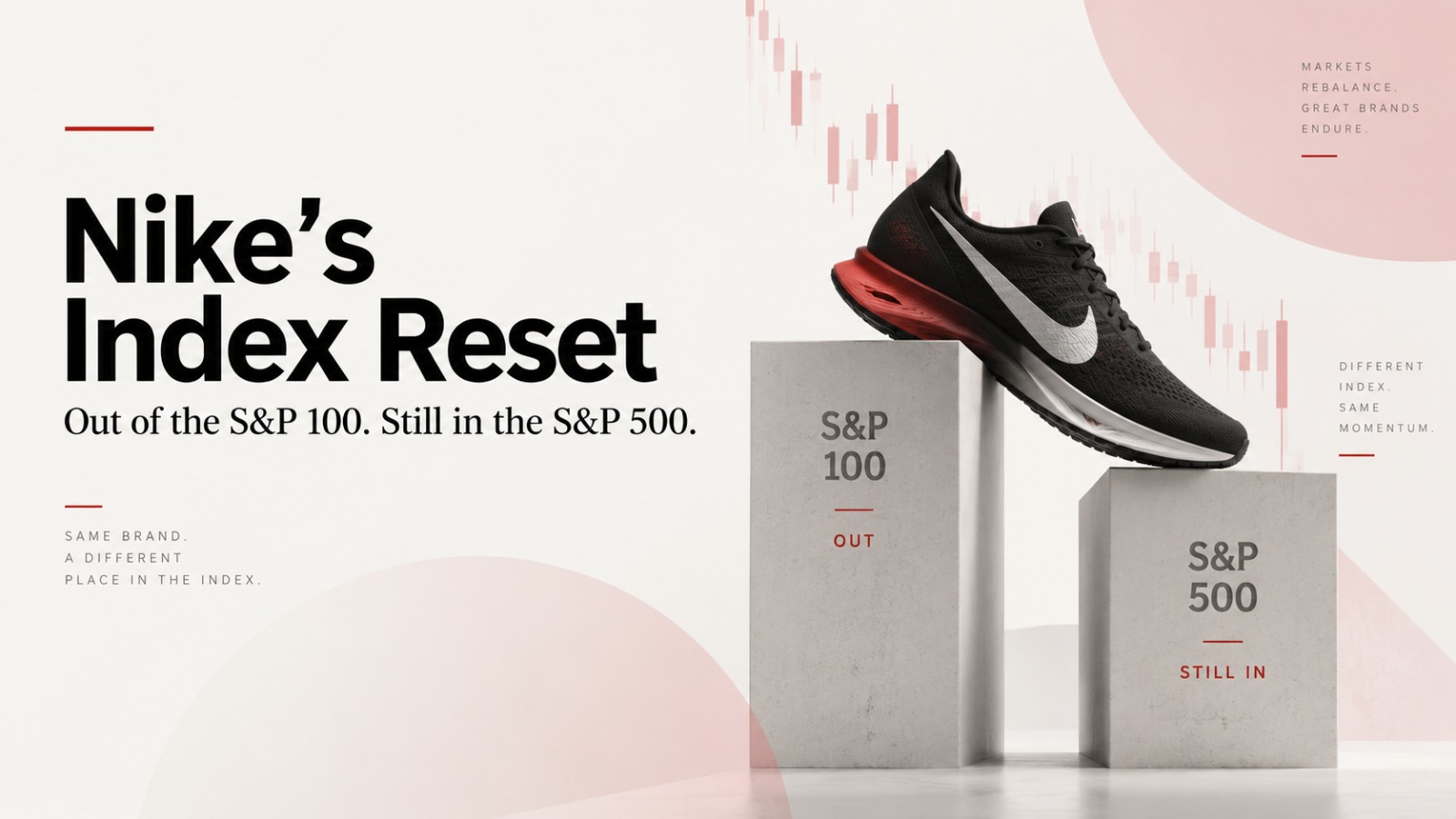
Nike will leave the S&P 100 after nearly 18 years, but the index change is unfolding alongside a more consequential shift inside the business: wholesale revenue is rising again while Nike Direct and digital sales remain under pressure.
Nike is preparing to lose a place it has held since the end of 2008, but the company is making one point especially clear: it is not leaving the S&P 500.
The sportswear company will be removed from the S&P 100 on September 21 as part of the index’s quarterly rebalancing. Nike’s investor relations and communications team addressed the change in a memo to executives after headlines and social media commentary appeared to create confusion over what the removal meant.
The memo stressed that Nike remains in the broader S&P 500 and said the S&P 100 change does not affect the company’s business, strategy, operations or public listing.
That distinction matters because the two indices carry very different pools of investment capital.
The iShares S&P 100 ETF, which tracks the index Nike is leaving, has about $20 billion in assets and holds roughly $19 million worth of Nike shares. By comparison, the Vanguard S&P 500 ETF has more than $1 trillion in assets and holds more than $700 million of Nike stock. A comparable State Street fund holds around $560 million, while the iShares Core S&P 500 ETF holds about $575 million.
So while Nike’s departure from the S&P 100 is symbolically significant, its continued presence in the S&P 500 remains important to the company’s exposure to major index-tracking funds.
The index exit follows a steep erosion in Nike’s market value
Nike’s removal comes after a prolonged decline in its shares.
The stock has fallen more than 40% in 2026 and is heading toward a fifth consecutive annual decline. The company’s market capitalisation was recently around $55 billion, compared with an all-time high of $281 billion reached in November 2021.
Another account of Nike’s longer-term decline puts the move in even sharper perspective. Nike shares closed at $38.40 on September 4, valuing the company at around $57 billion. The stock was nearly 80% below its November 2021 record of $179.10, with around $230 billion in market value erased from that peak.
The S&P 100 removal is therefore arriving after years of valuation pressure rather than as an isolated market event.
Nike will leave the index alongside Honeywell Aerospace, Simon Property Group and Colgate-Palmolive. Dell Technologies, Palo Alto Networks, Arista Networks and Sandisk will take their places.
A more important shift is happening in Nike’s sales mix
Away from the index reshuffle, Nike’s operating numbers point to a significant change in the way the company is reaching customers.
Nike had spent years putting greater emphasis on direct-to-consumer sales through its own stores and digital platforms. The approach was designed to give the company more control over pricing, customer data, product presentation and the overall consumer experience.
But the latest figures show wholesale moving in the opposite direction to Nike Direct.
In fiscal 2026, wholesale revenue increased 6% to $27.5 billion, while Nike Direct revenue declined 6% to $17.7 billion. Nike Brand Digital sales fell 12%.
The contrast was even more pronounced in North America, where wholesale revenue rose 14% while Direct revenue declined 6%. Nike is now rebuilding its wholesale distribution network while continuing to operate its own stores and digital channels.
Those numbers offer a clearer view of Nike’s current transition than the index change alone. The company is not abandoning direct sales, but it is putting renewed weight behind retailers after a period in which its own channels played a larger strategic role.
Earlier figures also underline the pressure. During fiscal 2025, Nike Direct revenue fell 13% to $18.8 billion, while Nike Brand Digital declined 20%. Gross margin dropped 190 basis points to 42.7%, with higher discounts, changes in channel mix and inventory obsolescence reserves among the factors cited.
Competitors have gained ground while Nike resets
The broader sportswear market has also become more competitive.
On recorded 2025 sales of CHF 3.01 billion, up 30%, and expected at least 23% constant-currency sales growth in 2026. Hoka, owned by Deckers Brands, increased fiscal 2026 revenue by 15.9% to $2.59 billion, while New Balance reported 2025 global sales of $9.2 billion, up 19%.
The pressure is particularly relevant in running and performance footwear, categories where these brands have been gaining traction.
China has added another difficulty. Greater China revenue fell from $7.55 billion in fiscal 2025 to $6.59 billion in fiscal 2026, representing a 13% currency-neutral decline. Footwear revenue fell 15%, Direct revenue declined 12% and digital sales dropped 29%.
Nike linked the weakness to lower store traffic, heavier discounting and higher inventory levels.
Nike is adjusting rather than simply defending its old model
The company’s response is increasingly visible in its product and distribution strategy.
Nike is accelerating new product launches, reducing supplies of some existing footwear, repositioning Nike Brand Digital as a full-price platform, reinvesting in wholesale distribution and improving how its products are presented in physical stores.
CEO Elliott Hill has identified product innovation, brand strength, marketplace execution and cost efficiency as priorities for the turnaround.
That makes Nike’s S&P 100 departure significant for reasons that go beyond index membership.
The company is simultaneously dealing with a much lower valuation, weaker direct sales, pressure in China and faster-growing competitors, while attempting to rebuild relationships with wholesale partners and refresh its product pipeline.
The September 21 index change will be easy to measure. Nike’s bigger test will take longer: whether the shift back toward a more balanced marketplace can translate into stronger sales, healthier margins and renewed momentum.
Also Read: Why Is Nike Stock Falling? $1 Billion China Risk Weighs on NKE