iPhone Duo crease: Apple’s first foldable iPhone has finally answered one of the biggest questions surrounding the device: yes, the iPhone Duo does have a visible display crease.
Early hands-on footage recorded after Apple’s launch event shows a fold line running through the inner display. How distracting that crease actually is appears to depend heavily on the viewing angle, lighting and reflections, but the first real-world videos make one thing clear. Apple has reduced the familiar foldable-phone problem, not eliminated it.
That distinction matters because expectations around Apple’s first foldable were unusually high. After years of watching Samsung and other Android manufacturers refine flexible displays, Apple entered the category with the opportunity to solve some of the compromises buyers have come to associate with foldable phones.
The iPhone Duo shows that at least one of those compromises remains.
iPhone Duo crease is visible from certain angles
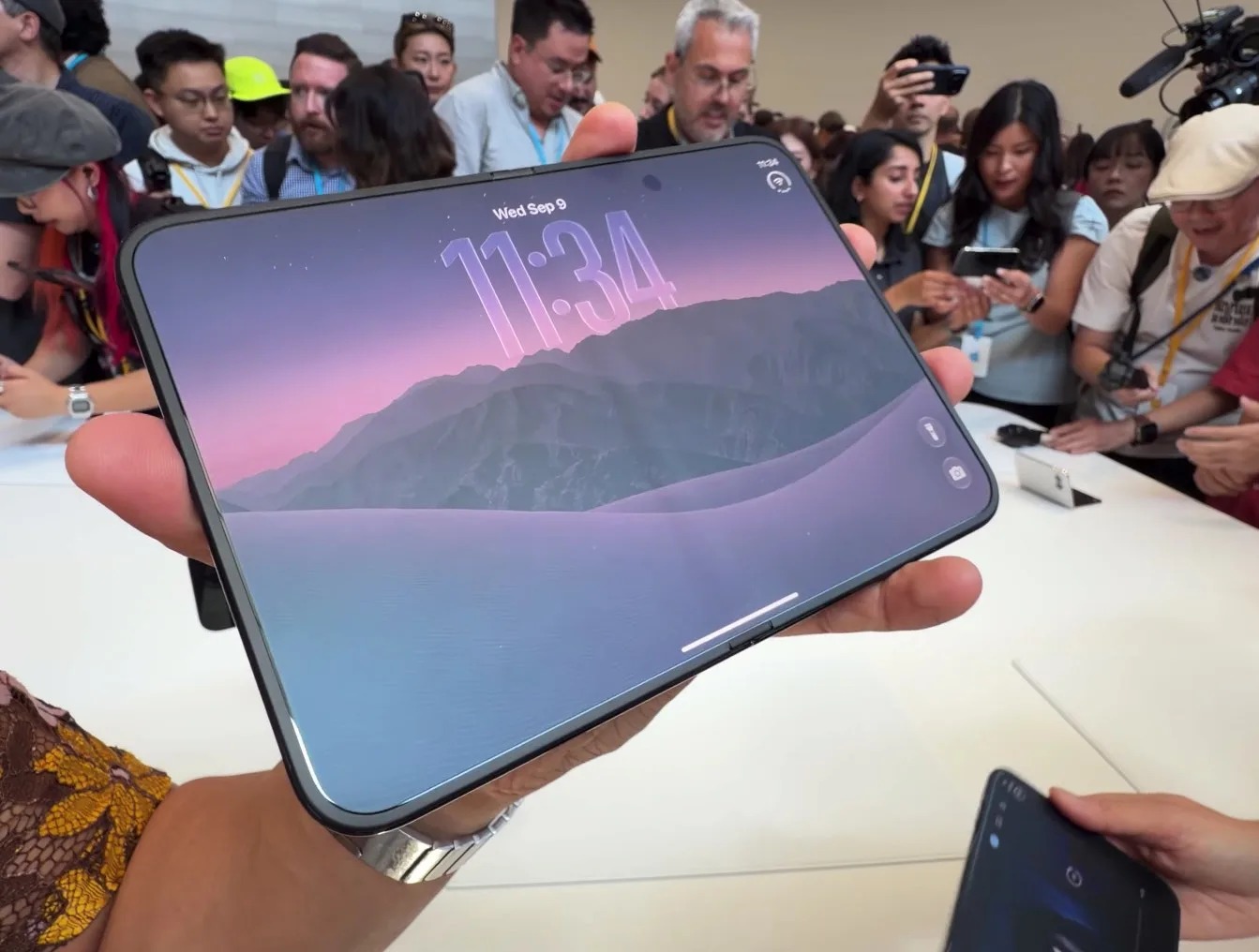
Hands-on videos from Apple Park show that the crease becomes noticeable when the device is tilted or viewed under certain lighting conditions.
Notebookcheck’s assessment is relatively positive. It found that while the crease is clearly visible from some angles, it becomes almost completely invisible when the screen is viewed straight on. It suggested that the Duo’s crease may be slightly less noticeable than the one on Samsung’s Galaxy Z Fold8.
That is not quite the same conclusion reached by 9to5Google.
Its hands-on assessment described the crease as looking roughly as visible as the fold line found on the Galaxy Z Fold 8 and Fold 8 Ultra. The publication acknowledged that Apple has done work to conceal it, but concluded that a crease remains a real part of the iPhone Duo experience.
The two observations are not necessarily contradictory. A foldable display can look almost seamless from one position and reveal its hinge line immediately when light hits it from another angle. The early footage itself suggests that viewing conditions play a major role.
Apple is using the display surface to make the crease harder to see
One of Apple’s more interesting approaches appears to be the finish of the inner screen.
The iPhone Duo uses an anti-reflective inner display that appears noticeably matte compared with the outer screen. By reducing reflections, the surface can make the fold line less obvious in situations where glare would otherwise highlight it.
Notebookcheck specifically points to the matte nano-texture surface as one reason the crease can be difficult to spot head-on. It also notes that a scratch-resistant coating is used on the nano-texture surface.
The crease, however, has not disappeared underneath that treatment.
9to5Google also describes Apple as using a two-layer flexible glass structure intended to reduce tension that could otherwise cause material to bunch around the centre of the folding screen.
In other words, Apple appears to be attacking the problem from more than one direction: through the structure underneath the display and through the way the display surface handles light.
The result looks cleaner in some conditions, but it is not crease-free.
The matte display creates another visual compromise
The anti-reflective treatment may help disguise the crease, but early hands-on coverage has highlighted another issue created by the finish.
The Duo’s under-display camera area does not share the same matte appearance as the surrounding screen. That difference in reflectivity can make the camera area stand out rather than disappear into the panel.
9to5Google noted that the contrast between the matte inner display and the camera region makes the supposedly hidden camera more noticeable in real-world viewing.
It is an interesting trade-off. A surface treatment that helps suppress one visible feature of the folding screen can draw attention to another.
Has Apple solved the foldable-phone crease problem?
Not completely.
What the first videos suggest is something more nuanced.
Apple appears to have made the crease difficult to notice under favourable viewing conditions. Look directly at the screen and it can virtually disappear. Tilt the phone, move it under stronger reflections or examine it from an angle, and the centre fold becomes considerably easier to see.
That puts the iPhone Duo in familiar territory for anyone who has followed foldable phones closely.
Flexible displays physically bend through the same section every time the device opens and closes. Notebookcheck notes that completely removing the crease is technically difficult because that section of the display repeatedly goes through folding and unfolding cycles.
The more important question may therefore be not whether a crease exists, but how often owners actually notice it during normal use.
That answer will require considerably more real-world use than a launch-day hands-on session can provide.
Early reaction puts the crease debate back in focus
The iPhone Duo’s display has already become a talking point in hands-on coverage, precisely because Apple was expected to bring its own solution to one of the category’s longest-running weaknesses.
9to5Google framed the crease as one of the same pain points Apple now shares with established foldable manufacturers, while noting the criticism Samsung has faced over visible fold lines in previous Galaxy Z Fold generations.
What the available material does not establish is a widespread wave of iPhone Duo owners complaining about the crease. The phone has only just been shown in early hands-on footage, and the material provided mainly captures observations from journalists and viewers around those demonstrations.
So describing this as a confirmed mass “user complaint” issue would go further than the evidence currently supports.
What can be said with confidence is that the crease is real, it is visible in particular conditions, and it has immediately become part of the conversation around Apple’s first foldable.
The bigger test begins after launch
Apple has not produced a magically crease-free foldable display. Instead, the early evidence suggests it has concentrated on making that crease less distracting.
That may ultimately be the more realistic benchmark.
If owners stop noticing the fold line after a few minutes of use, Apple’s approach could still prove successful even if cameras can reveal it under carefully chosen angles. If the crease becomes more noticeable over time, the conversation will be very different.
For now, the iPhone Duo demonstrates that even Apple cannot entirely escape the physics of a screen designed to fold in half.
The crease is there.
The real question is whether people will care once they start using the phone every day.
Also Read: Nike to Exit S&P 100 After Nearly 18 Years, Remains in S&P 500