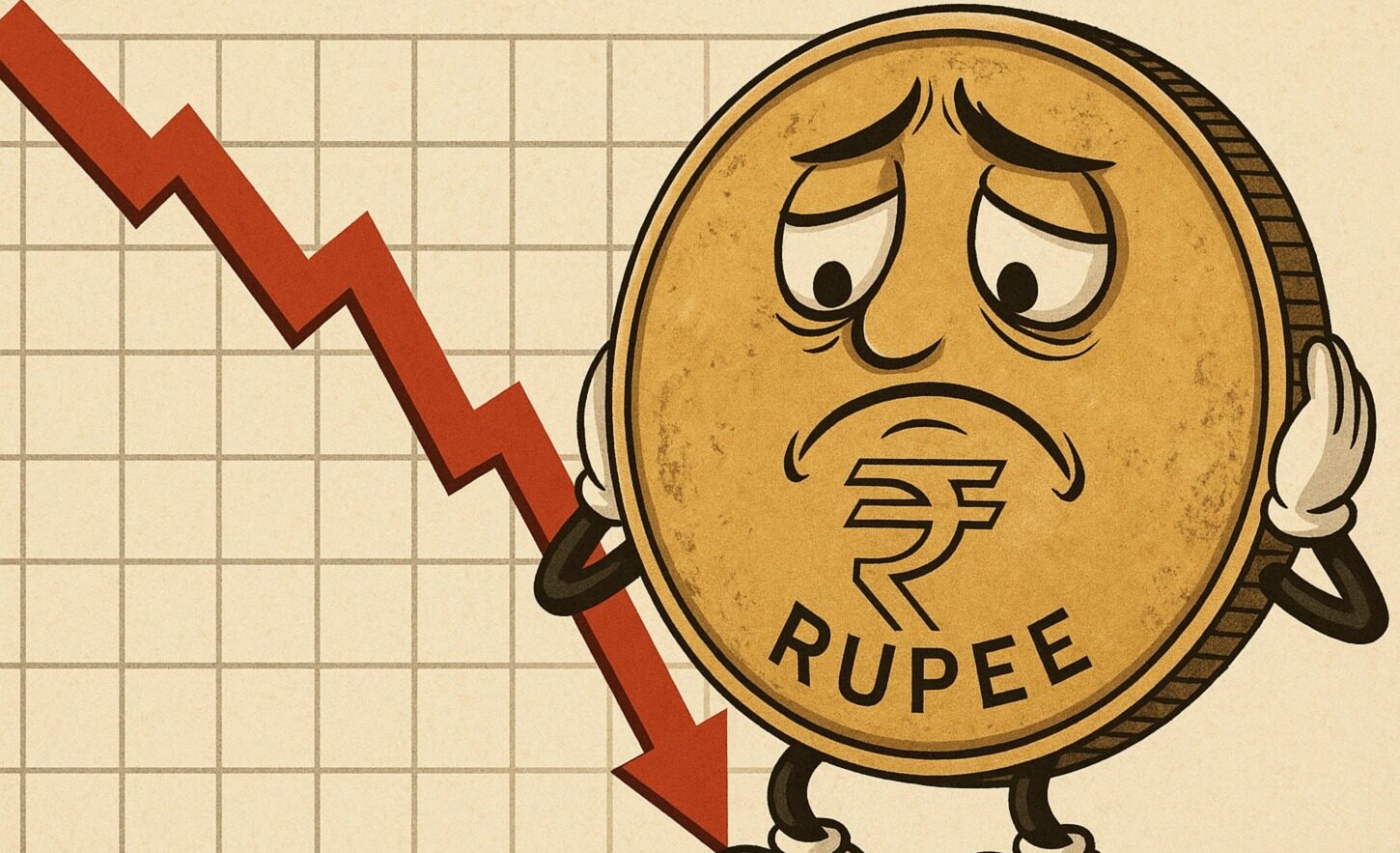
If the Indian rupee could speak, 2025 would be the year it asked for a break. A currency that once traded below four rupees per US dollar at independence is now struggling above 89 and slowly inching toward 90. Its steady decline has become a symbol of the broader economic strain India is facing this year.
A Currency Shaped by History and Pressure
The value of the rupee has always reflected India’s economic journey. Before independence, the currency followed British decisions because it was tied to the pound, which was linked to gold. Back then, the rupee had far greater purchasing power than it does today.
In 2025, the situation is very different. The rupee has weakened by 4.3 percent so far and currently holds the title of Asia’s worst-performing currency. On Friday morning, it slipped to 89.42 per dollar, continuing a drop that began speeding up toward late November.
Also Read: Uranium Found in Delhi Groundwater, Health Alert Raised
A Slow Slide That Turned into a Steep Fall
The rupee did not collapse overnight. It began with small dips in January that seemed harmless at first. March and April brought a brief recovery, and early May even saw the strongest point of the year at 83.7538. This improvement came with hopes for an early trade agreement with the United States.
That period of confidence faded quickly.
July Brings the First Shock to the Markets
In July, the United States announced tough tariff plans and raised concerns about India’s purchases of Russian crude. These developments rattled the markets, and the rupee recorded its steepest monthly fall since 2022. Investor confidence took a serious hit.
August Delivers the Hardest Blow
August was the turning point. The United States imposed extremely high tariffs on Indian exports, touching 50 percent which was the highest among Asian countries. A further 25 percent penalty was added for India’s trade with Russia. The rupee fell sharply and dropped past 88 per dollar, signaling deeper trouble for the economy.
September Adds More Uncertainty to the Picture
September brought no relief. Reports surfaced about new penalty tariffs being pushed toward Europe and discussions on raising H 1B visa fees to 100,000 dollars. These developments added to the uncertainty and kept the rupee under pressure.
November Sees Investors Pulling Back
By late November, foreign investors had withdrawn nearly 16.3 billion dollars. Concerns over earnings, rising tariffs, high valuations and economic growth brought heavy demand for the US dollar. The rupee weakened further as investors exited the markets.
A Central Bank Balancing Stability and Reality
Throughout the year, traders believe the Reserve Bank of India intervened several times, especially in February and October, to control the currency’s fall. However, on November 21, when the rupee slipped past 89, the central bank stayed quiet. That silence triggered rapid selling and accelerated the decline.
Despite this, the RBI has sold large amounts of dollars since July to slow the fall. India’s foreign exchange reserves stand near 693 billion dollars, which covers about 11 months of imports. This offers support but cannot fully stop the downward pressure.
Many economists believe the RBI may be allowing a gradual weakening since defending a fixed value becomes difficult with rising tariffs and slowing inflows. A controlled decline may be more realistic under current conditions.
Why India Stands Apart in Asia This Year
Several Asian currencies, such as the Taiwan Dollar, Thai Baht and Malaysian Ringgit, strengthened in 2025. India remains the exception. The main reason is the heavy tariff pressure placed specifically on Indian exports. Other Asian exporters are not facing such severe penalties and are benefiting from stronger dollar inflows.
How a Weaker Rupee Affects Everyday Life
A falling rupee has both benefits and drawbacks.
Positive Effects
• Indian exports become more competitive in global markets.
• Families receiving money from abroad get more rupees per dollar.
Negative Effects
• Imports such as crude oil, electronics and fertilizers become more expensive.
• Higher import costs may push inflation upward.
• Businesses dependent on imported inputs face rising expenses.
A gradual decline supports exporters, but sudden drops increase uncertainty and raise prices, which affects the broader economy.
What the Coming Months May Look Like
The rupee faces a challenging road ahead. Its direction will depend on global negotiations, investor behavior and how actively the central bank responds. A slow decline may be manageable, but sharp swings risk affecting growth and increasing inflation.
For now, the rupee’s journey in 2025 shows how global policies, domestic pressures and investor sentiment can come together to shape the path of a nation’s currency.
Also Read: Pype AI: The Bengaluru Startup Reimagining Hospitals With an ‘AI Front Desk’