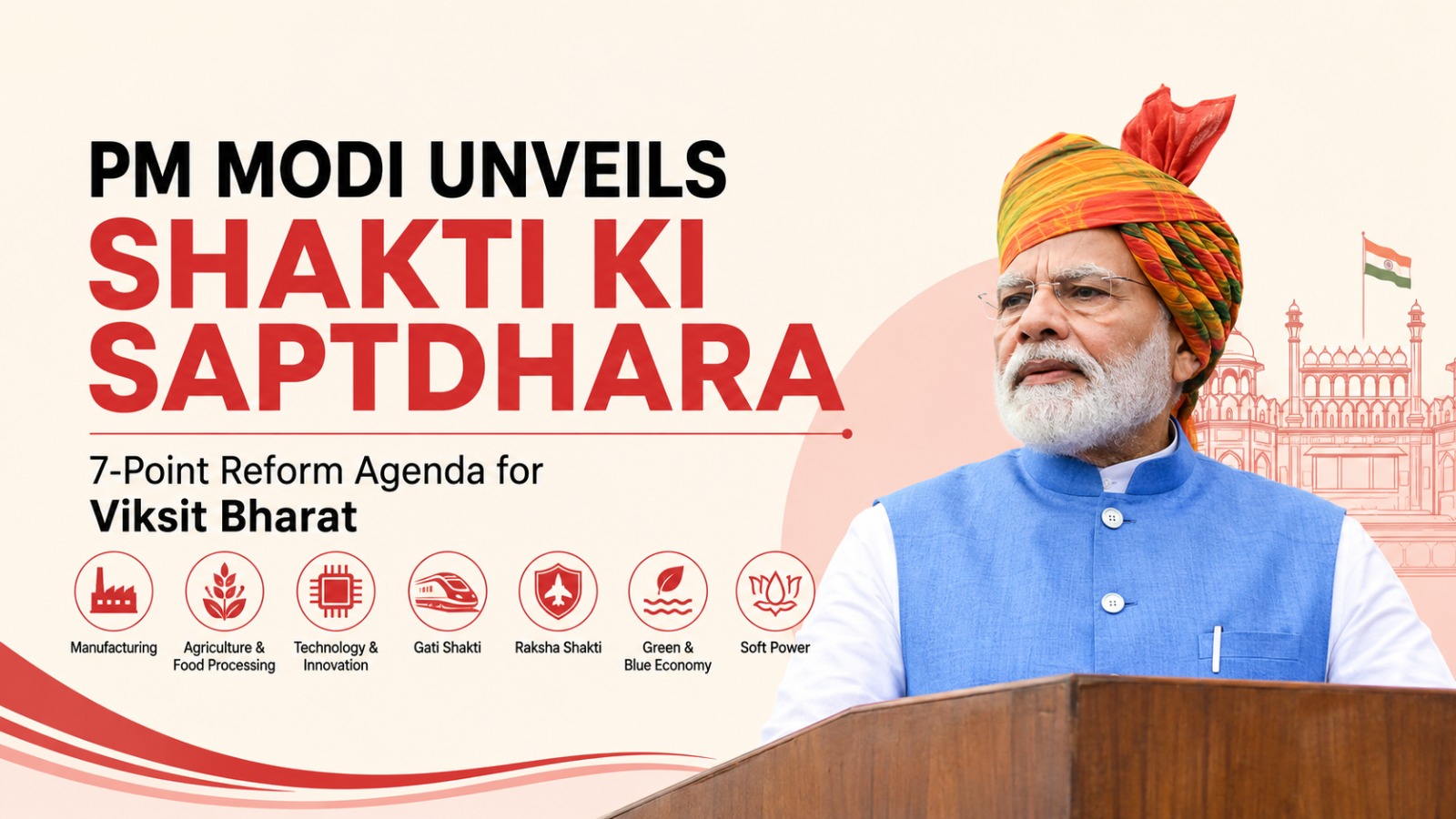
Prime Minister Narendra Modi on Saturday unveiled a seven-point reform agenda, described as Shakti ki Saptdhara, outlining what he called the next generation of reforms required to achieve the vision of a developed India, or Viksit Bharat.
Addressing the nation from the Red Fort on India’s 80th Independence Day, the Prime Minister identified seven strategic areas that will shape the country’s future growth and development. The roadmap focuses on manufacturing, agriculture and food processing, technology and innovation, Gati Shakti, Raksha Shakti, the green and blue economy, and India’s soft power.
According to PM Modi, these seven streams together will provide the foundation for India’s long-term progress and strengthen the country’s journey towards becoming a developed nation.
Manufacturing Positioned at the Centre of Economic Expansion
The first pillar of the reform agenda focuses on manufacturing, which the Prime Minister described as a critical driver of economic growth and global competitiveness.
He stressed the importance of making Indian products more competitive in terms of cost, quality, and scale. The objective, he said, is to ensure that products made in India meet global standards and are capable of competing effectively in international markets.
The emphasis on manufacturing reflects the government’s broader efforts to strengthen domestic production capabilities and expand India’s presence in global supply chains.
Building Global Brands Through Agriculture and Food Processing
The second focus area centres on agriculture and food processing. PM Modi highlighted the need to move beyond production and place greater emphasis on value creation and international market access.
He said India must work towards taking agricultural and food products to global markets while transforming them into internationally recognised brands. The approach aims to increase the global reach of Indian agricultural products and create new opportunities for farmers and food-processing industries.
The Prime Minister’s remarks underscored the importance of strengthening the entire agricultural value chain, from production to branding and export.
Innovation and Emerging Technologies Take Priority
Technology and innovation form the third pillar of the seven-point agenda. PM Modi stressed the growing importance of digital and communication technologies in shaping the future economy.
He said India must continue to strengthen its capabilities in emerging technologies to drive the next phase of growth. The focus on innovation reflects the government’s intention to support technological advancement and ensure that India remains competitive in a rapidly evolving global landscape.
The Prime Minister identified technology as a key enabler that can support economic transformation across multiple sectors.
Also Read: Meet NeoSapien: The Bengaluru Startup Building an AI ‘Second Brain’
Faster Connectivity Through Gati Shakti
The fourth stream, Gati Shakti, focuses on improving mobility and connectivity across the country.
PM Modi said the government will continue to prioritise faster and seamless connectivity, supported by high-speed transport networks and modern infrastructure. Improved infrastructure, he noted, plays a crucial role in enhancing the movement of both people and goods.
The emphasis on connectivity is aimed at supporting economic activity, improving logistics efficiency, and strengthening integration across regions.
Strengthening Self-Reliance in Defence
The fifth pillar, Raksha Shakti, is dedicated to enhancing India’s defence capabilities and promoting self-reliance in defence technology.
The Prime Minister stressed the need to develop next-generation defence systems and technologies. He specifically highlighted areas such as drones and supersonic technologies as important components of India’s future defence ecosystem.
According to PM Modi, strengthening indigenous defence capabilities will be essential for ensuring national security and technological advancement in the years ahead.
Sustainable Growth Through Green and Blue Economy
The sixth area of focus is the green and blue economy. The Prime Minister said India’s vast natural resources provide significant opportunities for building a sustainable and future-ready economy.
He noted that these resources can help create new avenues for growth while supporting environmental sustainability. The green and blue economy framework is intended to balance economic development with responsible resource utilisation.
The focus reflects the growing importance of sustainability in shaping long-term economic strategies.
Expanding India’s Global Cultural Influence
The seventh and final pillar is soft power, an area where PM Modi said India already possesses significant strengths.
He highlighted sectors such as Yoga, Ayurveda, holistic health, creative industries, and tourism as key contributors to India’s global influence. These areas, he said, have the potential to further enhance India’s cultural presence and international standing.
The Prime Minister emphasised that India’s soft power can play an important role in strengthening global engagement while showcasing the country’s heritage, traditions, and modern achievements.
Foundation for the Next Generation of Reforms
Describing the seven pillars as the “power of seven,” PM Modi said the Shakti ki Saptdhara framework would serve as the cornerstone of the next phase of reforms. He said the agenda is designed to accelerate development across critical sectors and support India’s aspiration of becoming a Viksit Bharat.
The seven-point roadmap, spanning manufacturing, agriculture, technology, infrastructure, defence, sustainability, and cultural influence, outlines the government’s vision for driving growth and strengthening India’s position in the decades ahead.
Also Read: Marvel Studios Locks 7 Key X-Men Roles With Adam Driver Cast as Mr. Sinister