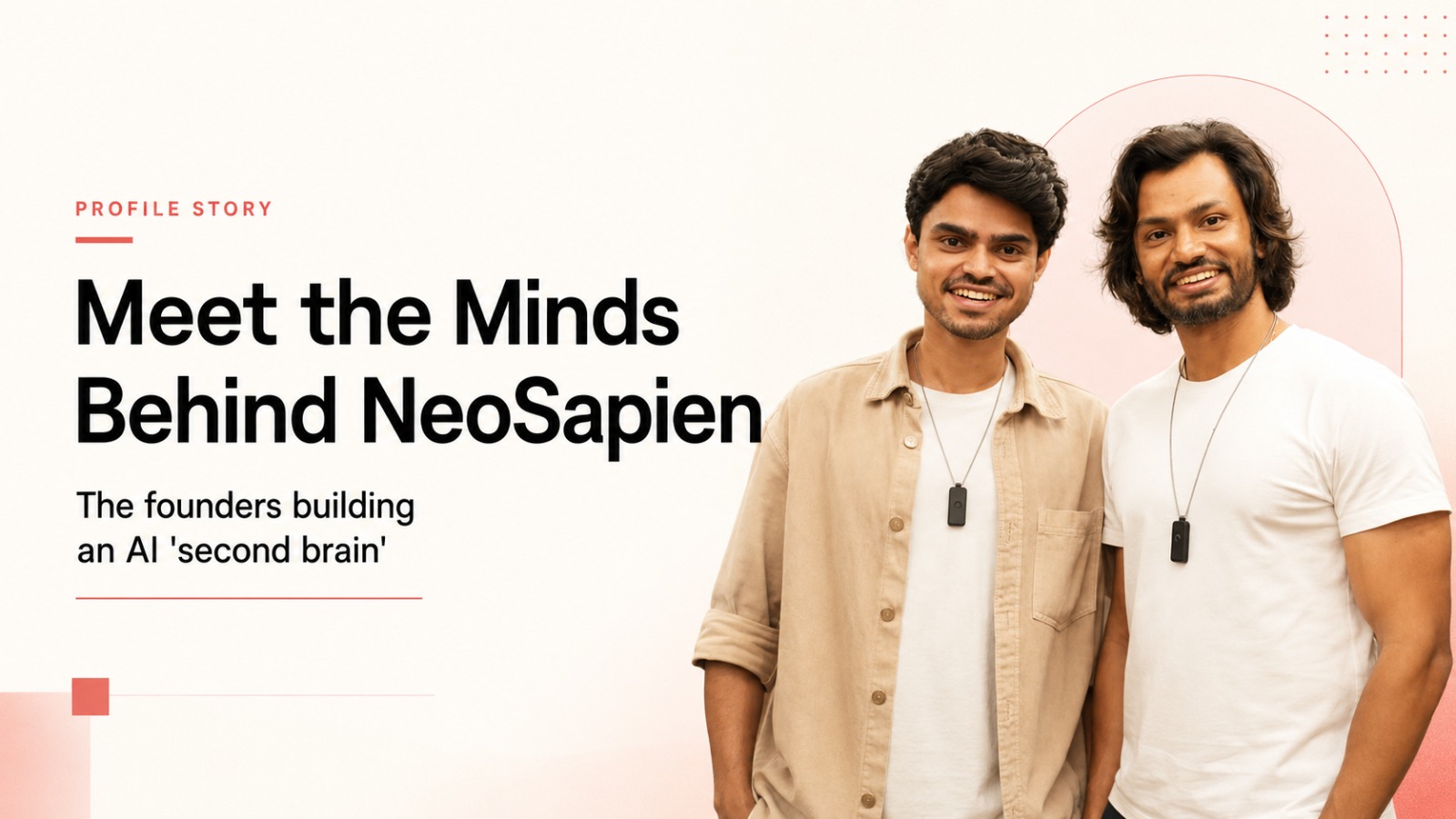
Founded in Bengaluru in 2024, NeoSapien is trying to turn everyday conversations into searchable memory. With Neo 1 now launched in the US and a second Indian patent secured, the startup is taking its bet on ambient AI beyond the Indian market.
For most people, forgetting a detail from a meeting means searching through messages, reopening notes or simply admitting that the conversation has become fuzzy.
NeoSapien wants to remove that ritual altogether.
The Bengaluru startup has built Neo 1, a pendant-style AI wearable designed to stay with its user through conversations, capture what was said and turn those exchanges into information that can be recalled later.
It is a different interpretation of the wearable computer. Instead of putting another screen on the wrist or a camera in front of the eyes, NeoSapien is focusing on something less visible: memory.
Founded in 2024 by Dhananjay Yadav and Aryan Yadav, the company is positioning Neo 1 as a personal “second brain” that works quietly in the background. The device can transcribe conversations, organise information, create meeting summaries, identify action items and help users return to details they might otherwise forget.
That idea has now moved beyond an early Indian wearable experiment. NeoSapien has officially launched Neo 1 in the United States, giving the company an international market for an AI hardware product built in India.
NeoSapien: Building AI Around Memory, Not Another Screen
NeoSapien’s proposition is easiest to understand through an ordinary business meeting.
Rather than reaching for a phone to record notes or trying to remember every commitment afterward, the user wears Neo 1 around the neck. The device listens to the conversation and processes the information so it can later surface useful context.
Its software is designed to connect conversations over time through a proprietary knowledge graph. In one example, the system can recognise that a user is meeting the same client months later and surface information from previous discussions before the next interaction. The reported voice-recognition accuracy is above 98% for Indic languages including Hindi, Kannada and Gujarati. The system can also prepare follow-up emails, identify pending tasks and place time on a calendar after a meeting.
Neo 1’s proprietary Second Brain Operating System supports more than 100 languages, widening the potential use of the product across professionals, students, founders and international teams.
The distinction NeoSapien is trying to make is important. Its founders are not presenting the wearable as a machine that should make decisions on behalf of its owner.
Dhananjay Yadav has described Neo 1 instead as a “memory layer”, built to help people recall conversations, extract action items and keep track of follow-ups while leaving the actual thinking to the person wearing it. The hardware was reported in May at ₹12,000, with heavier processes such as transcription and task extraction handled in the cloud to keep the physical device relatively minimal.
That focus also shapes the company’s broader ambition. Rather than treating the pendant as the end product, NeoSapien sees the possibility of bringing its intelligence layer to other wearable formats. The stated vision extends to glasses, rings and lapel pins that could eventually act as connected nodes inside a user’s personal knowledge network.
Patent No. 596075 Adds Another Piece to the Story
NeoSapien’s hardware push gained another marker in July.
The Patent Office, Government of India, granted Indian Patent No. 596075 to ZenithZephyr Wellness Private Limited, the company operating under the NeoSapien brand. The invention is titled “Emotion-Sensitive LED Wearable Device for Real-Time Emotional Feedback.”
The application, numbered 202441085359, was filed on November 7, 2024 and granted on July 20, 2026. The patent carries a 20-year term from the filing date, subject to the conditions and renewal requirements under the Patents Act, 1970.
It was reported as NeoSapien’s second patent in two years, adding an intellectual-property milestone at roughly the same time that the company began taking Neo 1 into the US market.
For a young Indian AI company, those two developments tell a larger story. NeoSapien is not only trying to sell a pendant. It is building around the idea that AI hardware can become a persistent companion to real-world conversations rather than another destination users deliberately open on a screen.
The Hardest Problem May Not Be Technical
A wearable that listens to conversations also enters difficult territory almost immediately.
There is a major difference between choosing to type a question into an AI chatbot and walking into a meeting wearing a device capable of processing what everyone says.
That difference could determine how quickly products such as Neo 1 find a place in offices, client meetings and other professional environments.
NeoSapien says audio is processed in encrypted memory rather than kept permanently as raw recordings. The system is tied to a user’s “voice print”, while raw audio is described as being discarded once the relevant context and text have been extracted.
But technical safeguards do not automatically solve the social question.
Being recorded can be sensitive in professional settings, particularly where confidential information or client trust is involved. Dhananjay Yadav has acknowledged that users need clarity about when a wearable is active, what it captures, what gets stored and how information can be deleted.
That makes adoption partly a behavioural challenge.
People already have established ways of remembering work conversations, from handwritten notes to WhatsApp messages and mental recall. NeoSapien has to persuade them that wearing an AI device all day provides enough value to justify changing those habits.
The company is therefore not starting with the assumption that Neo 1 should immediately become a mass-market accessory. Its early target users are people for whom missing context can carry a real professional cost, including founders, business owners, doctors, consultants, sales leaders, lawyers and senior professionals.
The pitch to that group is straightforward: fewer forgotten commitments and better follow-through.
From Shark Tank Visibility to a Bigger Hardware Bet
NeoSapien is still a young company, but it has already found itself in some unusually public moments.
The startup appeared on Shark Tank India Season 4 and later attracted attention when its wearable devices were stolen during the India AI Impact Summit in February 2026.
The more significant test, however, begins after that visibility.
NeoSapien has been reported to have production capacity of multiple thousand units per month and to be in talks to license its proprietary Neo OS to larger global manufacturers.
If that strategy develops, the company may eventually have two businesses to build: the NeoSapien-branded hardware customers can buy today, and the software layer that could potentially live inside devices made by others.
Neo 1 is still an expensive, as well as unusual concept. It requires from its users to place their trust into AI not only in terms of information, but in terms of wearing this AI in conversations throughout their daily life.
That is precisely what makes NeoSapien an interesting company to watch. In barely two years, its story has moved from a Bengaluru wearable startup to a second Indian patent, a US launch and an attempt to define what a “second brain” should look like when it leaves the screen and enters the physical world.
Whether that idea becomes a new computing habit will depend on something technology companies cannot patent: whether people decide they are comfortable putting an AI memory around their neck.
Also Read: Avengers: Doomsday Trailer Expected at D23: Release Time, Preview and What to Expect