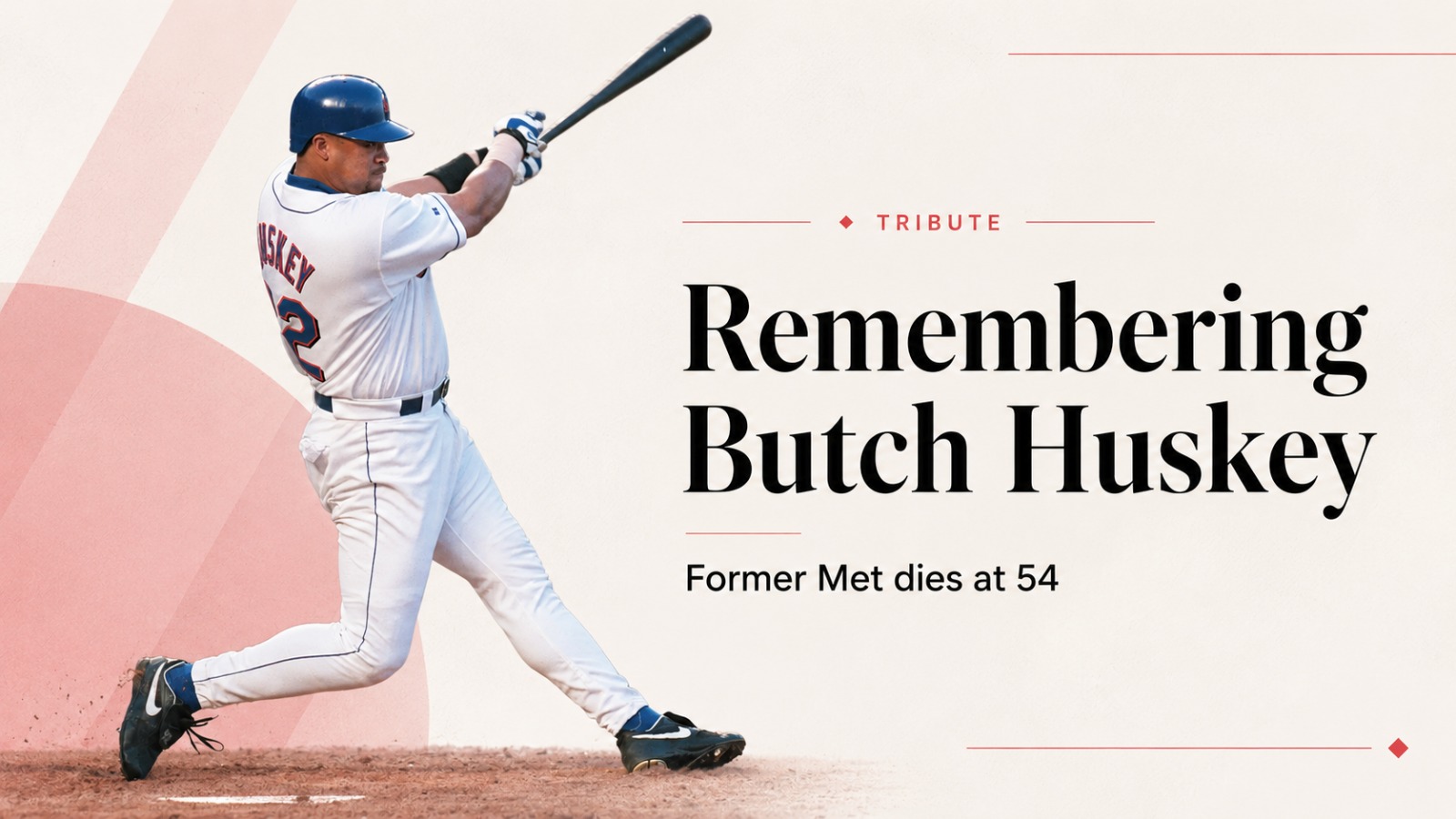
Former New York Mets slugger Butch Huskey has died at the age of 54, leaving behind a baseball story tied to one of the most meaningful uniform numbers in the sport and a productive five-season run in Queens.
Butch Huskey, the former New York Mets player who became a familiar presence in the club’s lineup during the 1990s, has died at 54.
The Mets announced his passing on Friday, August 14, writing, “We are saddened to learn about the passing of former Met Butch Huskey.” No cause of death was disclosed.
For Mets fans who watched the club through the middle and late 1990s, Huskey’s name carries more than a set of statistics. His career included a climb from a seventh-round draft pick to the major leagues, a 24-home run season, 55 homers in a Mets uniform and an unusual place in baseball history through the No. 42 on his back.
Here are five parts of Huskey’s career that help explain how he will be remembered.
1. He worked his way from a seventh-round pick to the Mets
Huskey’s professional story with New York began when the Mets selected him in the seventh round of the 1989 MLB Draft.
He came through the organization’s minor-league system before reaching the majors in 1993. It was the beginning of a Mets career that would eventually stretch across parts of five seasons.
That path is an important part of Huskey’s story. He was not presented with an instant route to the majors. He developed inside the Mets organization and eventually became a regular contributor at the highest level.
By the time his New York chapter ended, Huskey had appeared in 414 games for the Mets.
2. His 1997 season became the statistical high point of his Mets career
If one season stands out when looking back at Huskey’s years in Queens, it is 1997.
Huskey played 142 games that year and hit 24 home runs, his best home run total during his time with New York.
That season helped establish him as a legitimate power threat in the Mets lineup.
Across his entire Mets tenure, Huskey hit .264 with a .306 on-base percentage and a .434 slugging percentage. He finished those 414 games with a .740 OPS and 55 home runs.
He also drove in 214 runs for the club.
Those numbers give his Mets career a clear shape. Huskey was a player capable of supplying meaningful power, with the 1997 campaign serving as the most productive snapshot of that ability.
3. His No. 42 became part of a historic baseball transition
Perhaps the most distinctive piece of Huskey’s legacy has little to do with a box score.
Huskey wore No. 42 for the Mets at the time Major League Baseball announced in 1997 that the number would be retired across the league in honor of Jackie Robinson.
Because Huskey was already wearing the number, he was permitted to continue using it under a grandfather provision. He is remembered as the penultimate Mets player to wear No. 42.
It placed Huskey in the middle of an extraordinary moment in baseball history.
The significance belongs to Robinson and the enduring meaning of No. 42, but Huskey’s career became connected to that transition in a way very few players could experience. When photographs from his Mets years show the number across his uniform, they also capture a specific period when baseball was changing how one of its most important numbers would forever be treated.
4. His Mets years accounted for most of his major-league power
Huskey’s career continued beyond New York, but the bulk of his home run production came in a Mets uniform.
His 55 home runs with New York represented well over half of the 86 he hit during his major-league career.
That makes his five-season Mets stretch the defining chapter of his playing career.
There were also individual moments that remain preserved in photographs and game records. On August 23, 1997, for example, Huskey homered against the San Diego Padres in a game in which the blast was his third hit of the day.
For a player whose career moved through several organizations, those Mets years remained the period in which his power was most consistently on display.
5. He finished with 86 home runs and played for five MLB organizations
Huskey’s career did not stop when his Mets tenure ended.
New York traded him to the Seattle Mariners following the 1998 season. He played 74 games for Seattle before being moved to the Boston Red Sox in 1999.
His final major-league season was split between the Minnesota Twins and Colorado Rockies.
By the end of his MLB career, Huskey had produced a .267 batting average and a .760 OPS, along with 98 doubles, 86 home runs and 336 RBI.
Those totals tell the story of a player who built a substantial major-league career after entering professional baseball as a seventh-round selection.
A Mets career with an unusual place in baseball history
Deaths often send fans searching back through old statistics, photographs and memories. In Huskey’s case, the numbers provide only part of the picture.
There were 414 games for the Mets. There were 55 home runs in New York. There was the 24-homer season in 1997. There were later stops in Seattle, Boston, Minnesota and Colorado.
And then there was No. 42.
Huskey happened to be wearing baseball’s most historically significant number when MLB made the decision to retire it throughout the sport in Jackie Robinson’s honor. That circumstance gave his Mets career a connection to baseball history that exists alongside everything he accomplished at the plate.
For Mets fans remembering Butch Huskey after his death at 54, those threads come together into a career that was distinctly his own: a seventh-round pick who reached the majors, developed into a 20-plus-home-run hitter and spent the most productive years of his career in New York.
Also Read: Avengers: Doomsday Trailer Expected at D23: Release Time, Preview and What to Expect