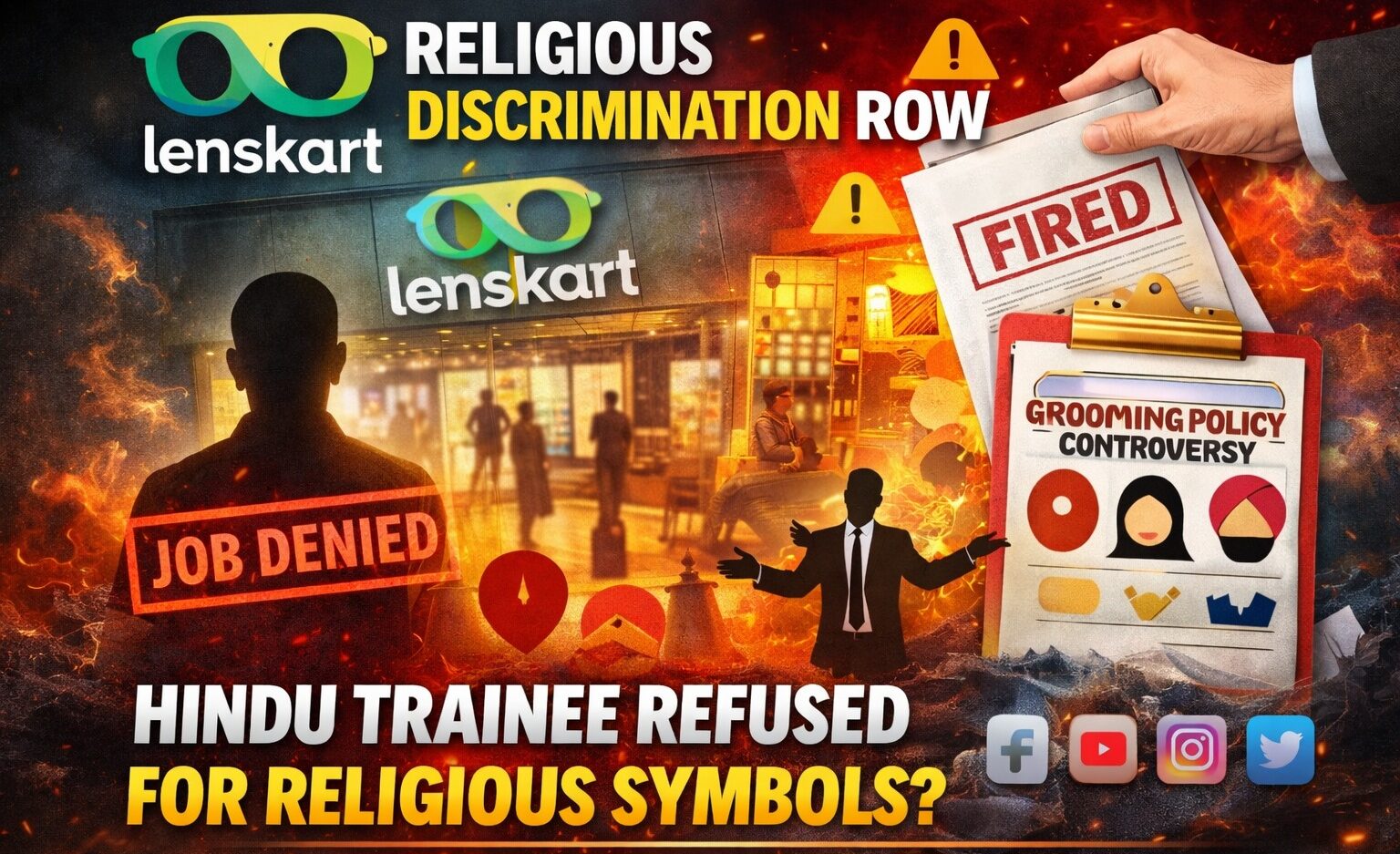
Eyewear retailer Lenskart is facing renewed criticism after a trainee alleged he lost a job opportunity for refusing to remove visible Hindu religious symbols, including a tilak and shikha. The claim surfaced through a viral social media post and a video interview featuring Zeel Soghasia, who said he was asked to change his appearance during training and was removed when he declined.
The allegation comes days after the company was already under scrutiny over a separate controversy involving an internal grooming document that was widely circulated online.
What the Viral Post Claims
The post shared on X stated that Zeel Soghasia was ordered by Lenskart to cut his shikha and remove his tilak. It further claimed that when he refused, he was fired. The message quickly gained attention online, with users accusing the company of discrimination and demanding action.
While the social media post amplified the issue, the core details match statements carried in reports based on Soghasia’s own video account.
Trainee Says Issue Began During Training
According to Soghasia’s account, he first attended an interview in Surat, Gujarat, after being contacted for a job opportunity. He said no concerns were raised during the interview stage regarding religious marks, hairstyle, or symbols.
He later travelled to Navi Mumbai for professional training. There, he alleged that on the second day of the program, management objected to his appearance and told him he would need to remove his tilak and cut his shikha to continue. He also claimed he was asked to remove religious tattoos from his hands.
Soghasia said he chose not to comply and was then unable to continue with the role.
Also Read: From Raebareli to AutoTech Riches: How Vikram Chopra Built CARS24 After an Early Setback
Wider Debate Around Workplace Dress Codes
The latest allegation has intensified an already active debate about workplace appearance policies and religious expression in private companies. Earlier this week, screenshots of a document described as Lenskart’s internal style guide triggered backlash online.
The circulated material appeared to restrict symbols such as tilak, bindi and kalawa while permitting certain other religious attire under specified conditions. That led to accusations of unequal treatment and calls for a boycott on social media platforms.
Company Response and Policy Update
Following the backlash, Lenskart issued a public clarification and said it would standardise and transparently share updated in-store style guidelines. The company stated that its revised rules explicitly welcome symbols of faith and culture, including bindi, tilak, sindoor, kalawa, hijab and turban.
The company also said that if any earlier communication caused hurt or made employees feel unwelcome, it regretted that impact.
The Zeel Soghasia allegation has drawn attention because it suggests concerns may go beyond an old internal document and involve on-ground implementation during hiring or training. However, as of now, the allegation remains a public claim made by the trainee, and no independent legal finding has been reported in the matter.
The controversy highlights a larger issue increasingly relevant to modern workplaces: how companies balance uniform appearance standards with the right of employees to express religious and cultural identity.
Online Reaction Continues
Even after the company’s clarification, discussion around the issue remains active online. Users continue to debate whether corporate dress codes should regulate visible symbols of faith and whether such policies are applied equally across communities.
With the matter now receiving national attention, public focus is likely to remain on how companies frame and enforce workplace inclusion policies in the future.
Also Read: OpenAI Executive Srinivas Narayanan to Exit After Three-Year Run