

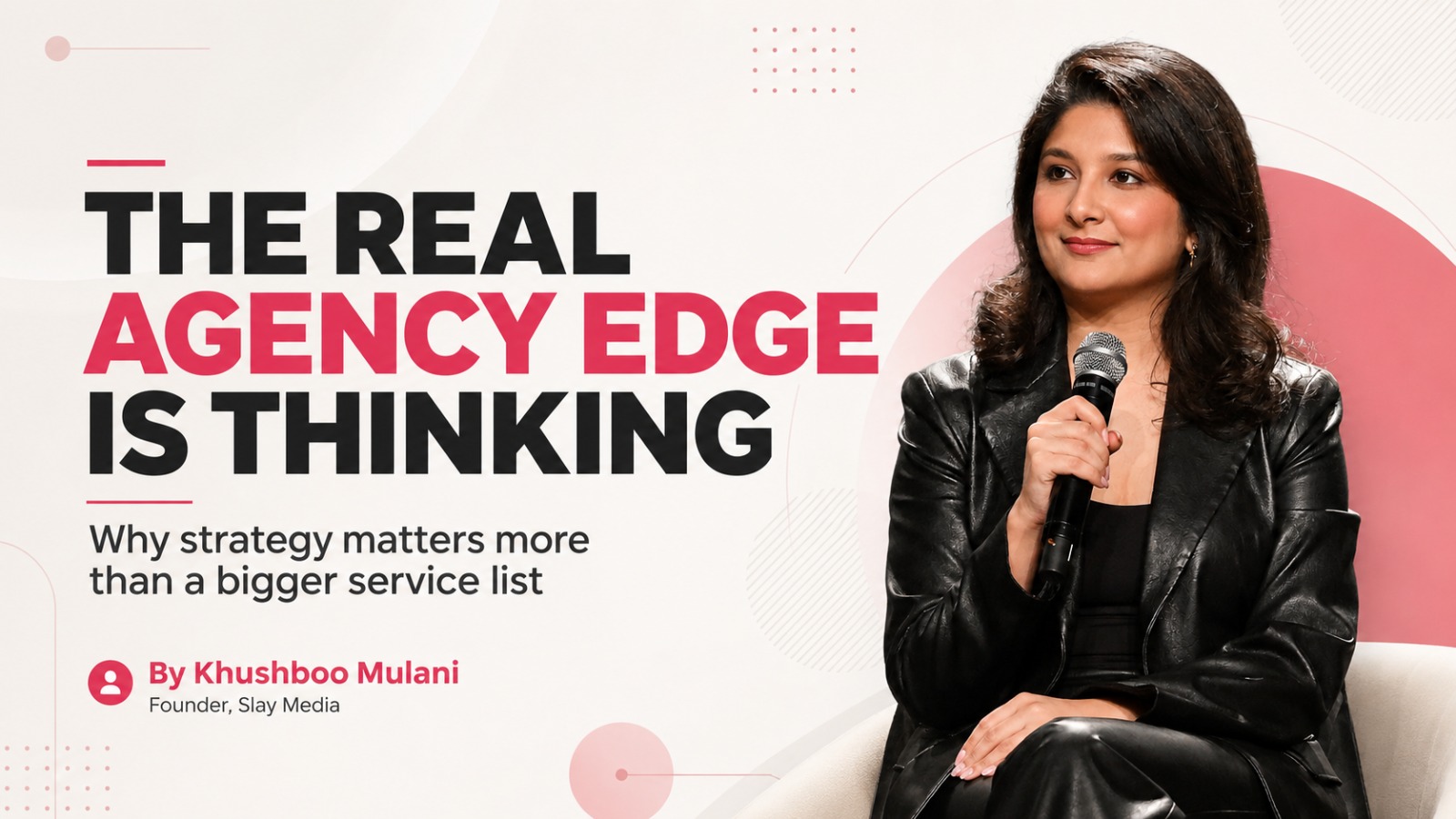
By Khushboo Mulani, Founder, Slay Media
Ask a brand what they want from their agency right now, and the answer is rarely more deliverables. It’s clarity. Confidence. Someone in the room who can look at the complexity of the current marketing landscape and tell them, with conviction, what actually matters and why.
That’s a different ask than the one agencies spent the last decade optimising for. And the gap between what clients need and what most agencies are built to provide is growing wider, quietly, uncomfortably, and fast.
The service expansion trap
There’s a familiar growth pattern in agency life. A client asks for something the agency doesn’t currently offer. The agency builds the capability, adds the service, expands the deck. Repeat across enough client conversations, and the agency eventually covers everything, social, SEO, content, performance, PR, influencer, CTV, email, events, and everything in between.
On paper, this looks like progress. In practice, it often produces an agency that does many things adequately and none of them with the depth of thinking that actually moves a business forward. The service list grows. The strategic value per engagement shrinks. And the client, who now has more outputs than ever, still isn’t sure whether the agency is actually helping them make better decisions.
Brands are looking for more than just agency partnerships that can activate media with efficiency. They are looking for strategic partners that make them smarter and more confident in their marketing decisions. That’s not a deliverable. That’s a relationship, and it’s built on the quality of thinking an agency brings to the table, not the length of its capability list.
What the industry is actually restructuring around
The signals are clear for those paying attention. Two decades of marketing insourcing have created a saturated market, commoditising creative ideation and execution. Brands can now build in-house teams for production, performance marketing, and content at a cost that makes outsourcing the same functions to an agency increasingly difficult to justify. The work that remains genuinely difficult to insource, and genuinely valuable to buy externally, is the thinking that shapes what gets produced, not the production itself.
Forward-thinking agencies will be using every engagement to share how advertising is impacting their clients’ business, offering up new solutions backed by innovative thinking, and elevating client conversations beyond lower-level topics, such as short-term KPIs and allocating budget into different media channels, that don’t hold weight with bigger business conversations.
The agencies still anchoring their value proposition in output volume are competing on the one dimension where they’re most exposed: cost. The agencies anchoring it in strategic clarity are competing on the dimension where they’re hardest to replace.
Strategy isn’t a department. It’s a posture.
The misunderstanding many agencies carry is that strategy is something that happens in a separate phase, a workshop, a deck, a planning document that precedes the “real” work of execution. That framing fundamentally undervalues what strategic thinking actually is.
Real strategic thinking is present in every client conversation. It’s in the ability to push back on a brief that’s going to produce mediocre results and articulate clearly why. It’s in the courage to recommend a direction that’s right for the brand even when it’s uncomfortable for the room. It’s in knowing what question the client is actually asking underneath the one they’ve put in writing, and answering that one instead.
That’s what clients are willing to pay for. That’s what they struggle to find.
AI is clarifying, not creating, the problem
Artificial intelligence has done something useful for the agency industry: it has made it impossible to pretend that production volume is the same thing as strategic value. In 2026, the focus of AI in marketing insights will shift from faster to better. Impact will be measured through business growth, innovation success, and time unlocked for strategic thinking.
When AI can produce a first draft, generate variations, schedule content, and optimise media placement faster and cheaper than any human team, the question every agency has to answer is: what’s left that only we can do? The honest answer, the valuable answer, is the thinking that directs all of it. The judgment about what to make and why. The cultural intelligence that shapes a brief. The strategic clarity that tells a client which opportunity to pursue and which ones to ignore.
Agencies that use AI to free up time for that thinking will pull ahead. Agencies that use AI to produce more output at lower cost, without reinvesting that efficiency into the quality of their thinking, will find themselves competing in a race that has no good ending.
The client relationship worth having
There’s a version of the agency-client relationship that the industry talks about aspirationally but rarely builds in practice: the trusted advisor. The partner that a brand’s leadership team calls before a major decision, not after it. The agency that earns a seat at the table because its thinking has repeatedly made the client’s business better, not just its marketing calendar busier.
That relationship isn’t built through scope expansion. It’s built through the consistent demonstration of judgment, knowing what to recommend, knowing what to decline, knowing when the brief is wrong and saying so with enough clarity and conviction that the client listens.
Agencies must commit to providing meaningful business-level partnerships that help clients navigate through all the complexity and upheaval that characterises the industry today. That’s the standard worth building toward.
The agencies that will define the next decade of this industry are the ones that get comfortable with a simple, uncomfortable truth: the competitive advantage was never the service list. It was always the thinking behind it. And in a world where the services themselves are becoming commoditised faster than ever, that thinking is the only thing worth protecting.
Build for that. Everything else will follow.
Also Read: iPhone 18 Pro Price Hike Could Reach $300