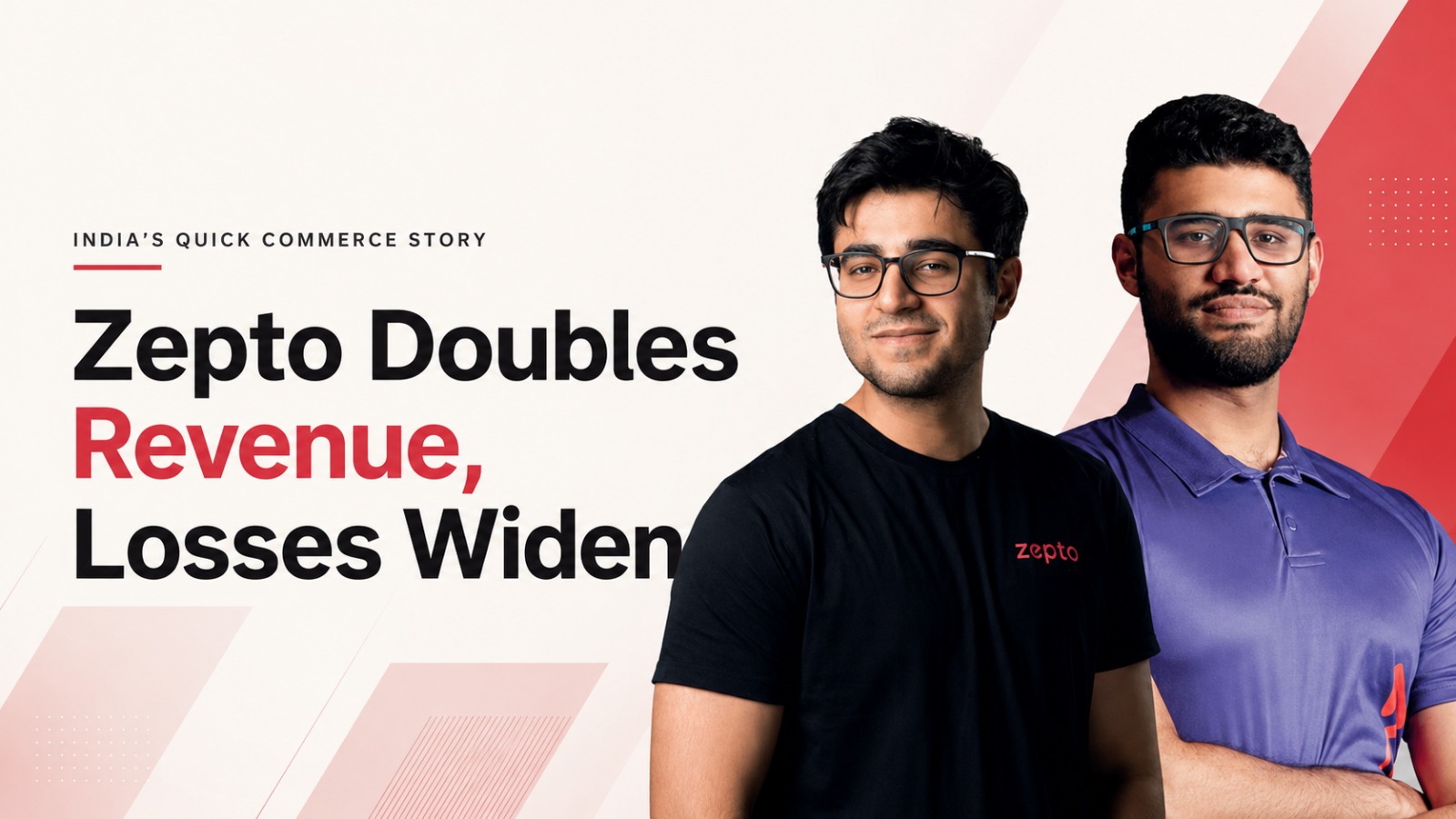
Zepto FY26 revenue capture the sharpest contradiction in India’s quick commerce market right now: growth is coming fast, but it is not coming cheap.
The quick commerce major more than doubled its revenue from operations to Rs 22,624 crore in FY26, compared with Rs 11,110 crore in FY25. At the same time, its losses widened to Rs 5,905 crore from Rs 4,700 crore in the previous year, a rise of about 26%.
The numbers show a company that has built serious operating scale, but is still spending heavily to protect speed, deepen its dark store network, acquire customers and keep the 10-minute delivery promise alive in a highly competitive market.
Zepto founded by Aadit Palicha and Kaivalya Vohra has filed its updated draft red herring prospectus with SEBI, placing its financial performance under closer public scrutiny ahead of its proposed IPO.
The revenue engine is clearly getting bigger
At the heart of Zepto’s growth is its core product sales business. Sale of products remained the company’s largest revenue stream, contributing around 78% of its operating revenue in FY26.
This segment grew 92% to Rs 17,588 crore in FY26 from Rs 9,145 crore in FY25. That growth reflects how deeply quick commerce has moved into daily consumption categories, from groceries and packaged foods to household essentials and other fast-moving products.
Zepto’s platform now offers more than 46,600 products across multiple categories, with delivery built around its network of dark stores. As of March 2026, the company operated more than 1,139 dark stores across the country and was handling more than 1.75 million orders per day.
That scale is significant. It shows Zepto is no longer just a fast-delivery brand chasing urban curiosity. It has become a high-volume retail network with a large fulfilment backbone.
Advertising and services add new layers of income
While product sales remain the main engine, Zepto also saw meaningful growth in other income streams.
Revenue from warehousing, marketplace and last-mile services more than doubled to Rs 2,780 crore during FY26. Advertising revenue grew 2.5 times to Rs 1,636 crore, showing that brands are increasingly paying for visibility inside quick commerce apps where purchase decisions are made quickly.
Platform services contributed another Rs 564 crore in FY26. The company also earned Rs 505 crore from non-operating sources such as interest on fixed deposits, taking its total income to Rs 23,128 crore.
These additional revenue streams matter because they can improve the economics of quick commerce over time. A business that earns only from selling products has limited room to absorb delivery and fulfilment costs. But advertising, marketplace services and platform-linked income can help create better margins if the company can control its spending.
The cost of speed remains heavy
Zepto’s biggest cost continued to be procurement of products. This expense accounted for nearly 63% of total expenditure and rose 90% to Rs 18,199 crore in FY26 from Rs 9,542 crore in FY25.
Delivery and handling expenses also surged more than 90% to Rs 3,046 crore. Leasing costs linked to its 1,139 dark stores stood at Rs 2,150 crore, while advertising and promotional expenses rose to Rs 1,389 crore.
Employee benefit expenses increased 44% to Rs 1,785 crore. This included Rs 557 crore in ESOP-related non-cash expenses. Of the total employee cost, Rs 192 crore was linked to employees working at warehouses and dark stores.
Finance costs grew 31% year-on-year to Rs 300 crore. Once other overheads, support and franchise expenses, power and fuel costs, and legal and professional fees were added, Zepto’s total expenses climbed 79% to Rs 29,027 crore in FY26.
That is the real pressure point in Zepto’s FY26 performance. Revenue doubled, but the company’s spending base also expanded aggressively.
Losses widen despite better cost efficiency
Zepto’s losses widened to Rs 5,905 crore in FY26 from Rs 4,700 crore in FY25. The main reason was clear: warehousing, delivery and other operating expenses rose with the company’s rapid expansion.
However, there was one sign of improved efficiency. Zepto’s expense-to-earning ratio improved to Rs 1.28 in FY26 from Rs 1.46 in FY25. This means the company spent Rs 1.28 to earn every rupee of operating revenue, an improvement over the previous year even though it remained loss-making.
Its EBITDA margin stood at negative 23.18% in FY26, while return on capital employed stood at negative 74.8%. Current assets stood at Rs 9,638 crore, including cash and bank balances of Rs 973 crore.
The improvement in expense-to-earning ratio suggests that scale is helping, but not yet enough to offset the overall cost structure.
The wider quick commerce picture
Zepto’s financials also need to be seen in the context of a market where rivals are scaling quickly.
Blinkit posted revenue of Rs 37,779 crore in FY26 and reported positive EBITDA of Rs 430 crore. Swiggy Instamart recorded revenue of Rs 3,859 crore, but reported an EBITDA loss of Rs 3,063 crore.
This comparison shows how uneven the path to profitability remains in quick commerce. Some players are beginning to show operating leverage, while others are still deep in investment mode.
For Zepto, the question ahead of its IPO journey is not whether demand exists. The company’s order volume, dark store count and revenue growth answer that clearly. The bigger question is whether the business can bring down delivery, leasing and fulfilment costs fast enough while still growing in a category where speed is the product itself.
Zepto’s FY26 performance is not a simple growth story and not just a loss story either. It is a scale story under pressure.
The company has built one of the fastest-growing consumer internet businesses in India’s retail ecosystem. Its operating revenue has doubled, its product sales engine is expanding, and its advertising and services income is becoming more visible.
But the cost of building a dense, always-on delivery network remains steep. The company’s losses widened because the infrastructure required to deliver convenience in minutes is expensive, especially when dark stores, riders, marketing, warehousing and inventory costs are all growing together.
Zepto’s next phase will depend on whether it can convert scale into discipline. The FY26 numbers show momentum. They also show why investors will look closely at cost control, store-level efficiency and the path to profitability as the company moves closer to the public market.
Also Read: