Fresh funding puts the Israeli food-tech startup SuperMeat, founded by Ido Savir, Koby Barak, and Shir Friedman on a sharper commercial path as cultivated meat investors look for companies that can prove cost, scale and regulation
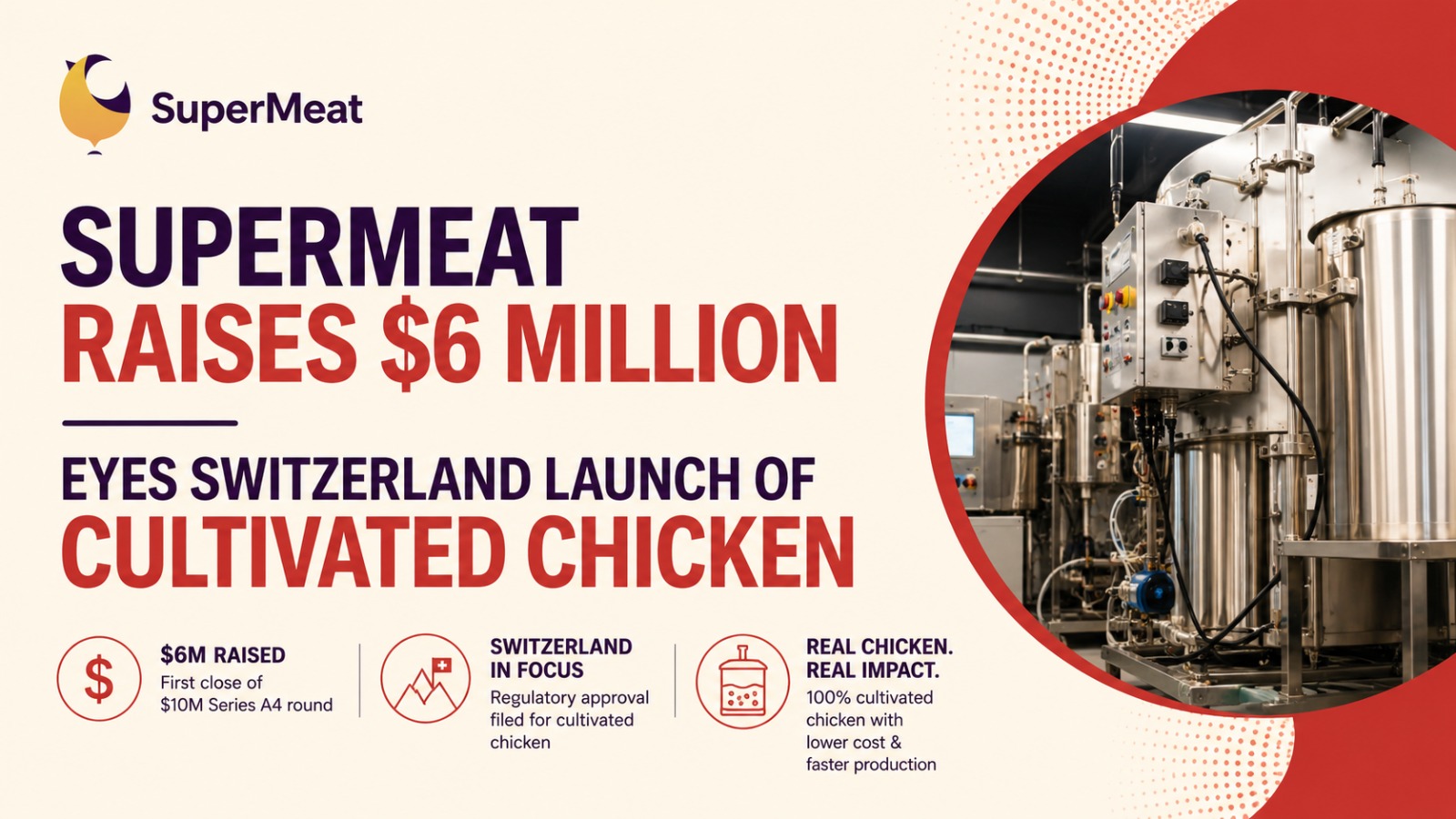
SuperMeat has raised $6 million in fresh financing, giving the cultivated meat startup fresh momentum at a time when the sector is being judged less on promise and more on proof.
The Israeli food-tech company secured the money as the first close of a targeted $10 million Series A4 round. Existing investors led the round, with Agronomics putting in $5 million through the issue of new ordinary shares and New Agrarian Company investing $1 million. Milk & Honey Ventures and other existing backers also joined the fundraise.
The latest closing takes SuperMeat’s total funding to $24.5 million. More importantly, it comes as the company prepares for what could become a defining test for its business: selling cultivated chicken in Switzerland.
SuperMeat has filed for regulatory approval in the country and is positioning Switzerland as its launch market. For a cultivated meat company, that step matters because market entry is no longer just about making meat from cells in a lab. It is about proving that the product can meet food safety requirements, scale beyond pilot production and win consumer confidence once it reaches plates.
The company’s pitch is built around cultivated chicken produced from chicken cells, without raising and slaughtering birds. Its process grows muscle and fat cells in bioreactors, where the cells receive warmth, oxygen and nutrients until they mature into meat tissue. Once the cells reach the required density, the remaining liquid feed is removed and the meat mass is harvested.
SuperMeat says the output is ground chicken that is ready to cook. The company also says its process can produce three pounds of meat, roughly the yield of one chicken, in two days. A conventional chicken takes around 42 days to raise and process.
That timeline is central to SuperMeat’s commercial argument. In a sector that has often struggled with high production costs, investors are now watching closely for companies that can make cultivated meat cheaper, faster and in larger volumes. SuperMeat has been trying to answer that challenge through cell-line stability, media cost reduction and process optimisation.
The company says its self-renewing cell line can reach densities of 80 million cells per millilitre in nine days. It has also developed a system that replaces expensive animal-derived inputs such as serum and albumin with lower-cost alternatives. That has brought its media costs below 50 cents per litre.
In 2024, SuperMeat reported another cost milestone. It said a combination of a stable cell line, animal-free media formulation and rapid differentiation protocols helped it reach production costs of $11.8 per pound at a 25,000-litre scale. The company positioned that figure as being in line with premium chicken pricing in the United States.
A key detail is that SuperMeat is not presenting this as a hybrid product with a small amount of cultivated cells mixed into mostly plant-based ingredients. The company says its cost progress is based on a 100 percent cultivated chicken product, made up of 85 percent muscle and 15 percent fat.
The fresh funding also arrives after several partnerships that appear designed to move the company closer to market readiness. Since 2022, SuperMeat has had an R&D and technology development framework agreement with Japanese food and biotech group Ajinomoto, which is also an investor in the startup. The company has also extended its collaboration with Micarna Group, a meat processor owned by Swiss retailer Migros Group, with the aim of producing and distributing cultivated chicken in Switzerland.
SuperMeat has also worked with Argentinian biotech company Stämm to improve yields and lower costs through process optimisation, with a goal of bringing cultivated chicken to market by 2026.
Switzerland is becoming an important regulatory battleground for cultivated meat. SuperMeat is not alone in waiting for approval there. Israeli startup Aleph Farms and Dutch company Mosa Meat have also submitted applications for their cultivated meat products. SuperMeat is also moving through a reorganisation under a UK holding company, a step that comes as the company looks beyond R&D and toward commercialisation.
The sector’s wider funding climate makes SuperMeat’s raise more notable. Cultivated meat startups raised only $74 million last year, nearly half of the previous year’s total and far below the peak investment levels seen in 2021. That slowdown has forced a sharper distinction between companies still selling a long-term vision and those claiming a realistic path to production economics.
SuperMeat is trying to place itself in the second category.
Its latest financing is not a giant round by food-tech standards, but it signals investor support for a more disciplined model: regulatory submission, licensing-led commercialisation, cost milestones and partnerships with established food companies. In the current market, that combination may matter more than a flashy valuation.
The environmental case remains part of the story too. A 2024 life-cycle analysis by CE Delft concluded that SuperMeat’s cultivated meat could generate roughly 50 percent fewer carbon emissions than conventional chicken. For a protein industry facing pressure over land use, emissions and supply-chain resilience, such claims could strengthen the company’s position if commercial rollout follows.
Still, SuperMeat’s next challenge is not only scientific. It is regulatory, operational and consumer-facing. Switzerland will test whether cultivated chicken can move from controlled production environments to a regulated food market with real buyers, retail partners and public scrutiny.
The funding gives SuperMeat more room to push that plan forward. The harder question now is whether cultivated chicken can move from being an innovation story to a food business that works at scale.
Also Read: Vaibhav Suryavanshi’s Rise Is Bigger Than a Net-Worth Number