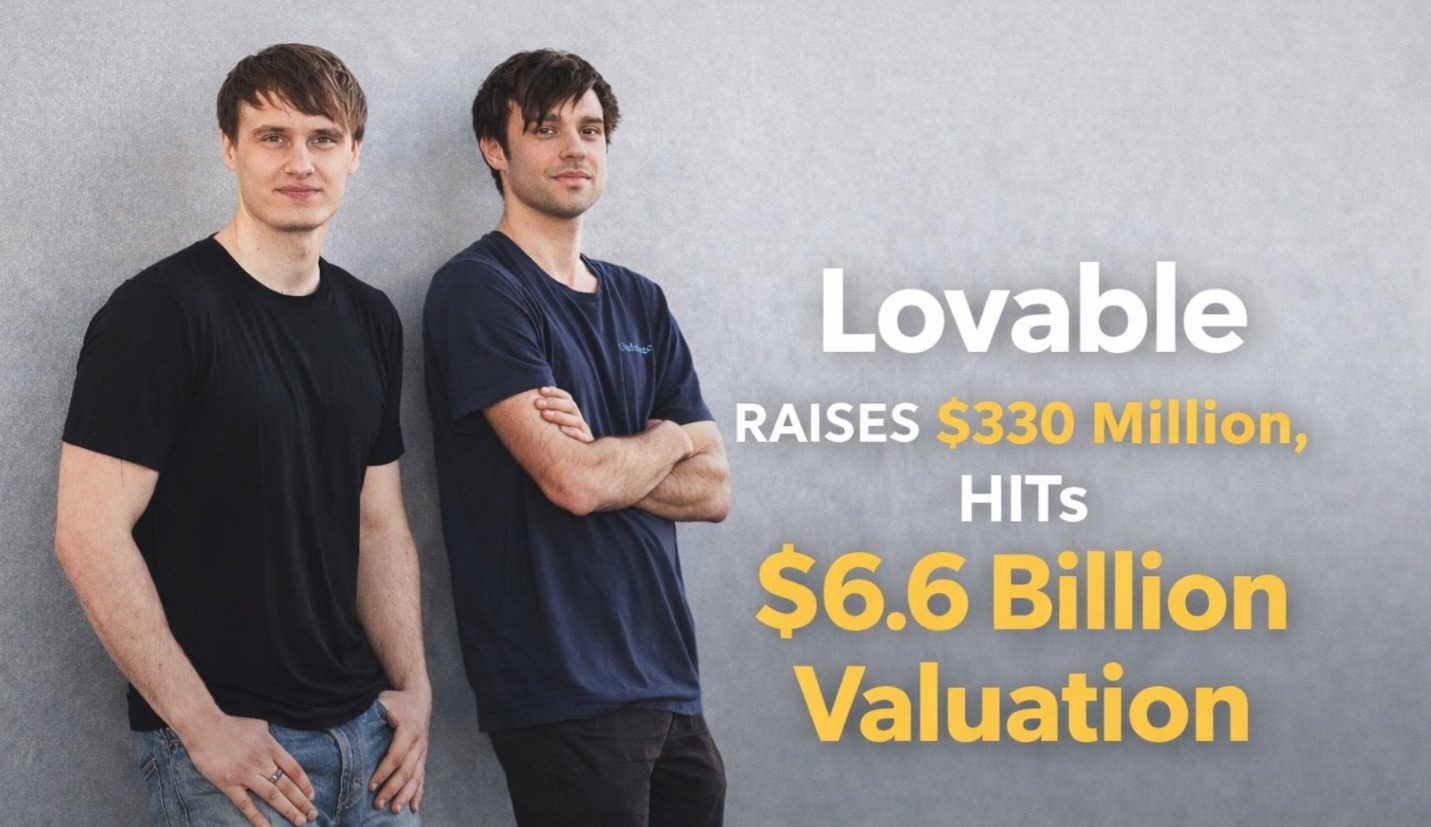
Launched in November 2024, the startup Lovable, founded by Anton Osika and Fabian Hedin has positioned itself at the centre of a fast-emerging category known as “vibe coding”, software creation driven not by traditional programming, but by plain-language prompts.
In less than a year, that proposition has translated into extraordinary commercial momentum. The company recently closed a $330 million funding round at a valuation of $6.6 billion, tripling its valuation from an earlier raise this year and placing it among the most valuable young AI software companies globally.
What has set Lovable apart is the speed at which usage converted into revenue. Within roughly eight months of launch, the company reached $100 million in annual recurring revenue, a milestone typically associated with far more mature SaaS businesses.
The Rise Of Lovable
Since its July funding round, when it raised $200 million at a $1.8 billion valuation, Lovable says its revenue has already doubled, reinforcing investor confidence that demand is not tapering off after early adoption.
At the core of Lovable’s product is a simple promise: people with ideas but no coding background can build functional websites and applications by describing what they want.
The platform generates full software outputs without requiring users to write code, design interfaces, or manage technical architecture. A free tier lowers the entry barrier, while paid subscriptions scale up for power users and enterprises. Despite its revenue surge, the company remains unprofitable, choosing growth and product expansion over near-term margins.
Lovable does not rely on a single proprietary AI model. Instead, it integrates and orchestrates multiple leading models from providers including OpenAI, Anthropic, and Google, dynamically selecting tools based on the task at hand.

This model-agnostic approach allows the company to focus less on training foundation models and more on usability, workflow, and end results, effectively acting as a layer that translates human intent into deployable software.
The broader landscape explains why investors moved quickly. AI-assisted coding has become one of the most aggressively funded segments in technology. Cursor, which focuses on professional developers, recently raised capital at a valuation of $29 billion.
Replit and StackBlitz, which also target non-traditional builders, have attracted multi-billion-dollar and near-unicorn valuations respectively. In July, Google signalled its interest in the category by striking a $2.4 billion acquihire deal for executives at Windsurf, another vibe-coding startup. CapitalG, Alphabet’s venture arm, participated in Lovable’s latest round, underscoring how closely Big Tech is tracking this shift.
However, the speed and availability that characterize vibe coding have their own set of unanswered questions. Experts have indicated potential security risks if AI code is heavily used, especially for amateur developers, if safety protocols become lax. As Lovable and similar code-prototyping tools transition to enterprise-grade software, their capacity to walk the tight rope between speed and dependability shall be crucial for winning enterprise confidence.
This remarkable increase in Lovable’s value represents a bets that are being placed across the industry at large, namely that the next wave of software builders will not be the traditional cut of engineer. If they can continue to grow while ironing out issues related to security and governance, this could become one of those defining platforms that shape the way software is developed, not through teaching people to code, but through making their code unnecessary altogether.
Also Read: Muuchstac: The Relentless Focus Behind a ₹450-Crore Acquisition