

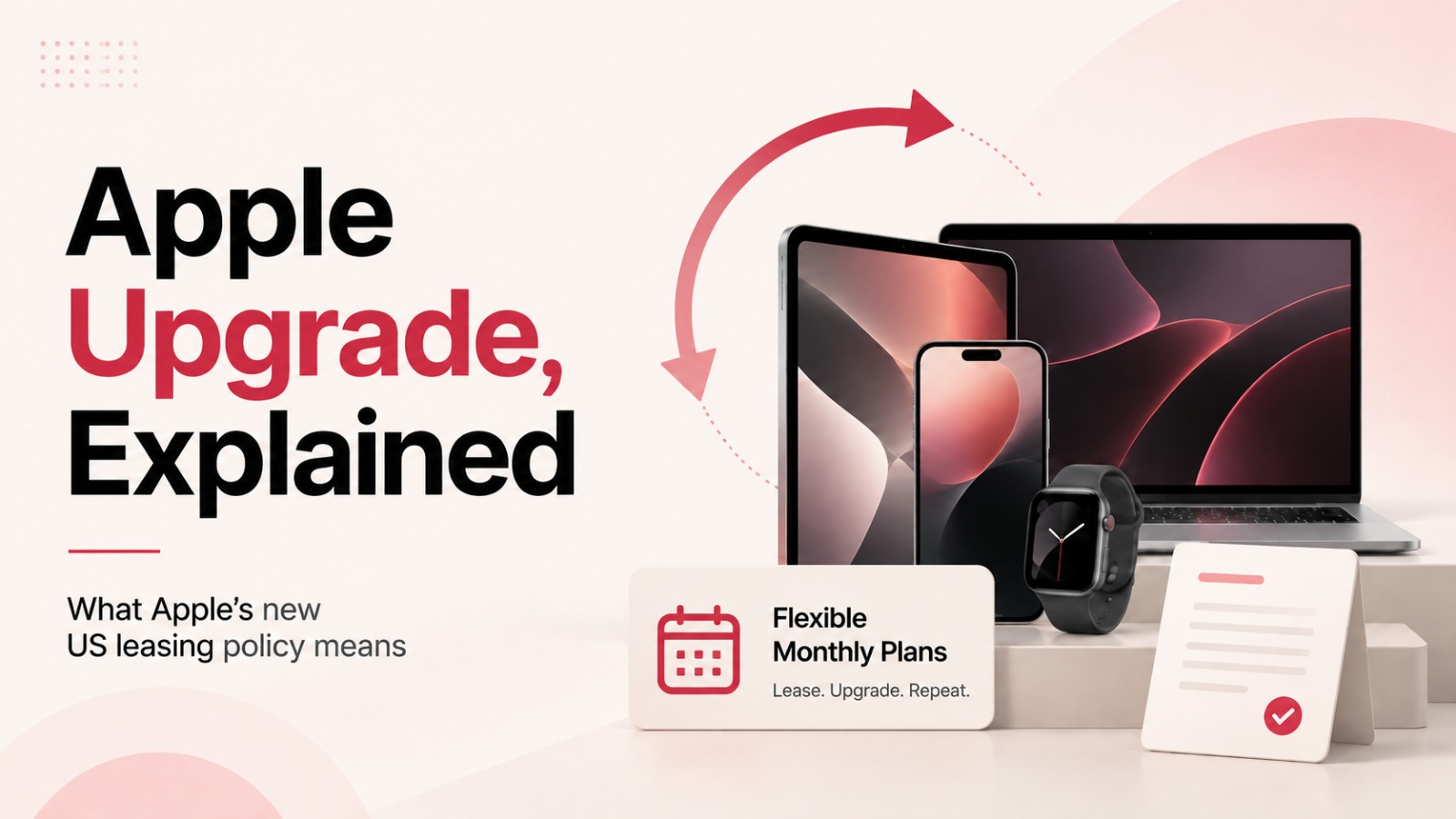
Apple has introduced a new device leasing policy in the United States that changes how customers can pay for and upgrade selected products.
The programme, called Apple Upgrade, covers eligible iPhone, Apple Watch, Mac and iPad models. Instead of purchasing a device outright or financing the full cost through instalments, customers can lease it for a fixed period and decide later whether to return, upgrade or buy it.
Klarna provides and manages the lease, while customers can enrol through Apple’s online store, the Apple Store app or a physical Apple Store in the US.
Here is what Apple’s new leasing policy actually means for customers.
What is Apple Upgrade?
Apple Upgrade is a consumer leasing programme, not a purchase plan or a conventional loan.
Customers choose an eligible Apple product and make monthly payments for a specified lease period. They are allowed to use the device during that time, but they do not automatically become its owner after making the scheduled monthly payments.
Ownership is transferred only when the customer pays the purchase fee specified in the lease agreement.
This distinction is central to understanding the policy. A lower monthly payment does not necessarily represent the total cost of buying the device. It represents the cost of leasing it for the selected period.
Which Apple products can be leased?
Apple Upgrade is available for selected models across four major product categories:
- iPhone
- Apple Watch
- Mac
- iPad
The programme does not cover every product Apple sells. The excluded devices listed by Apple include the iPhone 16, iPhone 16 Plus, Apple Watch SE, MacBook Neo, Mac mini, iPad with the A16 chip and Studio Display.
Refurbished accessories are also not eligible.
How long are the lease terms?
Lease periods vary according to the type of product.
Customers leasing an iPhone or Apple Watch can choose between 12-month and 24-month terms.
For a Mac or iPad, the available terms are 24 months and 36 months. However, Apple notes that the 12-month and 36-month options may not be available for every device model.
A longer lease can reduce the monthly payment, but customers remain responsible for the product under the conditions of the lease for a longer period.
How much does Apple Upgrade cost?
Apple has advertised the following starting monthly lease prices:
| Product | Starting monthly payment |
|---|---|
| iPhone | $17.99 |
| Apple Watch | $11.99 |
| Mac | $24.99 |
| iPad | $11.99 |
The final amount will depend on the product, configuration and lease duration selected. Taxes are not included in the advertised examples, and trade-in credit can alter the monthly payment.
For example, Apple lists an iPhone 17 Pro with 256GB storage, priced at $1,099 before taxes and trade-in credit, at a typical monthly lease payment of $31.99 for 24 months. The same device would cost $45.99 a month under a 12-month lease.
An Apple Watch Series 11 GPS model with a 42mm case is listed at $11.99 a month for 24 months or $21.99 a month for 12 months.
For a 14-inch MacBook Pro with 16GB of memory, Apple provides an example payment of $38.99 a month over 36 months or $53.99 a month over 24 months.
These examples cover the lease payments only. Customers who want to keep the device permanently must also consider the purchase fee stated in their individual agreement.
Is a down payment or security deposit required?
Apple says no security deposit is required under the programme.
The first monthly payment generally becomes due around 30 days after the device is shipped or made available for pickup. Lease approval depends on the applicant’s eligibility and creditworthiness.
Customers can also trade in a device they already own through Apple Trade In. The trade-in value may be used to reduce the monthly lease payments.
Those who make their lease payments with Apple Card can earn 3 per cent Daily Cash, subject to Apple Card approval and eligibility conditions.
How does the application process work?
Customers can apply while shopping online, through the Apple Store app or inside an Apple retail store.
Klarna handles the lease application and approval. Applicants are shown information about the available leasing options before enrolling.
Apple says the application can be completed within minutes. Klarna conducts a soft credit inquiry during the process, which does not affect the applicant’s credit score. Approval, however, is still based on eligibility and creditworthiness.
Once approved, customers can complete their order normally. Store customers can collect and begin using the device immediately, while online customers can choose home delivery or store pickup.
Lease details, billing dates and remaining payments can be viewed through the Klarna app.
What happens at the end of the lease?
At the end of the initial lease term, customers have three main options.
They can return the device and leave the programme, buy it by making a one-time payment, or apply to upgrade to a newer product by entering into another lease and returning the existing device.
An upgrade is not automatic or guaranteed. It requires a new lease agreement and remains subject to eligibility and credit approval. The monthly payment for the replacement device may also be higher than the amount charged under the earlier lease.
Customers should not ignore the lease when its initial term ends.
When no action is taken, the agreement may convert into a month-to-month lease for up to six months. Monthly payments can increase during this extension. If the customer still does not upgrade, return or purchase the product by the end of the extension period, the purchase fee under the agreement may be charged.
Can customers end the lease early?
Customers can close the lease by returning the device, but ending it before the initial term is completed may result in substantial fees.
The precise financial consequences will depend on the lease agreement. This means Apple Upgrade should not be treated as a plan that customers can leave at any time without additional cost.
What happens if the device is damaged or lost?
Insurance is not included in the standard Apple Upgrade lease.
Customers may face additional charges if the leased product is lost, stolen, damaged or returned in a condition that does not meet the requirements of the agreement.
An AppleCare subscription can be added separately. Apple offers AppleCare+ for individual devices and AppleCare One for customers who want coverage across multiple products.
Are there special rules for leasing an iPhone?
Customers taking an iPhone through Apple Upgrade must select an eligible postpaid plan from AT&T, T-Mobile or Verizon. A prepaid carrier plan cannot be used when starting the lease.
The leased iPhone remains unlocked, which means the customer can later change carriers, subject to the terms of the carrier they choose.
Who is eligible for Apple Upgrade?
The programme is available only to residents of the United States, excluding US territories. Devices must be shipped to a qualifying US address or collected from an Apple Store in the US.
Applicants must:
- Be at least 18 years old, or meet the legal age requirement in their state
- Have a valid Social Security Number or Individual Taxpayer Identification Number
- Hold an accepted credit or debit card
- Have an Apple Account in good standing
- Have a Klarna account
- Be able to receive security verification codes by text message
These requirements are in addition to Klarna’s credit and eligibility review.
The programme is not available through certain specialised Apple purchasing channels, including education, government, military, employee and some business purchase programmes.
What happens to Apple’s older iPhone payment programmes?
With Apple Upgrade in place, Apple is discontinuing the iPhone Upgrade Program and iPhone Payments in the United States.
Eligible customers enrolled in the earlier iPhone Upgrade Program may be able to move to Apple Upgrade. They can also choose Apple Card Monthly Installments, carrier financing or an outright purchase.
What should customers check before signing up?
The monthly price is only one part of the decision.
Customers should check the full lease term, purchase fee, early termination charges, device return conditions and possible damage fees before enrolling. They should also understand what happens if they take no action when the initial term ends.
Apple Upgrade may suit customers who prefer using a device for a fixed period and returning or replacing it later. It is materially different from an instalment purchase, where the buyer normally owns the product after completing all scheduled payments.
Under Apple’s new policy, using the device, upgrading it and owning it are separate choices, each governed by the lease agreement.
Also Read: iPhone 18 Pro Max Rumours Point to Bigger Battery, A20 Pro Chip and Major Camera Upgrade