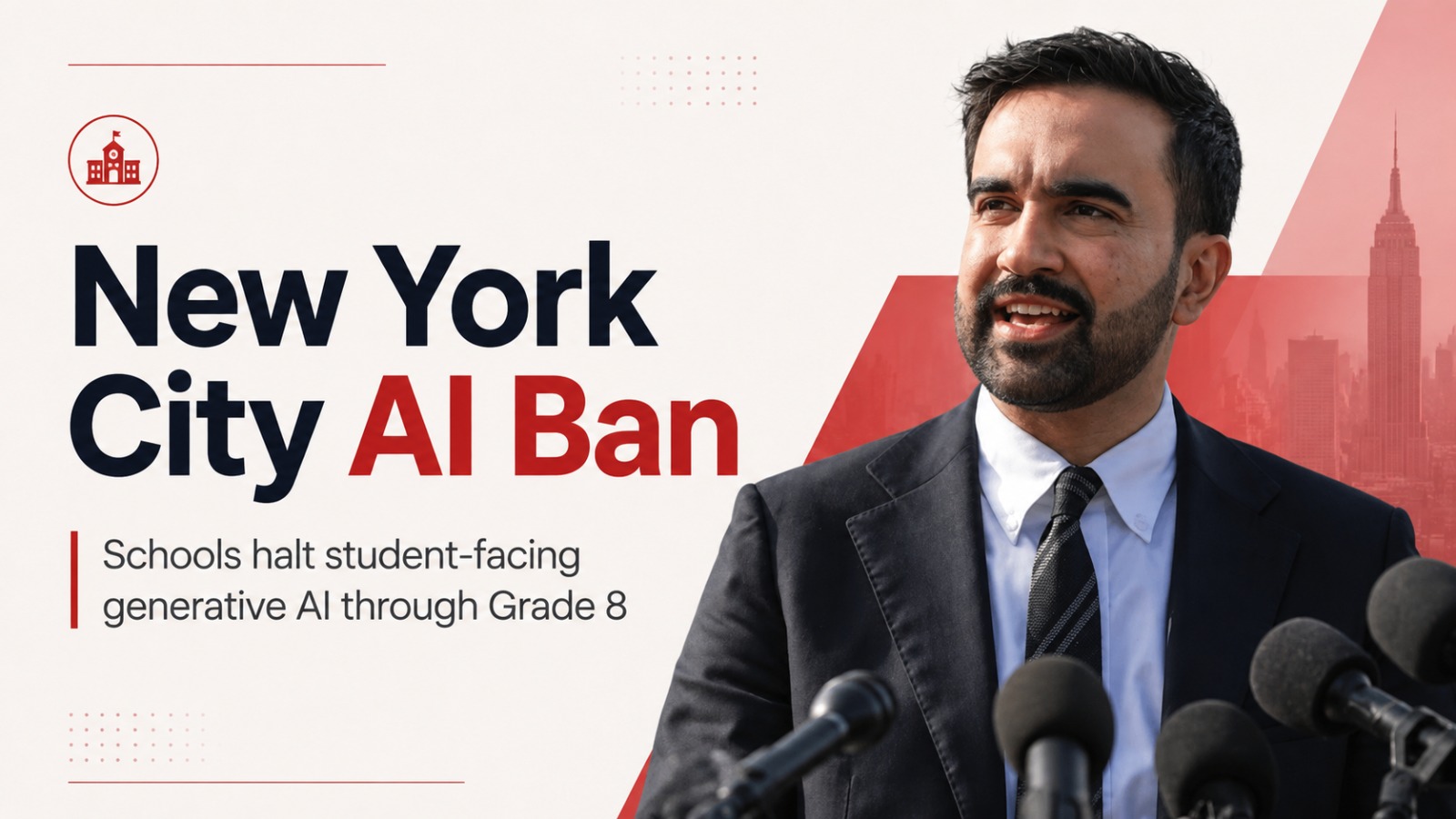
New York City AI Ban: New York City will place a one-year moratorium on student-facing generative artificial intelligence for younger public school students during the 2026-27 school year, a move that will affect nearly 600,000 children.
The restrictions cover students from 2-K through eighth grade and are designed to give the school system time to examine how generative AI affects learning, safety and relationships inside classrooms. The policy is being introduced alongside new recommendations aimed at limiting the amount of time younger students spend on individual screens.
Mayor Zohran Mamdani has placed human interaction at the centre of the decision.
“Children need teachers and human connection in order to learn and grow,” Mamdani said. “They need to develop skills alongside their peers, build relationships with educators and wrestle with tough problems on their own.”
The policy does not amount to a system-wide rejection of artificial intelligence. Instead, New York City is drawing different boundaries depending on a student’s age and how the technology is being used.
More than 38 existing programs face AI restrictions
One of the most immediate changes will be felt in software already used inside schools.
The district plans to discontinue or disable AI functions in more than 38 previously permitted programs that do not meet its new safety and oversight requirements. Student-facing generative AI functions, including AI tutoring tools, will fall within the restrictions for children through eighth grade.
Companion chatbots will face an even broader prohibition, with the ban applying across all grade levels.
Another account of the policy puts the number of affected educational AI tools at about 40, reinforcing the scale of the change across classrooms.
High school students will still encounter AI, but under supervision
The approach changes once students reach high school.
Rather than imposing the same blanket restriction, the city plans to introduce limited AI pilot programs under teacher supervision. Up to 50,000 students in general education classes could take part in five pilot programs, with participation limited to a maximum of five classes in each high school.
The tools used in those programs are expected to meet safety and data privacy requirements, and students will work with them under the direct supervision of trained educators.
Every public high school student will also receive two 45-minute AI critical-thinking or AI-literacy modules each year. The sessions are intended to cover what AI can and cannot do, along with bias, risks, ethics, careers and future skills.
This contrast shapes the policy. In New York City, unsupervised and student-facing generative AI is being limited for younger children, while older students are being provided with a structured AI education.
Teachers will retain access, with limits
Teachers will still be permitted to use approved AI tools for instructional planning and operational work.
However, there is one limitation associated with this policy. The AI technology will not be used by teachers for assessing and grading students in accordance with the aforementioned policy framework.
There will also be exceptions for certain educational needs, including assistive technology for students with disabilities, support for students learning English and career-readiness programs such as computer science.
Screen time is being tackled alongside AI
The city is treating generative AI as part of a wider debate about technology in schools rather than as an isolated issue.
Students in second grade and below will face restrictions on one-to-one screen use, meaning time spent on individual devices such as personal laptops.
For grades three to five, the recommended limit is 30 minutes of one-to-one screen time per day. For students in grades six through eight, the recommended cap rises to 45 minutes.
The plan also calls for a citywide review of educational technology, with tools considered nonessential to learning potentially removed.
The policy will be reviewed during the school year
The one-year timeframe is significant because New York City has not presented the restrictions as a permanent settlement.
A new Technology in Schools Coalition, bringing together students, educators, parents, elected officials, advocates, union representatives and experts, is expected to evaluate both the moratorium and the high school pilot programs during the 2026-27 academic year.
Recommendations for future policy are due after that review.
That leaves the city with a year-long test of two ideas running in parallel: whether younger students benefit from having generative AI pushed out of their everyday classroom experience, and whether older students can be introduced to the same technology in a controlled and educational setting.
The response has not been uniformly supportive. United Federation of Teachers president Michael Mulgrew welcomed the tighter screen-time limits but said the AI policy left questions unanswered, including how the Education Department would ensure adequate safeguards in the technology it buys.
Josh Golin, executive director of children’s advocacy group Fairplay, argued that the moratorium should last longer, saying AI products should demonstrate that they are safe, educationally effective and do not replace face-to-face interaction.
However, currently, New York City follows a policy that is not complete acceptance nor a permanent restriction. It is a one year attempt at reducing AI among younger children, saving the interactions between teachers and peers, and making the exposure of the older ones intentional.
That may ultimately prove to be the most important part of the policy: the city is not only deciding where AI should be allowed in schools, but also at what age students should begin learning how to use it.
Also Read: Uber Layoffs in India May Impact 250 Employees in Restructuring