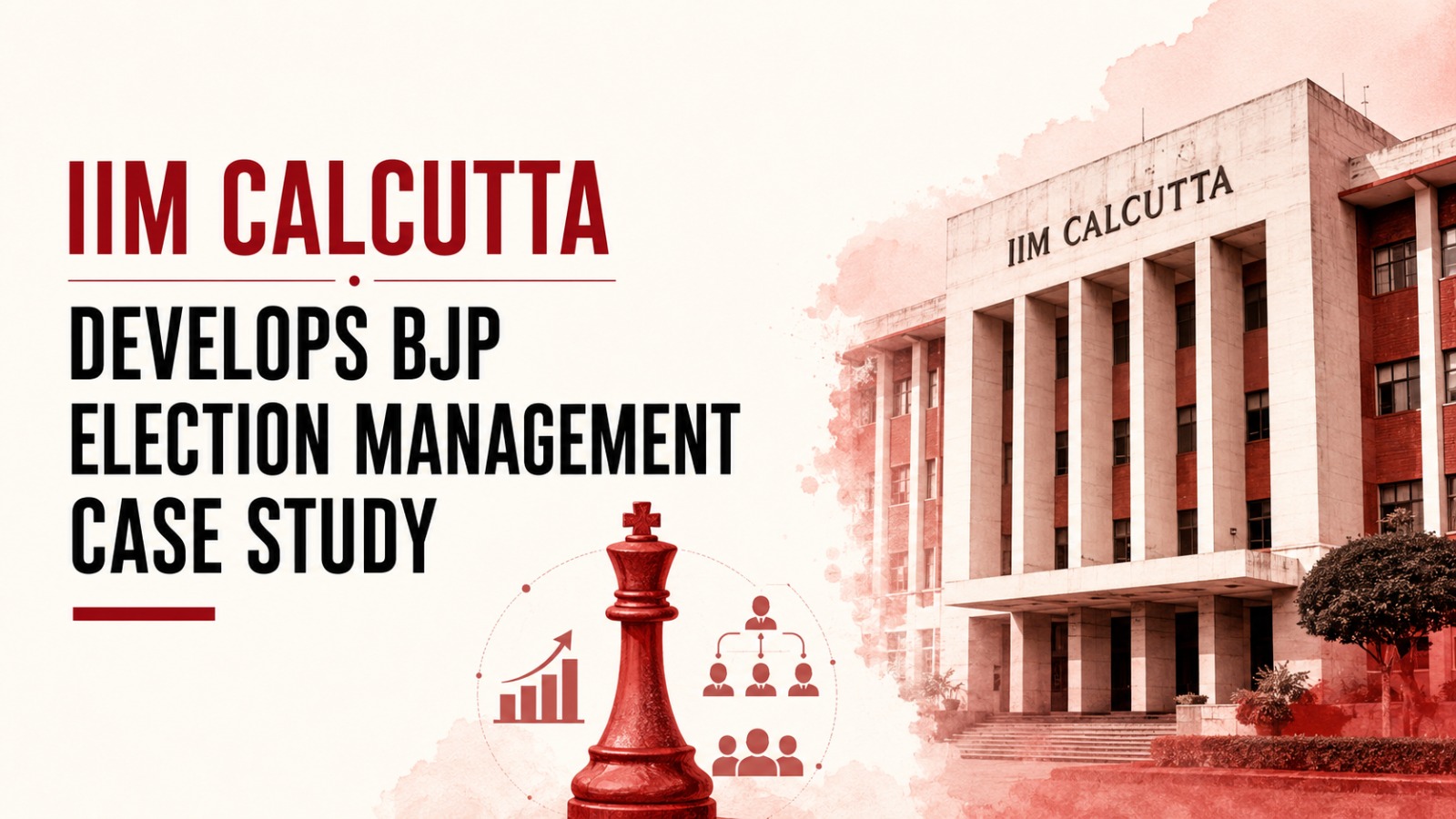
The Indian Institute of Management (IIM) Calcutta is developing a strategic management case study that examines the Bharatiya Janata Party’s (BJP) election management approach in West Bengal. The case is intended to be used as a teaching resource for management students and will explore the organizational and strategic aspects of the party’s election campaign.
Once completed, the case will be taught at IIM Calcutta and made available to management institutions around the world through the institute’s Case Research Centre in collaboration with Ivy League Case, a US-based case publishing platform. Institutions interested in using the case for academic purposes will be able to adopt it as part of their curriculum.
Faculty Team Leading the Research
The case study is being developed by a team comprising IIM Calcutta Director Prof. Alok Rai, Prof. Ramya Venkateswaran from the Strategy Group, and former Operations Group faculty member Prof. Bodhibrata Nag.
According to Prof. Alok Rai, the research focuses on understanding how a coordinated organizational structure was created to manage an election campaign that was widely considered highly challenging. The study aims to identify the strategic management principles and organizational practices that were applied during the campaign.
As part of the research process, the faculty team has already held extensive discussions with Sunil Bansal, who was in charge of the BJP’s West Bengal election campaign, West Bengal BJP President Samik Bhattacharya, and former state president Dr. Sukanta Majumdar. The researchers are also attempting to speak with Union Home Minister Amit Shah and West Bengal Leader of Opposition Suvendu Adhikari as part of the study.
Also Read: Hyderabad Startup Goodeebag Brings Doorstep Convenience to Household Recycling
Examining Organizational Strength at the Grassroots
One of the primary objectives of the case study is to document and analyze the efforts made to build grassroots organizational capability. The research seeks to understand how local organizational structures contributed to strengthening the party’s presence at the booth level and across constituencies.
The study will also assess the role of booth-level organizational networks, cadre morale, engagement with local cultural, religious, and social organizations, constituency-based segmentation, candidate selection, and communication architecture in enhancing electoral competitiveness.
Applying Business Strategy Frameworks to Political Organizations
A distinctive feature of the case is its use of established strategic management frameworks to analyze a political organization.
Researchers will apply the Resource-Based View (RBV) and the VRIO framework to examine which organizational resources and capabilities can be considered valuable, rare, difficult to imitate, and effectively embedded within a non-business organization.
The case will also use the McKinsey 7-S Framework to study organizational alignment across strategy, structure, systems, staffing, skills, style, and shared values within a large and decentralized political organization.
Understanding Organizational Adaptation Across Regions
Another focus area of the research is to determine whether organizational capabilities developed in one political and cultural environment, such as Uttar Pradesh, can be effectively transferred to a different social, political, and cultural setting like West Bengal.
The study will further apply Dynamic Capabilities Theory to examine how the organization identified changing local conditions, responded to emerging opportunities, and adapted its organizational structures and operational routines to suit the evolving political landscape.
From Election Campaign to Governance
The case also intends to analyze the broader challenge of transitioning from opposition politics to governance. Researchers will examine whether the organizational capabilities developed during an election campaign can be effectively transformed into governance-related capabilities after electoral success.
To support classroom learning, the research team is preparing detailed teaching notes alongside the case study. These notes are expected to help instructors facilitate discussions and guide students through the analytical frameworks used in the case.
Encouraging Strategic Debate in the Classroom
Beyond documenting election management practices, the case has been designed to encourage classroom discussion on a broader strategic question. Students will be asked to evaluate whether the BJP’s performance in the 2026 West Bengal Assembly election represented a sustainable competitive advantage, a resource-based advantage, or the outcome of context-specific campaign execution.
Through this approach, the case aims to provide management students with an opportunity to apply established strategic management theories to the functioning of a large political organization, while examining how organizational capabilities, leadership, structure, and execution interact in a complex electoral environment.
Also Read: Coforge Secures $230 Million AI Transformation Deal, Shares Gain Over 1%